

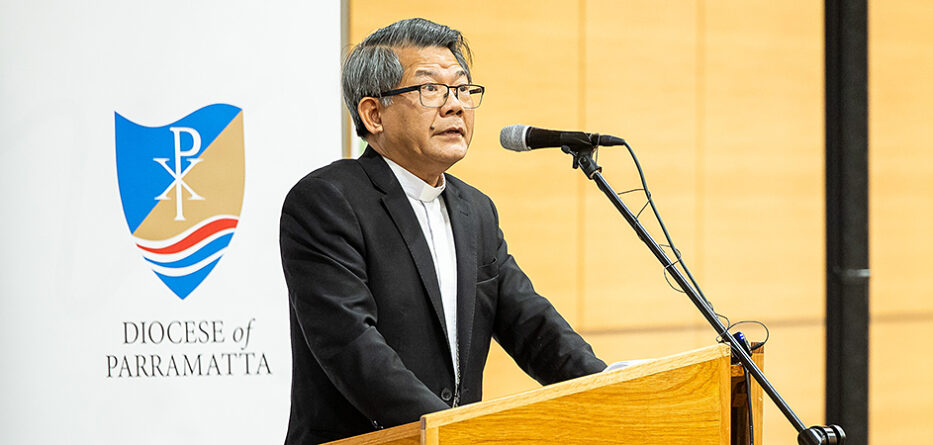
Most Reverend Vincent Long Van Nguyen OFM Conv DD STL, Bishop of Parramatta and Chair of the Australian Catholic Bishops Conference’s Commission for Social Justice, Mission and Service
Address at the launch of the Australian Catholic Bishops Conference’s 2024-2025 Social Justice Statement, “Truth and Peace: A Gospel Word in a Violent World” at St Pauls’ Catholic College, Greystanes
20 August 2024
August, particularly, the feast of the Assumption is dear to my heart. 44 years ago, I was on a boat escaping from the chaos of war, oppression and vengeance following the Fall of Saigon. The Vietnam War was the longest 20th-Century conflict in which Australians fought.
Unparalleled cruelty and violence ravaged many other parts of our world. Millions lost their lives in global and regional wars as guns, bombs and missiles ruthlessly tore through their flesh and bones and left their homes, villages and cities as scenes of utter devastation.
In 1945, the dropping of nuclear weapons on the Japanese cities of Hiroshima and Nagasaki introduced the world to a frightening new chapter in the history of human conflict. Imagine thousands of people vaporised in an instant and thousands more condemned to the agonising death caused by the immense power of radiation. Imagine a thriving city turned into a virtual wasteland in the blink of an eye.
While nuclear weapons have not been used since then, violence and conflict continue to plague our world in this new century. As this year’s Social Justice Statement points out, there are over 50 state-based conflicts and over 80 non-state conflicts raging across the globe at present. We know all too well about some of these brutal conflicts such as the war in Israel and Palestine and the war between Ukraine and Russia, but there are many more that are not so well-known – Sudan, Myanmar, West Papua to mention just a few. Yet, whether we know about these conflicts or not, the consequences for our fellow human beings are just as devastating, just as lethal, for little children, for their mothers and fathers and for their grandparents. In every century up to the present, grief and loss are the constant companions of those caught up in the senselessness of war.
Is it any wonder that Pope Francis recently said that our world is “on the abyss”? But, despite all these seemingly endless horrors, our statement is not one of resignation and pessimism. We cling to the hope that springs from the God who is love, the God who loved each and every one of us into being and bestowed on us a dignity that no one can take away. In the face of the many lies and false promises of the tyrants, this truth, the truth that we are loved by God and are born to live in peace and to flourish continues to fill the dreams of every Christian woman and man. Every person of goodwill shares this dream too. While we may stand on the abyss, we can turn back if we are prepared to take the risk of challenging the lies of the merchants of war, and to embrace with passion and commitment what has always brought peace and joy to every human heart.
I could speak about many conflicts that beset our world at present but let me just talk about one which has filled our media screens for the last 10 months. How can we not be deeply distressed by what has happened in the Holy Land since 7 October last year? The unspeakable brutality of Hamas soldiers visited on so many Israeli children, women, men, students and workers from other countries is outrageous. And, still, there are many held hostage, wondering if they will ever see their loved ones again.
What has happened to Palestinians in Gaza since that fateful day must also tear at the heart of anyone with a shred of human decency. Thousands of women, children and men dead, thousands starving to death, thousands homeless. Surely, God weeps over the unholy tragedy which has developed in this holy land.
Pope Francis recently encouraged young people to cut down screen time and read more literature and poetry. I want to read a short poem from Mosab Abu Toha, who is a Palestinian poet living in Gaza. Things You May Find Hidden in My Ear is a poem he addressed to a doctor who was treating his wounded ear.
When you open my ear, touch it gently.
My mother’s voice lingers somewhere inside.
Her voice is the echo that helps recover my equilibrium
when I feel dizzy during my attentiveness.
Then, he urges his doctor to rid his ear of the sounds of violence and war:
The drone’s buzzing sound, the roar of an F-16,
the screams of bombs falling on houses,
on fields, and on bodies, of rockets flying away —
rid my small ear canal of them all.
Spray the perfume of your smiles on the incision.
Inject the song of life into my veins to wake me up.
Gently beat the drum so my mind may dance with yours, my doctor, day and night.
Couldn’t you imagine an Israeli saying the same things? Or a Ukrainian or a Russian? Or anyone caught up in the devastation of war anywhere in the world?
Beneath our skins, our cultures, our religions, we all long for the same things. We are no different from each other at heart. Our peace and security will never be guaranteed by more and more guns and bullets, bombs and missiles, or tanks, fighter jets or battle ships. Peace flourishes when we see each and every person, not as an enemy to fear or distrust, but, as they truly are, our sisters and brothers.
Peace flourishes when we step out of our comfort zone and seek dialogue and friendship with people who are different from us. We cultivate a culture of peace when we cultivate this culture of encounter and dialogue, when we see everyone, not as a stranger to be feared, but as members of the one human family.
In Jesus, God breaks the grip of scapegoating by stepping into the place of a victim. His death and resurrection means that God has reset the cycle of human behaviour. We can and we must resist the spiral of violence. In God’s world, peace-making is possible. Swords can be turned into ploughshares and spears into sickles. Peace-making involves the extraordinarily beautiful and wonderful things emerging from the most ordinary actions of people willing to reach out to others in friendship, to seek understanding, and to work together for what is good. That is what we Bishops invite everyone to do in their own way by simple, but powerful actions which strengthen the bonds of peace. Let’s all do something every day to change the talk of conflict and war to talk about friendship and peace.
I would like to end by reading a poem by Judyth Hill, which expresses this idea so beautifully. It is called Wage Peace. May we all reject the logic of guns and bombs and wage peace with the logic of encounter, of dialogue and friendship, and of love:
Wage peace with your breath.
Breathe in confusion and breathe out maple trees.
Breathe in the fallen and breathe out lifelong friendships intact.
Wage peace with your listening: hearing sirens, pray loud.
Remember your tools: flower seeds, clothes pins, clean rivers.
Play music, learn the word for thank you in three languages.
Learn to knit, and make a hat.
Think of chaos as dancing raspberries,
imagine grief as the outbreath of beauty or the gesture of fish.
Swim for the other side.
Wage peace.
Never has the world seemed so fresh and precious.
Have a cup of tea and rejoice.
Act as if armistice has already arrived.
Don’t wait another minute.