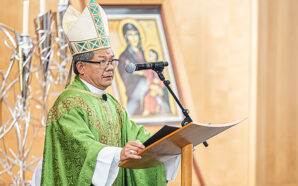


Most Reverend Vincent Long Van Nguyen OFM Conv DD STL, Bishop of Parramatta
2026 Chrism Mass – Empowering the powerless is our business model
Readings: Isaiah 61:1-9; Apocalypse 1:5-8; Luke 4:16-21
1 April 2026
My dear people, colleagues in ordained ministry and in consecrated life,
As the world around us is shrouded in the darkness of violence, war and chaos, we gather tonight to reaffirm our commitment to be the vehicle of God’s light, hope and healing. Indeed, it is times like this that the Church must rise up as a force of conscience, truth, justice and solidarity. We exist not to protect our own interest and security, not to curry favour with the mighty or legitimise those in power. Rather, we exist primarily as the living Body of Christ which heals wounds, warms hearts and offers closeness especially to those who suffer. We must endeavour to embody God’s loving presence, deep pathos and compassion for his people.
The Word of God this evening speaks of a God who identifies himself unashamedly with those who are downtrodden: the poor, the captive, the sick, the rejected and the forgotten of the world. In Jesus the Anointed One, God embraces, heals, restores, dignifies and honours them. In him, the Crucified, we are called to be an ecclesial community that offers them sanctuary, protection, advocacy, opportunity and hope. Just as we are healed by his wounds, the Church must also heal as the wounded healer, that is, by embracing the call to vulnerability and powerlessness.
In the first reading, Isaiah reminds his people in exile that the promise of renewal was being fulfilled despite appearances to the contrary. The Anointed of God would bring honour to the dishonoured, a garland instead of ashes and oil of gladness instead of mourning. He would heal the broken-hearted, comfort the sorowful and free the captives. But far from making Israel great again, Isaiah speaks of building a new society rooted in justice, care for the weak and solidarity with the vulnerable. The revitalisation project is not synonymous with a restoration of a bygone era of political and military dominance. That “golden” period of Israel’s monarchy ironically saw the gradual fragmentation of the covenant community and the betrayal of their core values. Rather, the revitalisation project had more to do with Israel living out its vocation as a beacon of justice for the nations.
This is a sobering and poignant lesson for the Church today, too. We have much to learn from our ancestors in faith. We too are tempted to go back to the imaginary golden era of power, wealth and control. We must learn once again the kind of Church that we have discerned to be through our Diocesan Synod: prayerful, eucharistic, humble, listening, welcoming and missionary rather than a church that revels in temporal power, siege mentality, triumphalism, pomp and circumstance.
In the Gospel, Jesus takes up the message of Isaiah and turns it into a kind of personal manifesto. The blind see, the deaf hear, the lame walk, the dead raised and Good News preached to the poor constitute the signs of God’s reign. Wherever Jesus goes, people experience its in-breaking power through his person, teachings and actions. He fulfils the messianic prophecy of old and makes present the divine intent of redemption and reconciliation. Consequently, empowering the powerless is the business model of the community of disciples. We have no other goal worth achieving more than loving the unloved, serving the underserved, seeking out the lost and forgotten. In the world where might is right, where the strong exert their power and influence, the Church is on the same side of the kind of people Jesus himself made into the object of his concern.
Dear brothers in ordained ministries,
As men entrusted with the administration of the sacraments, you are at the forefront of the Church that heals, strengthens and empowers God’s people. But we realise that we can only do this effectively not as lone rangers with a Messiah-complex but as wounded healers. Ministry in the era of synodality entails a significant degree of vulnerability. As we renew our vows tonight, let us we embark upon the journey that requires of us to let go of various strains of clericalism and to embrace mutual empowerment through shared decision-making with our people.
Dear consecrated men and women,
Through your vowed life, you embody Christ’s vulnerability and powerlessness in a visible way. In the time of uncertainty and confusing signals, religious blaze new trails and point to new horizons. The Church and the world need the gift of prophecy, courage and wisdom to go to the crossroads that the spirit is beckoning.
Dear faithful people,
We are conscious that the work of evangelisation belongs to all the baptised. In fact, with the historic Diocesan Synod, we have decisively embraced the call to baptismal co-responsibility. In the age where atheism and spiritual alienation are on the rise, let us be the yeast in the dough, that is, to transform the world by our faith in action. As priestly people, we are sent to consecrate and shape the world in accordance with the divine mandate. We cannot live our consecration fully without going out and embracing those at the periphery. Our consecration pushes out into the deep. Let us commit ourselves to be the Church that strengthens the weak, heals the broken-hearted, lifts up the fallen and invites all to the communion of love. May we learn to be once again the Church that accompanies all on the journey towards the fulness of life, love and hope in God.