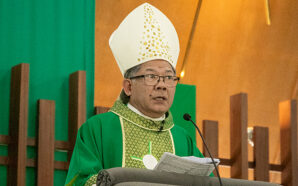


Most Reverend Vincent Long Van Nguyen OFM Conv DD STL, Bishop of Parramatta
Homily for the 16th Sunday in Ordinary Time, Year A
Readings: Wisdom 12:13-19; Romans 8:26-27; Matthew 13:24-43
Working for the Kingdom even if the harvest is not within our horizons
Dear friends,
We live in a world where violence is so prevalent, and evil seems to have the upper hand over against the best of human natures. We don’t have to look hard for evidence of this. The United States and Iran are at war with each other again with terrible consequences for the innocent people on the ground and the rest of the world. Then there are other armed conflicts like those in Ukraine, Palestine, Sudan… that are still raging on without an end in sight. Diplomacy and peaceful resolution continue to elude those who work for peace.
Closer to home, during this past week alone, there have been several confronting incidents in which women and young girls fell victim to family and domestic violence. It is a silent curse in our society that we are yet to eliminate despite national campaign, investment and education. It seems that we Christians have our work cut out in terms of challenging the dominance of evil, violence and retaliation. As artisans of peace and cultivators of hope, we are called to interrupt the cycle of conflict and witness to the Christian ethic of forgiveness and reconciliation.
It is in this lived context that the Word of God speaks to us today. It galvanizes us. When things get too difficult or when we do not see the result of our efforts. Anchored in the power of God’s love, we can stay the course even when we come up against the forces of resistance and our own limitations and failures. The Word of God teaches us to persevere in the work of the Kingdom even if the harvest is not within our horizons. As St Paul says, we must fight the good fight, even if we ourselves may not be able to see the reality of what we hope for.
The book of Wisdom exhorts us to show love in place of hate, compassion in place of resentment and forgiveness in place of anger. The book originally addresses the minority Jews in Egypt who struggled to live by the Covenant. They asked why the faithful were oppressed and humiliated while the unfaithful prospered. In response, the author writes that God shows his power of mercy and magnanimity towards sinners. Leniency and generosity are a sign of God’s strength rather than weakness. Jesus later would reveal this fundamental quality of God in his own death on the cross. He would reset the cycle of human behaviour by delivering us from our propensity to violence and enabling us to build a new future powered by the energy of divine love.
The Gospel gives us a collection of parables that urge patience and trust as well as total commitment of the part of the disciples. Discipleship is intimately bound up with the realization of God’s plan for the world. Hence, nothing short of an enduring love, an unwavering faith and an unmitigated commitment will do.
The kingdom is immersed in a world of violence and injustice. This is what the parable of the darnel and wheat implies. Evil and good exist side by side. But that does not mean God is impotent to achieve his plan. Instead of losing heart, we are buoyed up by the patience of God and the hope of eschatological fulfilment.
The kingdom does not manifest itself in size, in success and in power. Instead, it is found in the smallness of the mustard seed, in in the poverty of the widow’s mite, in the rarity of the pearl or in the insignificance of the yeast. These images are essentially counter-cultural. In other words, they challenge the prevalent attitude about greatness, success and power.
Through these parables, Jesus teaches that God’s kingdom though begun in vulnerability will reach its fulfilment. Evil, like the weed of darnel will not succeed. Rather, it is God’s plan that will be realized as surely as the good seed of the farmer. Our response is not to focus on the evil around us or the wrongdoing of others but to do what is right within our power.
Dear friends,
Our hope is not attached to results and successes of temporal nature. It is rooted in the life, suffering, death and resurrection of Jesus. Today’s liturgy reminds us that nothing in this world, not even human frailty and sinfulness, can derail God’s plan. On the other hand, it also calls us to be participants of that plan. We are privileged to embody and enact the vision that God has for humanity and all of his creation. We should not be deterred by the lack of apparent success. Like Jesus, who was vindicated and gloried to be the hope of the world redeemed, we must persist in our being the agents of the Good News.
Let us pray that we may embrace his way of compassion, gentleness, vulnerability and powerlessness. May we follow the example of Christ by living out a courageous discipleship in silent hope, in vulnerable trust, in humble service and self-emptying love especially during this time of the great cleansing and renewal in our Church. Let us anchor ourselves in God’s way shown in Jesus. May we become humble servants working for the Kingdom even if the harvest is not within our horizons.