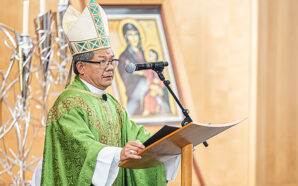


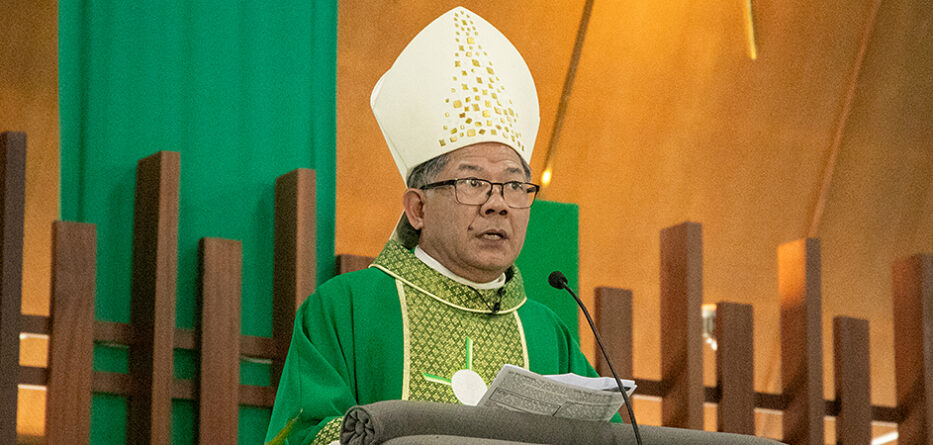
Most Reverend Vincent Long Van Nguyen OFM Conv DD STL, Bishop of Parramatta
Homily for the 19th Sunday in Ordinary Time, Year A
Readings: 1 Kings 19a, 11-13a; Psalm 85; Romans 9:1-5; Matthew 14:22-33
Dear friends,
We are living in a time of fear. This observation is made by the Australian Bishop’s 2026 Social Justice Statement called “Living the Gospel in times of social division”. The statement examines the tragic events of the Bondi attack as well as a rise in antisemitism, Islamophobia and other forms of racism. Fears and grievances are being reinforced, amplified and exploited. Increasingly, Australians are being drawn into the “us versus them” politics, as evident by the incendiary language and polarisation in our national discourse over migration.
In this climate, we who are inspired by the Gospel of Jesus can be the catalysts for the culture of encounter, dialogue and mutual enrichment. We can help create an environment in which people of diverse culture, race and religion can grow in unity, harmony and prosperity. The Statement reminds us of the layers of enrichment that successive generations of migrants, refugees and First Nations Peoples have contributed to Australia. We are given the task of safeguarding this richness, fostering social bonds and moving beyond the fear of strangers to the love of neighbours.
The Word of God on this Sunday is also about an encounter with the God who empowers us move beyond our fears. Christian discipleship is not about staying put in our comfort zones or digging our heels in where we feel secure. We are constantly challenged to grow and expand the limits of our engagement.
In the first reading, we heard the story of the prophet Elijah and his transforming experience on Mount Sinai. Elijah took refuge in a mountain cave because he had been pursued by his enemy. There, alone and vulnerable, he did not want to go on. He wanted to quit and go back to his former life of tranquillity. But it was at this point that he was given a lesson in humility and courage. At the mouth of the cave, Elijah witnessed a series of dramatic events: a mighty wind, an earthquake and a fire. Yet, God was not in any of these manifestations of power. Instead, he showed himself in a gentle breeze which was not often associated with divine revelation.
After this unusual encounter and his being fed by the poor widow, Elijah realised that God was to be found not only in the show of force but also in the strength of gentleness. He learned to embrace vulnerability as opposed to the conventional notion of power. Armed with this new insight, he continued his mission of anointing the new king of Israel and guiding its future.
The Gospel story too presents us with a lesson of meeting God in the moments of fear, doubt and uncertainty. It tells of the unexpected storm and how the disciples came to recognise Jesus. Initially, they took fright and thought they had seen a ghost floating on the waters. Upon hearing the bidding of Jesus, Peter jumped off the boat and walked towards him. But his heroism was superficial. It was not unlike what happened at Caesarea Philippi. There, his profession of faith in Jesus as the Christ was quickly shown to be shallow when he tried to talk Jesus out of the cross.
Peter and his fellow disciples learned an important lesson. They met the same God who had revealed himself to their ancestors. Jesus who overcame the storm was a clear allusion to the sacred moments in Israel’s history, particularly through the Exodus. They were in the presence of the same God who accompanied his people from chaos of the sea to the safety of the land, from fear into belief, and from darkness into light. “Courage! It is I! Do not be afraid”. These words of encouragement from Jesus were an invitation to grow in their faithful discipleship. They also alluded to the new horizons that they were called to travel in their mission to the world.
Dear friends in Christ,
This weekend, we honour St Mary of the Cross, one exemplified the best of the Christian spirit by seeing the face of Christ in the downtrodden and championed their cause with selflessness and courage. There was something quintessentially Australian about the way she endeavoured to give a fair go for the underprivileged. It was not simply doing charity to the poor out of a sense of pity and sympathy. Rather it was Mary’s profound respect for their dignity and her commitment to the reign of justice. For this, she lived her life with passion and compassion: passion for justice and compassion for the victims of injustice. She embodied strength not through power and wealth but through gentleness and love.
The Word of God today challenges us to be responsive to the call of walking beyond our limitations just as Elijah and Peter did. With Mary McKillop, let us rise to the occasion, walk the path of humility and courage. Out of vulnerability, the power of God is revealed. Out of a still small voice, his presence is manifest. May we be strengthened by the Eucharist to walk the journey of transformation and we may be leaven to the kingdom through our active discipleship, witness and engagement in the world.