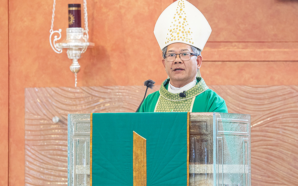


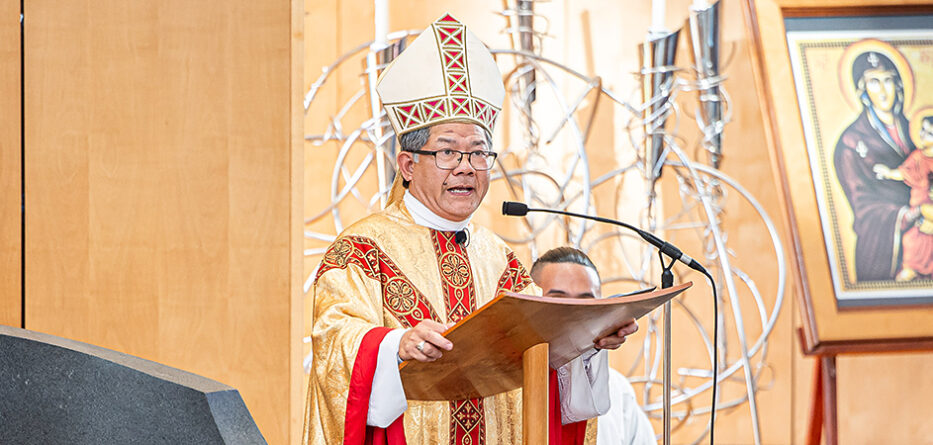
Most Reverend Vincent Long Van Nguyen OFM Conv DD STL, Bishop of Parramatta
Homily for the 2nd Sunday of Easter 2026
Called to be the mobilisation of a greater good and a greater hope
Readings: Acts 2:42-47; 1 Peter 1:3-9; John 20:19-31
“This is the day the Lord has made. Let us rejoice and be glad in it”
Dear sisters and brothers,
Right throughout the Easter season, we use these words of the psalmist to give thanks and praise God for the supreme gift of his Son’s resurrection. Easter means God has triumphed over the forces of darkness and evil. Celebrating the day of the Lord is not merely obligatory, or liturgical and spiritual only. It is intrinsically communal. Just like the Sabbath is celebration of the covenant community where even the orphans, widows and strangers are accorded dignity, Easter empowers us to be pilgrims of hope with our brothers and sisters, to be partners with the living God in the transformation of the world. With the risen Lord, we are to restore damaged relationships, repair injustices, give equity to the underclass and reimagine community in alignment with God’s vision of solidarity and harmony.
Scriptures today provide us with a resurrection hope that can shape our response to life’s challenges. In a world of conflict, violence, fear and division, we are called to be the catalysts for the Kingdom and the mobilisation of a greater good, a greater hope, a greater vision and a better world.
We are inspired by the early Christian community, who shows us the way out of the darkness of despair and disillusionment in the wake of the crucifixion. In fact, right throughout the Easter season, the scriptures focus our attention on the fledgling Church and how it transforms itself into a shining instrument of the Gospel. What is presented in today’s account is a rather idealistic picture of the early Christian community. It is one of peace, generosity and devotion. Though marginalised and persecuted, it is a powerhouse of prayer, internal cohesion and solidarity. For this reason, many were attracted to join them.
Incidentally, many dioceses this year also report an increase in the number of new converts. While this may be too early to conclude that we have turned the corner and a religious revival has begun, we can imitate the early Christian community in being the force of spirituality, compassion and solidarity. It is the church of our origins which was at its best because it was few in numbers, poor, humble, synodal and aligned with the Gospel. It is this model community so beautifully portrayed in the Acts of the Apostles, rather than the dominant, powerful imperial church of Christendom that we endeavour to emulate.
The Gospel today tells us the story of Jesus showing himself to his disciples after his resurrection. The evangelist is very clear that even in his risen state, the crucifixion wounds do not disappear. The resurrected body of Christ remains marked by his earthly suffering, forever. It is not until the disciples see the wounds of Christ that they recognize Jesus for who he is. Thomas who saw these wounds exclaim: “My Lord and my God.”
As the late Pope Francis often reminded us that what the Church needs most today is to heal wounds, to warm hearts and to offer closeness to those who suffer. We embody the wounded Lord and minister to his wounds in the poor, the sick, the captive, the disadvantaged. The Church without wounds and Christian faith without wounds are not compatible with the Gospel. Our ministry as wounded healers can only be authentic when we immerse ourselves in the liminal places of pain, ambiguity, struggle and despair. Indeed, our shared suffering with others is the precondition for the preaching of the Good News. For that was the way of Jesus.
Today, we celebrate Divine Mercy Sunday. The image of the wounded Christ is particularly fitting for today’s liturgy. It reminds us that God’s love is all-embracing, unconditional and sacrificial. We are invited to avail ourselves of this love, to sustain ourselves by it. Only on the strength of Divine Mercy can we live a fuller Christian life and become the instruments of God’s love.
My friends,
The Church today is not unlike the Church gathered in that upper room of old. In many ways, we are battered and bruised; we are in a state of grief, fear, confusion and uncertainty. The changes around us may not be as dramatic as affecting the disciples in Jerusalem. Nevertheless, they are very unsettling and disconcerting. There is a sense in which the Church finds itself in an uncharted territory. Yet, it is not in yearning for or holding on the known and the security of institutional power, but in reimagining the future and venturing into the unknown chaos like the old exodus that we will find new life.
The early Church refused to be cocooned in the old comfortable and secure Jewish settings. It ventured forth and lived out Jesus’s counter-intuitive and counter-cultural way. Like a mother, it accompanied and empowered rather than treating those who strayed with arrogance, self-righteousness and exclusivity. We are heirs to this Gospel-inspired community. Let us walk with one another as pilgrims on the journey nurturing a faith that integrates doubts and questions but above all expresses itself in love, solidarity and service.