

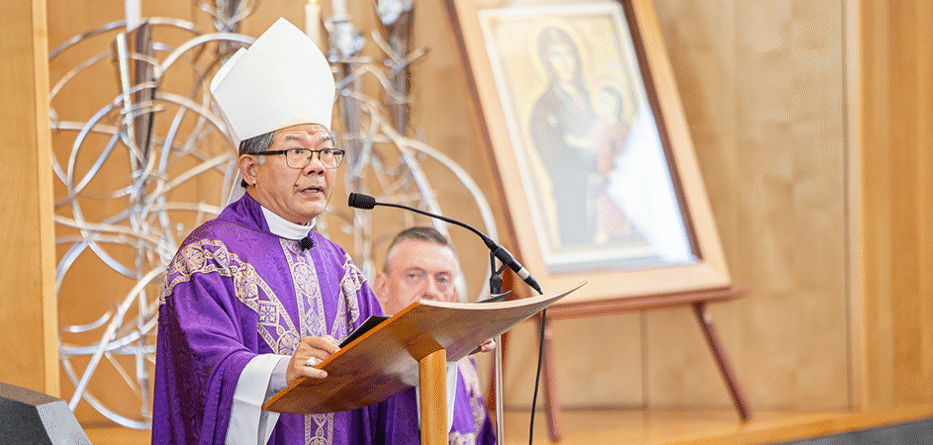
Most Reverend Vincent Long Van Nguyen OFM Conv DD STL, Bishop of Parramatta
Homily for the 4th Sunday in Lent, Year A
Readings: 1Sam 16:1-13; Eph 5:8-14; John 9:1-41
15 March 2026
Recognising the peaky blinders and regaining spiritual vision
Dear sisters and brothers,
Some of us might be familiar with a TV series called the Irish Peaky Blinders. It is about a fictional crime family operating in Birmingham just after World War 1. Peaky blinders refer to the sartorial elegance of the criminals but also their unusual method. They were known to sneak up from behind, then pull the hat peak down over victims’ faces so they could not describe who robbed them.
We might not go around wearing peaky caps that can be our blinders. Nevertheless, all of us, and most of the time, go around the world with other kind of blinders on. The blinders are not necessarily physical hindrances, but rather preconceived ideas, assumptions, biases, thoughts or judgments, created by the mind that block us from experiencing the present moment as it is. These can and do prevent us from seeing or hearing or accepting life as it manifests itself to us in the now. We can lose sight of the sacramental sign before us that is the manifestation of the presence of God, here and now. In other words, we don’t have to lose your physical senses to walk in the dark.
The Word of God this 4th Sunday in Lent speaks of the unexpected ways with which the God of our ancestors breaks through human barriers of gender, ethnicity, social status or disability. In Jesus, God frees us from our blindness and empowers us to be the witnesses of the one who is the light of the world.
In the first reading, the prophet Samuel was sent to the house of Jesse in Bethlehem, in order to anoint the future king of Israel. Samuel was not blind physically. However, like other privileged people, he had a few blind spots. He evaluated the children of Jesse, one after the other, according to his cultural assumptions and biases. To his total surprise, the one deemed unworthy turned out to be the chosen of God. Samuel was taught a sobering lesson that day: “God does not see as man sees”. God’s way subverts human thinking.
It is a kind of sobering lesson that we all need to learn. We may be blessed with physical sight. But like Samuel, we need to have our eyes of faith wide opened; we need to expand our limited horizons so that we can see the way God wants us to see in the other. How often our ingrained prejudices prevent us from accepting and respecting people who are different to us. We must be challenged as Samuel was, to see beyond our fears and biases.
This message is reinforced by the Gospel which is a story full of rich symbolism and profound spirituality. Like the woman at the well story last Sunday, the man born blind is a victim of fear, misunderstanding and prejudice. He is judged and condemned by others. One is reminded of the way Job was similarly judged through the lense of the old reward and punishment binary. His friends maintained the old belief that God would only punish the guilty and reward the righteous in this world. Poor old Job was blamed for his predicament. He, like the blind beggar, was made an outcast and a sinner.
How often that is still the case even in our own days and in our own society! How often we see people through the prism of our own judgment whether it is domestic violence, entrenched poverty, systemic oppression or intergenerational disadvantage. It is Jesus who shows us the way. “He was born blind so that the works of God might be displayed in him”, he declares. In this way, the traditional link between sin and one’s predicament no longer holds true. Jesus changes the way we view people who bear social stigma.
The blind man was receptive to the gift of sight and enlightenment. He recognised Jesus first as a healer, then, a prophet and finally as Lord. His journey of transformation is a sharp contrast to the descent into blindness on the part of Jesus’ adversaries. They judged him a sinner, then rejected his testimony and finally expelled him for his faith in Jesus. We can detect a sense of irony in all of this. It is the fully sighted people who are guilty of ignorance, prejudice and hard-heartedness. The story makes it clear to us who has the gift of true vision.
Dear friends,
As we approach Holy Week, we are summoned to recognize that in God’s kingdom we wear no labels other than our identity as the children of God. In Christ, St Paul proclaims that “there is no longer Jew or Greek, slave or free, male or female”. Our faith makes us step beyond these human boundaries. It challenges us to align our personal biases and cultural assumptions with God’s vision.
In the face of fear and stereotyping, let us be resolved to build a community of hospitality, compassion and solidarity, starting from those who are at the margins of our society. Like the blind man, may we be healed and made whole from the darkness of our fears and insecurities. May we be gifted with the new vision of faith that enables us to see and act according to the values of the Gospel. Let us pray that Christ open our eyes so we may see like him; our ears that we may hear like him and our hearts so we may love like him.