

First Sunday of Advent, Year A
Readings: Isaiah 2:1–5; Psalm 121(122):1–2, 4–5, 6–9; Romans 13:11–14; Matthew 24:37–44
30 November 2025
“Stay awake, because you do not know the day when your master is coming.” – Matthew 24:42
Today, we begin the season of Advent, leading up to the commemoration of the birth of Christ this Christmas. But as well as looking back to the time when Jesus was born into this world, we also look forward to the time when Christ will come again. Not just the moment at the end of time when Christ will appear again in glory to judge the living and the dead, not just the moment when God will call us from this life, but also the moment when Christ will appear again in our lives.
But the Gospel reminds us that we do not know the day or the hour when Jesus will return. Jesus uses a frightening image to remind us that he will appear at an hour we do not expect. He uses the image of a thief or burglar who breaks into a house at an hour we do not expect. It is a strange comparison that Jesus makes, comparing himself to a burglar.
But the fundamental difference between Jesus and a burglar is that whilst a burglar has the desire to break into our house in order to steal something precious from us, to take something of value away from us, the desire of Jesus is to break into our house—into our lives and into the home of our hearts—not to take something precious from us, but to give something precious to us: grace, love, forgiveness, and the promise of eternal life (1 Jn 2:25).
Lord, may I always be ready to receive you into my life, and into my heart. Amen
Fr Antony Jukes OFM
Artwork Spotlight:
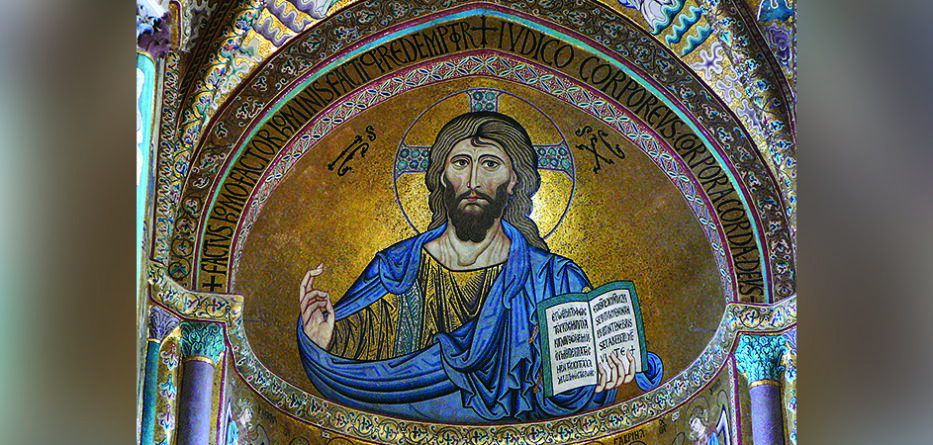
Christ Pantocrator, Greek-Byzantine Mosaicsists
Christ Pantocrator (c. 1148). Mosaic, 600cm high. Cathedral of Cefalù, Sicily, Italy. Public Domain.
“But why are we listening to such a scary Gospel on the first day of Advent?” some may reasonably ask. “We thought we’d be preparing for Christmas!”
In its earliest form, Advent was simply a preparation for Christmas. But it quickly acquired an eschatological character (from the Greek eskhatos meaning “last”.) From the beginning of the seventh century, Advent was understood not only as a time of preparation for the Christmas solemnity, but also, and especially, as a time of expectancy for the return of Christ in glory. This was especially so in the Gallic liturgy, and may have come about through the influence of Irish missionary monks who, in their preaching, laid stress on the coming of Christ in judgment, and thus on the need to do penance.
The word “Advent” originally designated not the period of preparation, but the feast of Christmas itself. The coming of Christ in the flesh and its liturgical commemoration was the adventus Domini: the advent of the Lord. From thi,s you can see that right from the start, the Church saw the liturgy as a happening, not just as a memory. But then the term memory took on a deeper meaning. What we remember in the liturgy actually becomes present.
In the New Testament, Adventus translates the Greek parousia, which refers to Christ’s coming. For this reason, the season of Advent came to signify both his birth in history and his return at the end of time.
Gradually, the word Adventus assumed a distinctly liturgical meaning—it came to be applied to the weeks of preparation for Christmas and of expectation of the glorious return of Christ.
Many of us today might find it difficult to understand the idea of two comings intermingled with the Advent liturgy. But the early Fathers of the Church did not see this as a problem—they had a unified vision of the mysteries of Christ. Pope St Leo the Great, in his sermons for Christmas and Epiphan,y leads his hearers and readers beyond the mystery of the Incarnation to the contemplation of Christ now enthroned in glory and to his return at the end of time. The Church evokes the coming of Christ in all its aspects—past, present and future— and so the season of Advent recalls the coming on earth of the incarnate Word, deepens our awareness of Christ’s Presence in the Church every day, and heightens our hope and longing for his return.
So, we are really speaking now of three comings. St Charles Borromeo, archbishop of Milan (+1584), explains: “The Church desires us to understand that Christ, who came once in the flesh, is prepared to come again. When we remove all obstacles to his presence, he will come at any hour and moment to dwell spiritually in our hearts, bringing with him the riches of his grace.” And St Bernard (+1153): “In the first (coming), Christ was our redemption; in the last, he will appear as our life; in this middle coming, he is our rest and consolation.”
The Incarnation is the beginning of a process which is not yet finished. Christ will return in glory to crown his work of salvation. It is a promise.
The Christ Pantocrator mosaic in the Cathedral of Cefalù in Sicily is often described as one of the most majestic images of Christ in Western Christian art. The cathedral was commissioned by King Roger II of Sicily in 1131, reportedly in fulfilment of a vow he made after surviving a storm at sea. At that time, Sicily was a multi-ethnic kingdom under Norman rule where Latin, Byzantine and Arab cultures coexisted. An enlightened monarch, Roger encouraged this cultural blend. He invited artisans from Constantinople to create mosaics in the churches and palaces of his kingdom.
The title Pantocrator means “Ruler of all” or “Almighty” in Greek. It presents Jesus as the eternal Judge, Teacher, and Saviour—a cosmic ruler rather than merely a human figure. His raised hand in blessing invites us into a relationship with him, while the open Gospel proclaims the truth of his Word: “I am the light of the world. Whoever follows me will not walk in darkness” (Jn 8:12).
Christ’s face is serene but powerful, intended to convey omniscience and compassion. The mosaic is enormous—six metres and spans the entire semi-dome of the cathedral’s apse. Historically, it is an important reminder of the great portraits of Christ in the churches of Constantinople now lost to us.
This judge of all is not to be feared. His eyes and thoughts are full of mercy for humankind.
Mons Graham Schmitzer
Fr Antony Jukes OFM
Fr Antony Jukes OFM, from Chingford, East London, joined the Franciscan Order of Friars Minor in 2002 and was ordained in 2009. He has served in a parish, youth retreat centre, and a Franciscan Study Centre, and is now the novice director in Killarney, Ireland.
Monsignor Graham Schmitzer
Monsignor Graham Schmitzer is a retired parish priest. He was ordained in 1969 and served in many parishes in the Diocese of Wollongong. He was chancellor and secretary to Bishop William Murray for 13 years. Prior to ordination, he worked for the Department of Attorney General and Justice before entering St Columba’s College in 1962. He enjoys travelling and visiting major European art galleries.
With thanks to the Diocese of Wollongong, who have supplied this reflection from their publication, The Promise: Advent and Christmas Daily Reflections 2025. Reproduced with permission.