

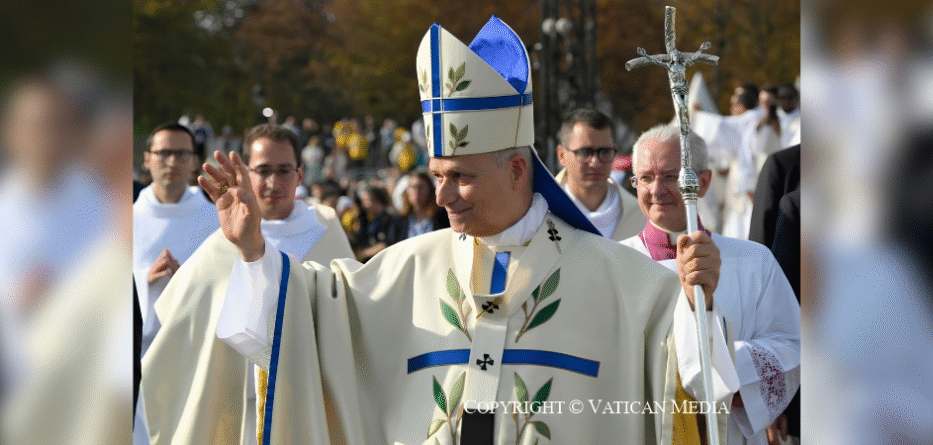
Some of my readers know that, as a liturgist, I belong to a small fraternity of priests who have had the immense privilege of planning a papal Mass. In 1987 I was entrusted with coordinating the Mass Pope St. John Paul II celebrated in the Los Angeles Memorial Coliseum. It was the first papal Mass ever celebrated in Southern California, and 110,000 people took part. Anyone who has carried such a Herculean responsibility learns quickly that nothing about it is improvised. The sightlines, the timing of Communion, the placement of a thousand chairs and the tone of a single cantor’s voice all bear directly on whether a vast crowd becomes an assembly at prayer or stays an audience at an event. I like to think that there will be a front-row seat in the heavenly liturgy for everyone who has been given this task.
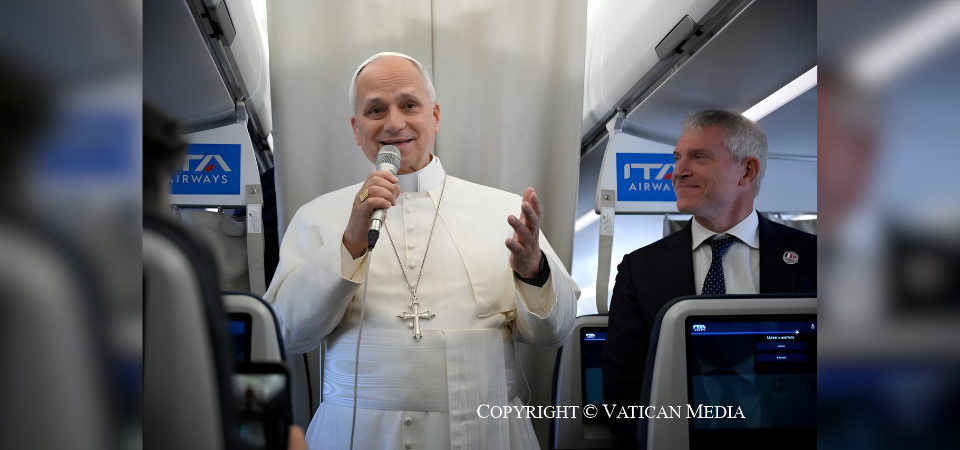
Ever since, I have watched national papal Masses closely, with a planner’s eye for their intricate details. I wrote at some length about the beautiful celebrations when Pope Leo visited Spain. In the same spirit, I want to offer a few reflections on the extraordinarily exquisite celebration of the Eucharist the Holy Father presided over on Saturday, September 26, in the incomparable setting of the Place de la Concorde.
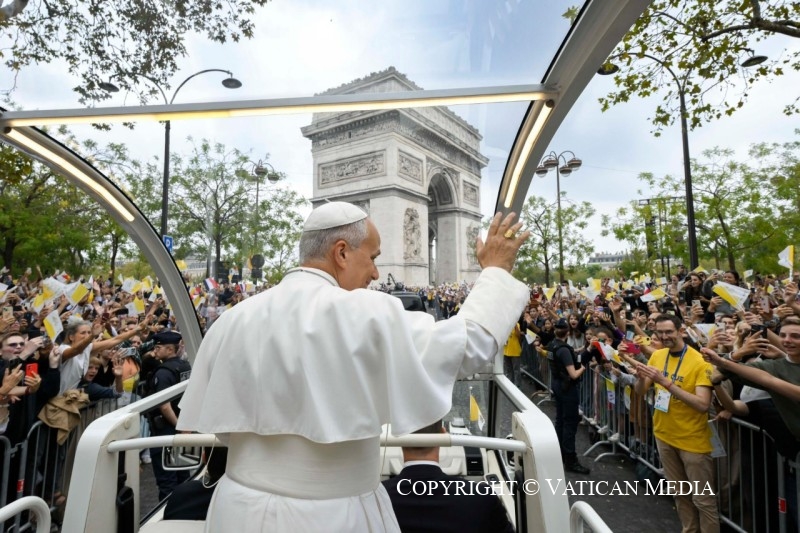
Image: Vatican Media
A Setting Without Equal
There is no more beautiful stage in the City of Light, where beauty is endemic. The Arc de Triomphe rose at the far end of the Champs-Élysées, and across the Seine the gilded dome of Les Invalides caught the afternoon sun. The day had begun gray and cool, but the sun broke through just as the Holy Father arrived. Some 800,000 of the faithful filled the square and the avenue.
The place itself deserves reflection. This is the largest square in Paris. It was once the Place de la Révolution, where the scaffold of the Terror stood and the blood of a king and of countless others was shed. It now bears the name Concorde, harmony. On Saturday it lived up to its name. The Holy Father opened his homily with the Psalmist’s praise of brothers and sisters dwelling together in unity. A square once consecrated by violence was, for an afternoon, consecrated by the Eucharist.
It is no surprise that the liturgy was so fine. France gave the liturgical movement many of its pioneers. Dom Prosper Guéranger’s restoration of Solesmes began the recovery of the Church’s liturgical memory. After him came the Centre de Pastorale Liturgique, Louis Bouyer, Aimé-Georges Martimort, Pierre-Marie Gy, and Joseph Gelineau, whose psalmody taught whole assemblies to sing the Psalter. Just across the border, at my own Louvain, Dom Lambert Beauduin was their close neighbor in spirit. This lineage was present at the planning table. The team that prepared the Mass under Fr. Guillaume Normand, vice-rector of Notre-Dame, included the director and faculty of the Institut Supérieur de Liturgie at the Institut Catholique de Paris. The fruits of the reform and renewal were evident at every turn.
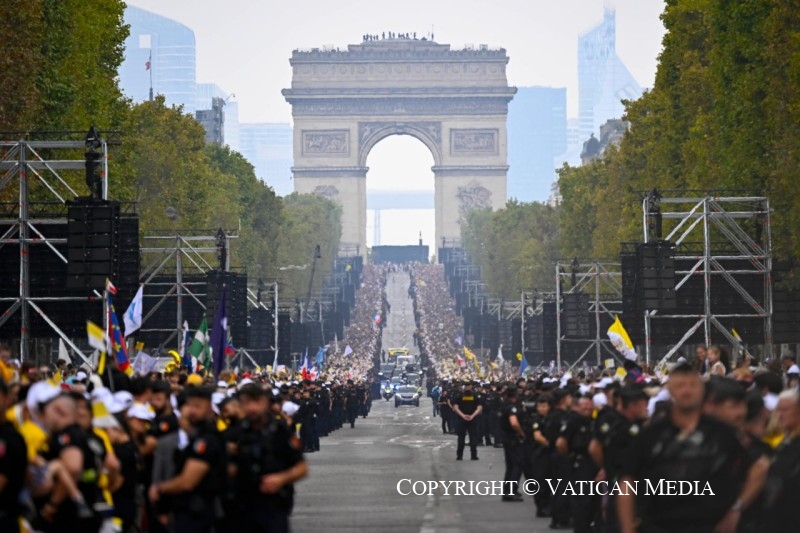
Image: Vatican Media
The Sanctuary: Noble Simplicity
The sanctuary was an excellent example of the “noble simplicity” the Council asked for (Sacrosanctum Concilium 34). Above all, it was organized around the altar. The planners sized the altar to the scale of the setting, large enough for more than a hundred bishops to gather around it at Communion, and it held every eye. That is exactly right. The altar is the holy table and the symbol of Christ himself in the midst of his people. It is not a prop or a pedestal for other liturgical objects. It is the symbol par excellence of the holy Presence. No reproduction of Da Vinci’s Last Supper adorned its front. No ersatz side altars competed with the one altar that signifies the one Christ. The planners also deliberately matched the ambo to the altar in design, so that the table of the Word and the table of the Eucharist spoke to each other, as the Council intended (Dei Verbum 21).
The candles were clustered at the corners of the altar and the cross stood to the side. There was no liturgical peekaboo, with the celebrant peering over a barricade of brass. He was clearly visible to the assembly, and the assembly to him, as the General Instruction asks (GIRM 307–308).
Behind the sanctuary rose a great silhouette of the south rose window of Notre-Dame, together with the vault decoration Viollet-le-Duc designed for the cathedral. It was a quiet reminder that the Mother Church of Paris, raised from its ashes, stood behind this celebration. The silver Virgin and Child given by Charles X in 1826 stood within the sanctuary. Parisians know it from the August 15 procession every year, and it was fitting for a Mass celebrated in Our Lady’s honor.
The chair of the universal pastor expressed its dignity by the architectural principle that less is more: noble wood, understated, drawing no attention away from the one who would preside. The General Instruction asks that the chair signify the office of presiding while avoiding “any semblance of a throne” (GIRM 310), and here it did. The flowers, arranged by young people of the Apprentis d’Auteuil foundation, followed the same principle of restraint (GIRM 305).
Most importantly, the design belonged to our own age. It made no attempt to ape an earlier architectural period. The Council was clear that the Church has never adopted any particular style of art as her own and welcomes the art of every age (SC 123). We are people of the twenty-first century, not the fifteenth or the sixteenth, and our worship should say so.
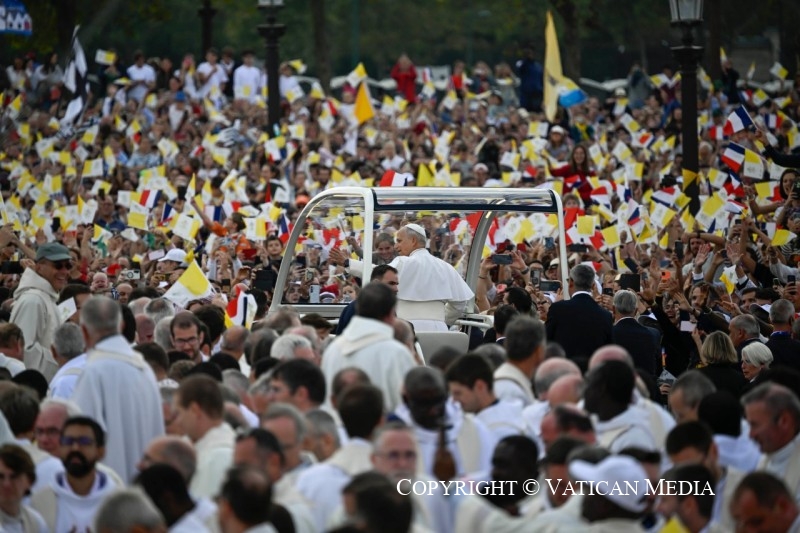
Image: Vatican Media
Ecclesial Proportion
The concelebrating bishops were arrayed in choir on either side of the sanctuary, and the concelebrating priests were given their own area among the People of God. Anyone who plans liturgies with hundreds of bishops and thousands of priests must attend to what I call the principle of ecclesial proportion. Whose sacrificium laudis is it? It belongs to all of us. The whole Church offers the sacrifice of praise, and the clergy serve that offering; they do not own it. The planners avoided any hint of clericalism in the visual massing of clergy, such as the endless procession that turns the entrance rite into a parade of rank. The assembly was allowed to see itself as what it truly is, the Body of Christ gathered around its Head.
The ministries were shared across the whole Church of Paris. Women served as readers and led the Prayer of the Faithful. Fittingly, the intercessions were entrusted to five neophytes from the diocesan catechumenate, the newest members of the Body, voicing the prayer of the whole. People from the diocese’s ministries to the poor, to immigrant communities, and to the Eastern Catholic Churches in France brought forward the gifts. Seminarians from seven dioceses of France and from Vietnam served at the altar. Among the four hundred altar servers from across the country were six young people with Down syndrome from the Jérôme Lejeune Foundation. This is participatio actuosa made visible: every order and condition of the baptized has a place at the table of the Lord.
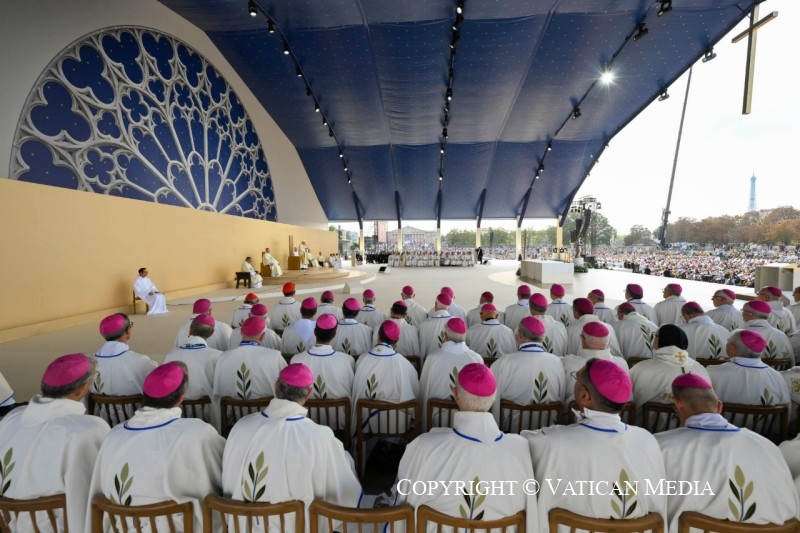
Image: Vatican Media
Vesture
The vesture was noble in its simplicity. The chasuble and the deacons’ dalmatics are symbols in themselves. They do not need lettering or added emblems. Their meaning is carried by the gracious fullness of their cut and the vibrant integrity of their color. The General Instruction puts it well: the beauty and nobility of a vestment should come from its material and design rather than from lavish ornamentation (GIRM 344). The Holy Father and the principal concelebrants, Archbishop Laurent Ulrich and Cardinal Jean-Marc Aveline, wore white. The vestments were made by the Paris houses of Chéret and Vuillaume, a deliberate tribute to French craftsmanship. Their restrained ornament echoed the day’s reading from Ezekiel, the river flowing from the Temple and the trees whose leaves do not wither. The ornament served the vesture rather than overwhelming it.
The assisting ministers wore albs, the baptismal garment and the vesture common to all who minister at the liturgy. The masters of ceremonies wore cassock and surplice. Everything was dignified and nothing was fussy.
Appropriately absent was any semblance of clerical triumphalism that one sees occasionally especially when bishops or cardinals celebrate the vetus ordo entering with a 20 foot cappa magna and livery mimicking another age or the singing of Ecce Sarcedos Magnus when the bishops enter. Such liturgical eccentricities are best left to the history books.
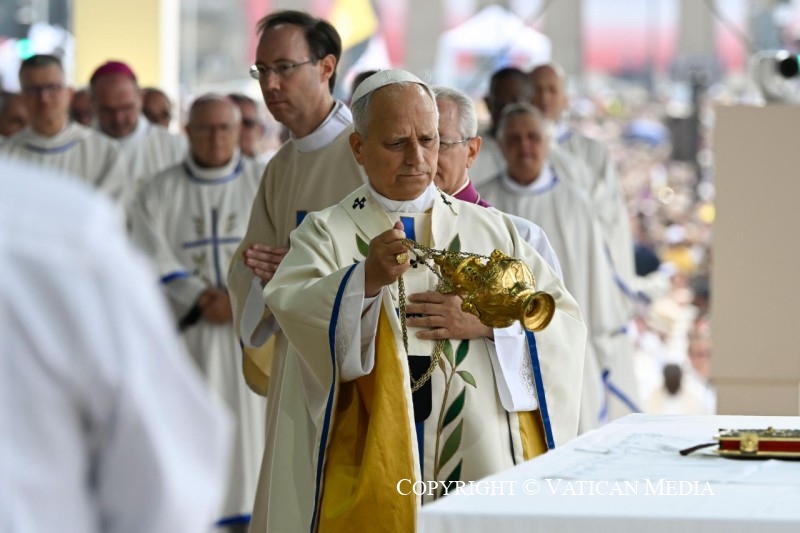
Image: Vatican Media
Music
The music drew on the whole treasury of French sacred song. There was chant: the Gloria of the Missa de Angelis, the Pater Noster, the Salve Regina. There was the classic French choral repertoire, including Fauré’s Kyrie from his Messe basse – a personal favorite – and the beloved Sanctus of Saint-Séverin. There were new compositions as well, most notably a responsorial psalm refrain written for the occasion by Karol Mossakowski, organist of Saint-Sulpice. The planners arranged the singers in three tiers. The young voices of the choir school of Sainte-Anne-d’Auray served as the pilot choir. Behind them sang a polyphonic choir of 150, and then more than a thousand singers from thirty-four diocesan choirs across France, singing in unison to carry the immense assembly. Many of them were young people, and they did what a liturgical choir exists to do: they led the people in song rather than performing for them.
The assembly responded. As the refrains rolled down the Champs-Élysées, the city itself became a sanctified space, a vast nave open to the sky. Along the avenue, the crowds followed the sacred action at the distant altar on video screens, which drew hundreds of thousands into a single act of praise and thanksgiving.
Before the Mass began, the assembly chanted a beautiful, calming litany. It quieted the great crowd and centered it on the Eucharist about to be celebrated. That was a wise pastoral touch. A crowd that has waited hours in the streets needs to be gathered into stillness before it can pray as one.
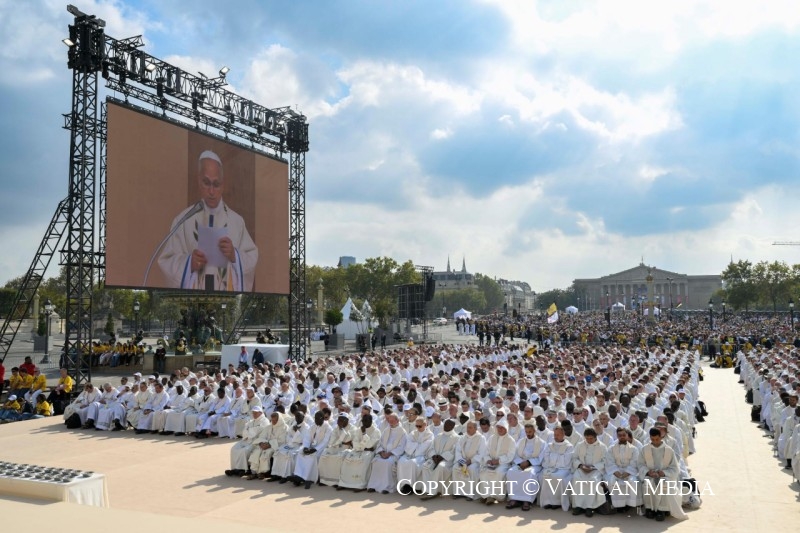
Image: Vatican Media
The Homily: The Thirst Only God Can Quench
The Mass was a votive Mass of Our Lady from the Collection of Masses of the Blessed Virgin Mary, under her title of Mary, Fountain of Salvation. It was chosen for its imagery of the living water that brings forth the fruits of the Spirit. The Holy Father’s homily drew on that imagery throughout. He began with Christ’s invitation on the last day of the Feast of Tabernacles, “Let anyone who thirsts come to me and drink” (Jn 7:37), and asked the assembly the question beneath every human life: What is my deepest thirst? What am I really seeking? We all long for happiness, love, and fulfillment. The Pope was frank that material goods and the many small idols of our age promise everything and leave the heart empty. Only God can fill that emptiness. He also pressed the baptized on a question that should unsettle us all: whether we have truly encountered Christ personally.
He then linked Ezekiel’s vision of water flowing from the Temple to bring life to the desert with the water that flowed from the pierced side of Christ on the Cross. Speaking to the French faithful as heirs of a long and beautiful history of faith, he urged them to “drink from the source that is the pierced heart of Jesus.” Drawing on Origen, he reminded them that those who drink from Christ become wells, springs, and rivers for others. He called them not to keep the faith to themselves but to let it overflow where discouragement and spiritual dryness prevail.
He named the saints who drank from this spring on French soil: the martyrs of Lyon, Blandina and Pothinus; St. Irenaeus; Sts. Martin and Francis de Sales; St. Vincent de Paul, Blessed Frédéric Ozanam, and St. Jeanne Jugan. In a nation whose public life is shaped by laïcité, it was a gentle but pointed reminder of where France’s deepest roots lie. He addressed families, young people (”you are today’s Church”), and the catechumens and newly baptized. He closed by entrusting France to Mary, Fountain of Salvation.
This was preaching in the mode of the Fathers: scriptural, mystagogical, and missionary. It was a homily that led the assembly from the Word to the altar, from the pierced side of Christ to the chalice of the Eucharist.
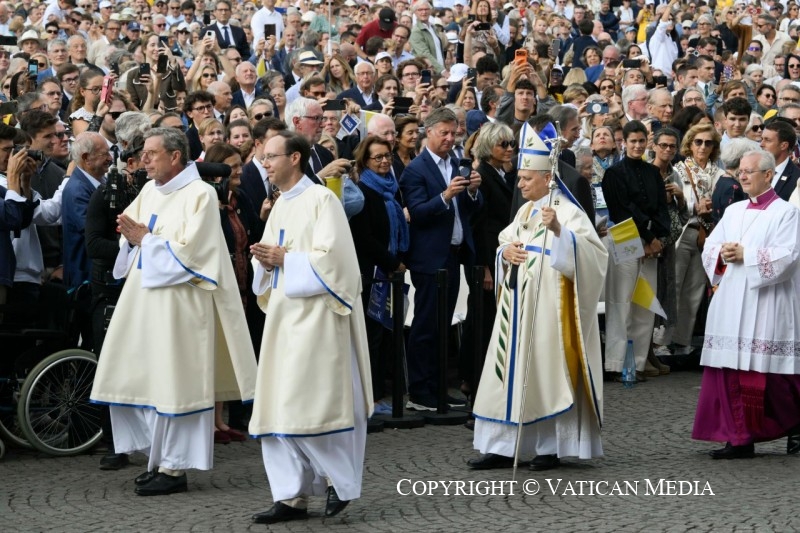
Image: Vatican Media
Communion
Everyone who has planned a papal liturgy knows the enormous challenge of distributing Holy Communion to hundreds of thousands. It must be done with reverence, and it must be done without taking a disproportionate share of the celebration. The Paris planners told the press that the Communion plan was one thing that could not be improvised, and the result proved them right. Communion under both kinds, so desirable as a fuller sign (GIRM 281), is a practical impossibility at such a scale. Even so, the bread of life was shared with a vast assembly with what looked like effortless grace. That appearance is always the fruit of months of meticulous planning. The assembly sang C’est toi, Seigneur, le pain rompu, a hymn so well known in France that everyone could join in, and the communion of voices expressed the sacramental communion taking place.
Coda
The Place de la Concorde has seen revolution, terror, and the pomp of empire. On Saturday it saw the People of God gathered in harmony around one altar, one Word, and one Lord, and it lived up to its name. For those of us who have carried the weight of such a celebration, it was a joy to watch it done so beautifully. And for the whole Church it was a reminder, and perhaps a scintilla of hope, that the reformed liturgy celebrated with care, noble simplicity, and full participation remains the most eloquent catechesis we have. Lex orandi, lex credendi, lex vivendi.
With thanks to Liturgy & Truth and Monsignor Arthur Holquin, S.T.L., where this article originally appeared.