

Fourth Sunday of Advent
Readings: Micah 5:1–4, Psalm 79(80):2–3, 15–16, 18–19, Hebrews 10:5–10, Luke 1:39–458
22 December 2024
Blessed is she who believed that the promise made her by the Lord would be fulfilled. LK 1:45
In this day and age, it is especially hard to believe in promises. During the time of a recent government election, there was a survey undertaken which showed that the vast majority of people did not actually believe the promises that were being made by the various parties.
Why would we believe just anyone? I think the answer as to who we believe boils downto relationship. Nothing sheds light like a true relationship. Maybe that is really what is being praised here, not so much the promise, but that Mary believed in the relationship—in the One who made the promise.
The promises of the Lord to us are many, easily found in the Scriptures. You can even go to the internet! Pick out one of them, maybe the one that said: “I am with you” (Is 43:5), or “I will not fail you or forsake you” (1 Ch 28:20). Repeat it often until it is part of you. It will sure up the knowledge of who God is for you, light will dawn!
His promises won’t take away our trials; they did not take away Mary’s, but his love through our belief in him will bring us to something deeper. Julian of Norwich said, “[God] did not promise that you would be without trial … he promised that you would not be overcome,” just like Mary.
A prayer to pray: I believe. Help my unbelief. Amen.
Mother Hilda Scott OSB
Artist Spotlight
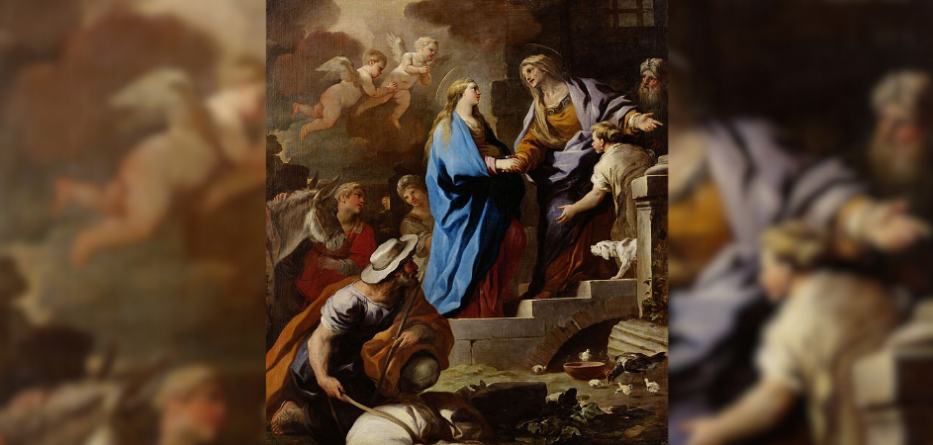
The Visitation of Mary by Luca Giordano (1634–1705)
The Visitation of Mary (c. 1696). Oil on Canvas, 206cm × 187cm. Kunsthistorisches Museum Vienna Austria. Public Domain.
In the first Eucharistic Prayer of the Mass, we call Abraham “our father in faith”. Against all hope, he believed in the physically impossible—simply because God asked. He believed that he and his aged wife, Sarah, would have a son. He believed that God would fulfil his promise of making him the father of a great nation, even when God asked him to sacrifice that only son, Isaac.
Because of this, God declared that through Abraham, all the nations of the earth would be blessed. Put another way, Abraham’s vocation was to be a blessing. And because Abraham responded to his vocation, the Messiah would eventually come to birth through his line.
As Abraham virtually stands at the beginning of the Old Testament, a model of faith, Mary stands at the beginning of the New Testament. God blessed her more than he did any other creature. She responds by blessing him: “My soul proclaims the greatness of the Lord and my spirit exults in God my saviour…. the Almighty has done great things for me. Holy is his name” (Lk 1:46–47, 49). Mary thus admirably fulfils the mission of her people whom the prophetess Deborah of the Old Testament had defined as “the people who bless the Lord” (Jg 5:11). Blessing God in response to God’s blessings is a frequent theme in the Scriptures. The formula becomes almost stereotyped. The recipient is congratulated for the blessing God has bestowed upon him/her, and God is blessed in thanksgiving, but the very congratulations are expressed as a prayer to God for continued blessings.
A good example is the congratulations the people offer Judith after she had defeated Israel’s enemy, Holofernes. “Blessed are you, daughter, by the Most High God, above all the women on earth. And blessed be the Lord God, the creator of heaven and earth, who guided your blow at the head of the chief of our enemies.… May God make this redound to your everlasting honour, rewarding you with blessings, because you risked your life” (Jdt 13:18, 20). The promise and hope expressed in this blessing are fulfilled in Mary. Her words, in praise of God, “All generations shall call me blessed,” (Lk 1:48) seem to say: “In me all blessings are contained. God will be blessed endlessly in thanksgiving, for all generations shall share in the blessings he has entrusted to me.” Mary is pregnant with blessing and thanksgiving for all mankind.
Beginning with Mary’s Magnificat, God’s people in the New Testament continue the mission to bless the Lord. The letter to the Ephesians bears this out:“Blessed be the God and Father of our Lord Jesus Christ, who has blessed us in Christ with every spiritual blessing in the heavens (Ep 1:3). We have been blessed with every spiritual blessing in Christ, the blessed fruit of Mary’s womb.
In speaking of her “lowliness”, Mary announces the disposition necessary for receiving God’s blessings. She identifies herself with God’s poor—so fully had she absorbed their spirituality. They are described in the Old Testament as those who fear the Lord, who seek the Lord, who hope in him, trust in him, wait for him, and are blessed by him.
And so, our vocation is the same God gave Abraham, the same he gave Mary: “Be a blessing! Be a blessing to the world, so that through our lives, God may be blessed!”
Known for his rapid painting pace, Luca Giordano (1634–1705) earned the nickname “Luca fa presto” (Luca paints quickly). Born in Naples, he honed his craft through studies in Rome, Parma and Venice, ultimately cultivating a sophisticated Baroque style that melded Venetian and Roman elements. In 1692, he was summoned to Spain by Charles II, where he resided for a decade and was bestowed the title of “caballero” by the king. Giordano passed away in Naples.
In his painting, The Visitation of Mary (c. 1696), Mary is clearly the central figure, adorned in the most vibrant colour. However, her gaze is directed towards Elizabeth. Giordano strategically draws our focus to Mary before guiding it towards Elizabeth, who holds the utmost significance as the central character in this Gospel narrative. Elizabeth, along with her unborn child, is portrayed as the first to grasp the importance of this encounter. Throughout the scene, she repeatedly emphasises the terms “blessed” and “honoured”, recognising the profound gift bestowed upon all those involved.
Elizabeth extends her arms in a welcoming gesture— using her right hand to greet Mary and her left hand to gesture inward. In this depiction, she symbolically invites the mother of God into her home, reflecting the hospitality we should all show. The scene includes both husbands: the speechless Zachariah peeks out from the doorway, while a kneeling Joseph gazes back over his shoulder. Elizabeth’s actions serve as a powerful testimony to both men.
The birth of the Messiah will mark the end of the pagan era, symbolised by the toppled Greek column. Giordano adds a hen and her chicks, for this whole painting glorifies motherhood.
Monsignor Graham Schmitzer
Mother Hilda Scott OSB is the abbess of the Benedictine Sisters at Jamberoo Abbey, NSW. Before becoming abbess, she served as prioress, novice mistress, and vocation director, and engaged in spiritual direction, retreat giving, and talks at the Abbey Retreat Cottages. She gained wider recognition through the ABC TV documentary, The Abbey. Before 1990, she was in a different religious order, teaching, working with youth and children, and doing pastoral work in parishes. Just before joining Jamberoo, she lived in a caravan park among the most disadvantaged in society.
Monsignor Graham Schmitzer, retired parish priest of Immaculate Conception Parish in Unanderra, NSW, was ordained in 1969 and served in many parishes in the Diocese of Wollongong. He was chancellor and secretary to Bishop William Murray for 13 years. Raised in Port Macquarie and educated by the Sisters of St Joseph of Lochinvar, he worked for the Department of Attorney General and Justice before entering St Columba’s College in 1962. He enjoys travelling and visiting major European art galleries.
With thanks to the Diocese of Wollongong, who have supplied this reflection from their publication, The Light: Advent and Christmas Daily Reflections 2024. Reproduced with permission.