

Homily for the 2nd Sunday of Easter 2026
Readings: Acts 2:42-47; Psalm 118; 1 Peter 1:3-9; John 20:19-31
Listen at: soundcloud
At Easter 175 years ago, the Jesuits took up residence on a property they named Sevenhill in the Clare Valley of South Australia. The name was a reference to the Seven Hills of Rome. Fr Aloysius Kranewitter had paid his first instalment for the land on 28 January 1851. At first the land was leased, and then ultimately purchased. Kranewitter’s fellow Jesuit Br Schreiner ‘took possession of the place’ on 25 March 1851, the feast of the Annunciation. In Easter week ‘Fr Kranewitter took up his abode with the Brothers and the first community was formed in Sevenhill’. Kranewitter had first come to the area a couple of years before in company with Franz Weikert and his family who had organised for 146 persons fleeing persecution in Europe to come to Adelaide. After a four month voyage, they had arrived in Adelaide on 8 December 1848.
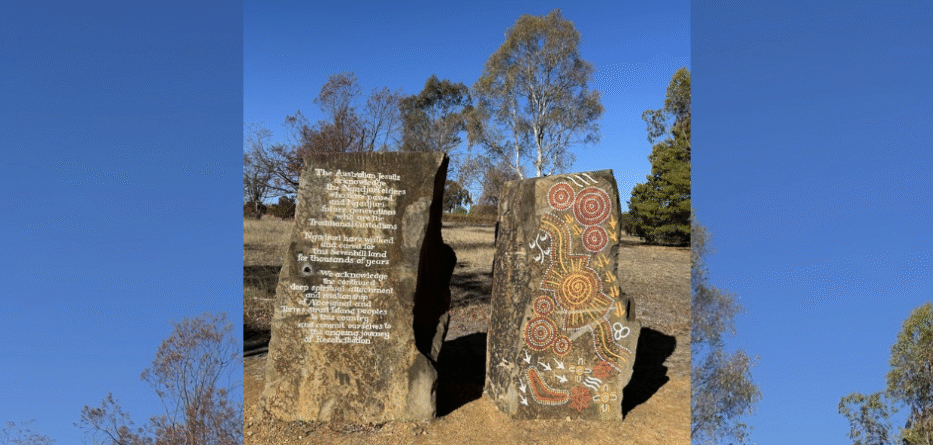
This weekend, 175 years after Kranewitter took up residence with two Jesuit brothers at Sevenhill, some of us gathered for a Welcome to Country and a Blessing of two large Acknowledgement Stones at the entrance to the property which was the first foundation of the Jesuit mission in Australia. One stone is inscribed with these words: ‘The Australian Jesuits acknowledge the Ngadjuri elders who have passed and the Ngadjuri future generations who are the Traditional Custodians. Ngadjuri have walked and cared for this Sevenhill land for thousands of years. We acknowledge the continued deep spiritual attachment and relationship of Aboriginal and Torres Strait Islander peoples to this country and commit ourselves to the ongoing journey of Reconciliation.’ This text was derived from discussions between the then Sevenhill parish priest Father Paul Fyfe SJ and prominent Ngadjuri woman, Auntie Pat Waria-Reed. The other stone features two rock paintings by Ngadjuri artists Adam and Elley Warrior portraying ‘the journey and meeting of the Jesuits and the Ngadjuri people and the home they made on the hills of the Clare Valley’.
In August, there will be a mass to celebrate the 175th anniversary of the arrival of the Jesuits at Sevenhill and in October a wine festival to mark the 175th anniversary of the planting of the first vines by Brother Schreiner who obtained cuttings from Bungaree Station, north of Clare, where grapes were produced from vines that originally came from the Rhine Valley in Europe.
Ten years ago, Jesuits Michael Head and Paul Fyfe joined Paul McKee in publishing The Vine and the Branches: The Fruits of the Sevenhill Mission. They noted:[1]
[B]y the time Fr Kranewitter arrived at the end of 1848, the Aboriginal population of the region had declined dramatically from pre-contact numbers. He bought land at Sevenhill which had been their land.
A more serious attempt to work with Aboriginal peoples occurred after 1866 when Fr Johannes Hinteroecker arrived at Sevenhill. He had a great interest in the Aborigines. It was one of the chief reasons why he came to Australia and he hoped to evangelise them. However, there were only a few left in the area, including a very small community on the land of Sevenhill. Although two were finally prepared for baptism, it was a ministry filled with difficulties. Still he wanted to assist them in their survival in the district and to maintain their culture. To do more serious work with the Aboriginal peoples, a substantial area of land near Oodnadatta was leased and a team of two priests and two brothers was prepared to settle there among the Aboriginal communities. Fr Hinteroecker was to be assisted by Fr John Pallhuber and Brs Georg Eberhard and Francis Poelzl. However, in October 1866 the head of the Jesuits writing from Rome, while praising the zeal and generosity of the Jesuits who wanted to undertake the mission, refused permission, mainly on the grounds that there were not enough in lower South Australia to carry out their current commitments. A second concern was the state of health of Fr Hinteroecker. Still he continued to work with the local Aboriginal people around Sevenhill, and when he left the house, Fr Matthias Hager took over the role. By 1871 there were only very small numbers remaining in the Sevenhill district. A few years later the government administrators told the Jesuits that they could not retain the lease at Oodnadatta if they did not construct a number of wells on the property. As this would have been too expensive, they gave up the lease. Serious Jesuit ministries with the Aboriginal peoples did not resume until the 1880s in the Northern Territory.
Commemorating and celebrating a significant anniversary of the establishment of the first Jesuit mission in the country has provided us with the opportunity to reflect not only on the heroism of the early missionaries but also on the dispossession and annihilation of so many of those who were the traditional custodians of the land before the arrival of the Jesuits. There is no doubt that the dispossession, diseases and killings had occurred before the Jesuits and the Weikert family arrived. No one suggests that Jesuits or members of the Weikert family bore any responsibility for the dispossession, diseases and killings that had occurred. But, like most non-Indigenous landholders in modern day Australia, we did profit from same. We Jesuits are grateful to the present day descendants of the Ngadjuri who graciously joined with us this weekend in marking this anniversary.
Aunty Angelena Harradine, Ngadjuri elder and mother of artist Elley Warrior, told us that the blessing of the stones was ‘an opportunity to better understand each other and build a better future in Australia’. She recalled the detailed discussions she and her mob had with the local Jesuits when ‘we spoke with each other, not at each other’. Fr Brendan Kelly SJ recalled that shortly after the stones were erected, a Ngadjuri elder came and wept. He wept tears recalling the violence and dispossession of the past. And he wept tears of joy for the spirit of reconciliation now present in the land.
On this second Sunday of Easter, recalling yesterday’s gathering at Sevenhill, we are challenged afresh by the example of the disciples at that first Easter sharing the common life committed to the prayers and the breaking of the bread. ‘All who believed were together and had all things in common; they would sell their property and possessions and divide them among all according to each one’s need.’ We are reminded in today’s gospel from John that the Risen Jesus empowered those first Christians to conquer their fears – emerging from behind locked doors, sharing the message of peace even with strangers. Our first reading from the Acts of the Apostles reminds us that the Risen Jesus also motivated those first Christians to share what they had with others, especially those in need. Today’s readings take on a new poignancy as we reflect on what it means for present landowners to be reconciled with those who are the descendants of those who were dispossessed.
Back in 2022 when planning the rock paintings, artists Adam and Elley explained: ‘It’s a very strong painting and appropriate for this location with its story of the meeting between the two peoples and the journey the Jesuits made and the strong connection both indigenous and the Jesuits have with the Ngadjuri land and the divine intervention of God’s hand to both peoples.’ The stones which were quarried at Mintaro weigh 6.5 and 8 tons. They stand as a permanent reminder of all that has gone before and of all that is promised in the future for life in a reconciled land.
Give thanks to the Lord for he is good, his love is everlasting.
The stone which the builders rejected
has become the cornerstone.
By the Lord has this been done;
it is wonderful in our eyes.
This is the day the Lord has made;
let us be glad and rejoice in it.
Give thanks to the Lord for he is good, his love is everlasting.
Fr Frank Brennan SJ AO, Adjunct Professor of Thomas More Law School at ACU and Adjunct Research Professor at the Australian Centre for Christianity and Culture, is a former Rector of Newman College, University of Melbourne, and CEO of Catholic Social Services Australia (CSSA). His latest books include Pope Francis: the Disruptive Pilgrims Guide (ATF Theology, 2025), and Gerard Brennan’s Articles and Speeches: Maintaining the Law’s Skeleton of Principle (2 volumes) (Connor Court, 2025).
[1] Michael Head, Paul McKee and Paul Fyfe, The Vine and the Branches: The Fruits of the Sevenhill Mission, ATF Press, Adelaide, 2016, pp.43,45.