

Homily for Trinity Sunday
Exodus 34:4b-6, 8-9; Daniel 3:52, 53, 54, 55, 56; 2 Corinthians 13:11-13; John 3:16-18
Listen at soundcloud.com
‘The grace of the Lord Jesus Christ, the love of God and the fellowship of the Holy Spirit be with you all.’
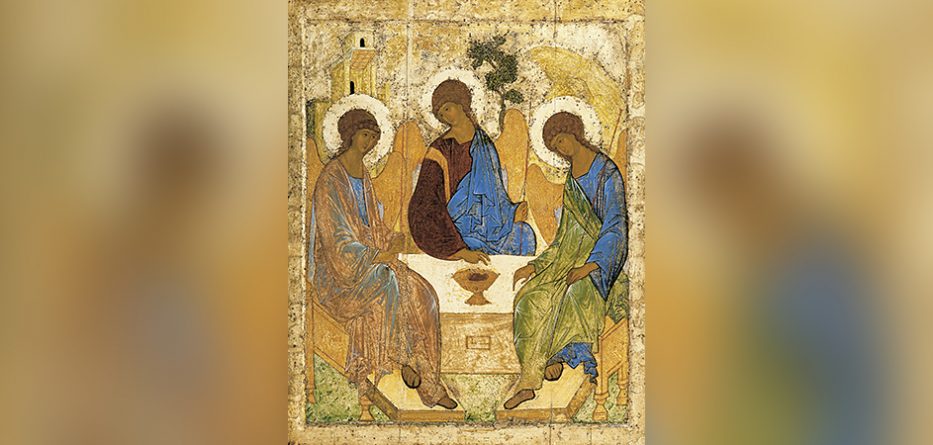
This greeting is so familiar to us. It is often used by the priest at the beginning of mass. It comes from today’s first reading for the feast of the Most Holy Trinity. It comes from Paul’s second letter to the Corinthians. We enjoy the love, grace and fellowship of our God who is Creator, Redeemer and Sustainer.
For us Australians, Trinity Sunday this year falls in the middle of National Reconciliation Week with the theme ‘All In’. The week is bookended by two significant dates: May 27 which was the date of the successful referendum in 1967 taking out the two adverse references to Aboriginal people in our Constitution, and June 3 which was the date of the 1992 Mabo decision when the High Court recognised native title.
Reconciliation Week this year has had a very dark pall hanging over it. This past month, we have all been coming to terms with the death of 5 year old Kumanjayi Little Baby who was abducted from a town camp in Alice Springs. This little girl and her alleged killer Jefferson Lewis were each shaped by life in these town camp conditions, and each in their own way was destroyed by them. We’ve had 238 years to improve the living situation of those living in this land since colonisation commenced. The conditions in the town camps are a continuing indictment on us as a nation.
We are grateful that there are now First Nations representatives in our national parliament helping us chart a better course. Senator Malarndirri McCarthy, the Minister for Indigenous Australians, told the Senate: ‘I rise today to share my heartbreak and extend my deepest condolences to Kumanjayi Little Baby’s mum, brother and family, who loved this little girl so much. … I reach out to my constituents in Alice Springs/Mparntwe and across the Northern Territory, who are devastated that this could happen in their community; to First Nations people across the country, who feel this loss so intensely; and to the whole Australian community, who have been shattered by news of the loss.’[1] Northern Territory Senator Jacinta Nampijinpa Price who was related to the deceased told Parliament: ‘Children deserve safety before ideology. They deserve protection before symbolism. Children deserve love, stability and educational opportunity before political sensitivities—and, yes, culture matters, but no child should be sacrificed on the altar of culture or political correctness. No child should be left in danger because adults are too afraid to intervene. No child should lose their life because governments lack the courage to act.’[2]
In today’s second reading, Paul tells the Corinthians:
Brothers and sisters, rejoice.
Mend your ways, encourage one another,
agree with one another, live in peace,
and the God of love and peace will be with you.
On Thursday at Australian Catholic University, 10 Aboriginal women launched their book entitled: Hope: Unfinished Business.[3] This was the background of their initiative.
When Pope Francis declared last year as the Jubilee Year of Hope, he quoted the Letter to the Hebrews: ‘May we who have taken refuge in him be strongly encouraged to seize the hope set before us. We have this hope, a sure and steadfast anchor of the soul’. Francis went on to reflect: ‘The image of the anchor is eloquent; it helps us to recognize the stability and security that is ours amid the troubled waters of this life, provided we entrust ourselves to the Lord Jesus. The storms that buffet us will never prevail, for we are firmly anchored in the hope born of grace, which enables us to live in Christ and to overcome sin, fear and death. This hope, which transcends life’s fleeting pleasures and the achievement of our immediate goals, makes us rise above our trials and difficulties, and inspires us to keep pressing forward, never losing sight of the grandeur of the heavenly goal to which we have been called.’[4]
During the Jubilee Year of Hope, there were many thematic celebrations in Rome for varied groups and interests. But sadly there was no special celebration for Indigenous peoples. Taking the initiative to help fill the gap, these 10 Catholic Aboriginal and Torres Strait Islander women got together to tell their stories ‘amid the troubled waters of this life’, confident that the storms that continue to buffet them and their people ‘will never prevail’.
Like many First Nations Australians, these writers draw heart and hope from the Uluru Statement from the Heart which was prepared by a large gathering of Aboriginal and Torres Strait Islanders who convened at Uluru for the 50th anniversary of the successful 1967 constitutional referendum.
The Australian Church came of age in Plenary Council when it gave pride of place to Indigenous voices and when its first decree was entitled: Reconciliation: Healing Wounds, Receiving Gifts. The 2022 Plenary Council voted overwhelmingly to endorse the Uluru Statement from the Heart and encourage engagement with processes for implementing the statement, including local, regional and national truth-telling efforts. Indigenous voices were heard; wounds were healed; and gifts were received. Without reservation, the Plenary Council said ‘sorry to Aboriginal and Torres Strait Islander people in and beyond the Church for the part played by the Church in the harms they have suffered’ and committed ‘to walk with Aboriginal and Torres Strait Islander people in continuing to work towards recognition, reconciliation and justice’.
A year later, First Australians suffered an enormous setback with the nation’s rejection of the Voice Referendum in 2023. There is ongoing analysis about the causes for the referendum’s defeat. But these writers continue to express hope that their place will be assured in a just Australia and in a truly synodal Church. Antoinette Cole writes: ‘Days and weeks after the 2023 Voice to Parliament referendum, and its failure, the grief that followed was not simply political, but profoundly spiritual and emotional for a significant number of Aboriginal and Torres Strait Islander peoples, and our non-Indigenous allies. For me, what was to follow was grief – where my hope was ruptured, towards meaningful steps in the truth-telling, reconciliation and healing in Australia. For many, in collective sorrow, hope became quieter and hidden, just like an anchor between the stormy waters.’
The greatest challenge to us as Church members committed to the gospel is convincing our fellow citizens that constitutional recognition of First Nations peoples is about much more than simply treating all people the same, by presuming that equality is treating each person and each group in an identical fashion. There are some differences that should be recognised. The constitutional recognition of these differences is quite consistent with Paul’s insistence to the Galatians: ‘There is neither Jew nor Gentile, neither slave nor free, nor is there male and female, for you are all one in Christ Jesus.’ (Galatians 3:28) As Pope Francis said in Laudato Si’: ‘It is essential to show special care for Indigenous communities and their cultural traditions. They are not merely one minority among others’.[5]
Many Australian Catholics in our pews, especially those who are recent migrants, are yet to understand, acknowledge and treasure this difference. Hopefully this book of readings can help them in that quest.
At the commencement of his pontificate, Pope Leo XIV recalled that the mission of the disciples was ‘to bring the hope of the Gospel into the “waters” of the world, to sail the seas of life so that all may experience God’s embrace.’[6] These ten writers have done just that, helping us all to heal wounds and to receive the distinctive gifts of those who have risen above their trials and difficulties, inspiring us all to keep pressing forward.
At his Jubilee Audience on 25 October 2025, Pope Leo reminded us that ‘to hope is to not know. We do not already have the answers to all the questions. We do, however, have Jesus. We follow Jesus and thus hope for what we do not yet see. We become a people in which opposites are brought together in unity. Like explorers, we enter into the new world of the Risen One. Jesus goes before us. We learn, taking one step after another. It is a journey not only of the Church, but of all humanity. A journey of hope.’[7]
I give thanks to these ten Aboriginal women who have boldly expressed hope, though not having all the answers. They offer us the prospect as Church and society of becoming ‘a people in which opposites are brought together in unity’. Hope is still an unfinished business; it is still hard work; and the graced realisation is that it is still hope. This week we are ‘All in’ with hope for Reconciliation Week.
As we continue to confront the reality of life in places like the Alice Springs town camps, we Christians take heart from today’s gospel for Trinity Sunday:
‘God so loved the world that he gave his only Son,
so that everyone who believes in him might not perish
but might have eternal life.
For God did not send his Son into the world to condemn the world,
but that the world might be saved through him.’
Fr Frank Brennan SJ AO, Adjunct Professor of Thomas More Law School at ACU and Adjunct Research Professor at the Australian Centre for Christianity and Culture, is a former Rector of Newman College, University of Melbourne, and CEO of Catholic Social Services Australia (CSSA). His latest books include Pope Francis: the Disruptive Pilgrims Guide (ATF Theology, 2025), and Gerard Brennan’s Articles and Speeches: Maintaining the Law’s Skeleton of Principle (2 volumes) (Connor Court, 2025).
[1] Senate Hansard 12 May 2026, 2.
[2] Ibid, 4.
[3] ‘Hope: Unfinished Business’, A collection of reflections from Aboriginal and Torres Strait Islander women, Edited by Kelly Humphrey, Dr Lisa Buxton and Lana Turvey Collins, Australian Catholic University, 2026.
[4] Spes Non Confundit #25 available at https://www.vatican.va/content/francesco/en/bulls/documents/20240509_spes-non-confundit_bolla-giubileo2025.html
[5] Laudato Si’, #146
[6] https://www.vatican.va/content/leo-xiv/en/homilies/2025/documents/20250518-inizio-pontificato.html
[7] https://www.vatican.va/content/leo-xiv/en/audiences/2025/documents/20251025-udienza-giubilare.html