

Homily for the 11th Sunday in Ordinary Time, Year B
Readings: Exodus 17:22-24; Psalm 92; 2 Corinthians 5:6-10; Mark 4:26-34
16 June 2024
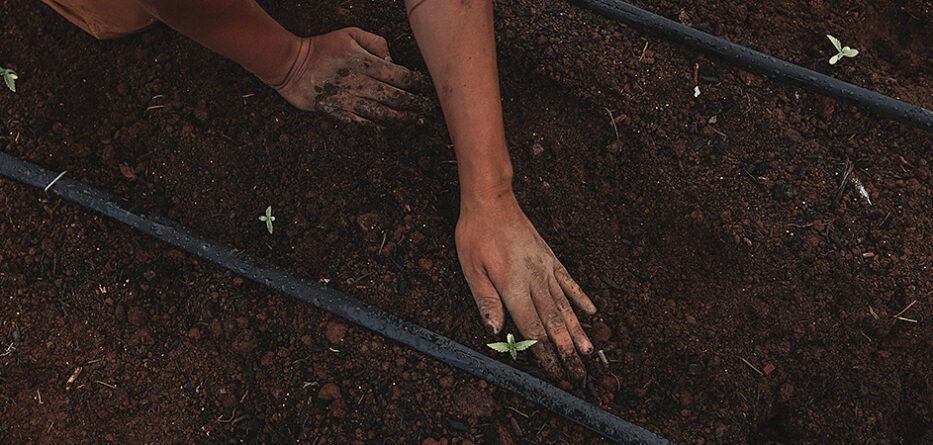
In today’s gospel from Mark, we hear a couple of descriptions of the kingdom of God. No matter how religious we might count ourselves, the kingdom of God remains a somewhat mysterious and elusive idea. Jesus uses parables or simple images to convey some sense of what the coming of the kingdom is like in the lives of the disciples and in the lives of ordinary listeners. ‘From little things big things grow’. There is the image of the seed planted by the farmer. The farmer scatters the seed which grows, yields fruit and is then harvested. We all understand that image even if we are not farmers. ‘From little things big things grow’. Then there is the image of the small mustard seed which grows into a large tree, offering shelter to the birds in its branches. We all understand that image even if we have never seen a mustard tree. ‘With many such parables he spoke the word to them as they were able to understand it.’ ‘From little things big things grow’.
Listen https://soundcloud.com/frank-brennan-6/homily-16624
Scripture scholars John R. Donahue and Daniel J. Harrington tell us: ‘The contrast between the power of Jesus, which is hidden and absent on the cross, and his glory when he returns (13:26–27; 14:62) is no less than the contrast between the smallest of all the seeds and the greatest of all the shrubs. The parables of Mark 4:1–34 are metaphors for the christology of the gospel.’1
On Thursday night, I attended the book launch in Sydney of Fr Richard Leonard’s new book Why God? Stories to Inspire Faith. The book is a collection of 52 of his articles from the London Tablet. In the foreword, Brendan Walsh, the Tablet editor, writes: ‘How do we put before the world holiness, forgiveness, reconciliation, prayer, when readers are no longer familiar with that kind of language?…. It’s a rope trick that gets more difficult to pull off in every generation as the gap between the imaginative world of the person of faith and the humdrum vocabulary and horizon of the contemporary reader yawns ever wider. How do we find writers who are bilingual – who can speak the language of the world and the language of heaven?’2
Daniel Street who works for the World Bank, having been based in Washington DC and now travelling the Pacific constantly, launched the book. He drew the audience’s attention to the latest research from the Pew-Templeton Global religious futures project.3 This project surveys over 200,000 people in 95 countries. One question asks people to identify if religion is very important in their lives. In Indonesia, 93% say that religion is very important in their lives. In India, it’s 80%; in Nigeria it’s 88%; and in Brazil it’s 72%. In wealthier western countries, the answer is very different. In the UK and in Germany, it’s 10%; in France, it’s 11%. Those countries with which we are often compared, Canada and the USA, come in at 27% and 53%. We Australians come in at a low 18%. We are one of the countries for which ‘the gap between the imaginative world of the person of faith and the humdrum vocabulary and horizon of the contemporary reader’ is widest. Religion is not the stuff of Australian writers’ festivals or popular media shows.
The evangelist Mark bridges the gap and writes bilingually with simple parables like those of the planted seed and of the mustard tree. ‘With many such parables he spoke the word to them as they were able to understand it. Without parables he did not speak to them, but to his own disciples he explained everything in private.’ Sometimes art can help us bridge that gap.
On Friday, I visited the Art Gallery of NSW and got to see the Archibald Prize winning painting of Tim Winton by Laura Jones. We’d had a week of the re-opened climate wars with industry leaders and public servants indicating that it was very unlikely that the Labor government would reach its 2030 twin targets of 82% renewables and 43% emissions reduction on 2005 levels, and with the Coalition saying that it would not even set any 2030 targets before the next election. All very depressing stuff. We’ve been around this track so often. Joëlle Gergis in the latest Quarterly Essay: Highway to Hell advises: ‘Global emissions need to fall 43 per cent by 2030 to have a chance of limiting warming to 1.5°C by 2100, and drop 28 per cent to keep the 2°C option alive.’4 She warns: ‘There are already irreversible changes in the climate system that will be with us for thousands of years. The challenge right now is to minimise future damage.’5
Laura Jones described her first meeting with Winton: ‘Last year, I watched his ABC documentary Ningaloo Nyingguli, about the fight to save Ningaloo reef. It was beautiful and terrifying. In a speech, Tim said the lack of action on climate change hasn’t been challenged enough in the arts.’ When announced as the Archibald winner, Jones, ‘a committed environmentalist, thanked her media-shy subject, Winton, …who admitted … he was “a very reluctant sitter’’. The four-time Miles Franklin Award winning novelist said he agreed to sit for Jones after seeing her “beautiful and tragic” paintings depicting coral bleaching on the Great Barrier Reef. He said: “It was clear we had some pressing (environmental) concerns in common … so I ended up agreeing to sit for her … This is lovely news. I’m thrilled for Laura.’’’6 The painting has been described as ‘a considered mix of awkwardness and composure’. Winton’s own observation on the painting is: ‘I look like I have the weight of the world on my shoulders.’7
Contemplating the painting, I recalled Kevin Carmody’s song ‘From little things big things grow’. Even in a fairly non-religious country like Australia, we confront big existential questions and we find hope in the smallest beginnings, signs for us Christians of the kingdom to come.
‘This is how it is with the kingdom of God; it is as if a farmer were to scatter seed on the land and would sleep and rise night and day and through it all the seed would sprout and grow, she knows not how. Of its own accord the land yields fruit, first the blade, then the ear, then the full grain in the ear. And when the grain is ripe, she wields the sickle at once, for the harvest has come.’
R. Lord, it is good to give thanks to you.
The just one shall flourish like the palm tree,
like a cedar of Lebanon shall she grow.
They that are planted in the house of the LORD
shall flourish in the courts of our God.
R. Lord, it is good to give thanks to you.
From the start of 2024, Fr Frank Brennan SJ will serve as part of a Jesuit team of priests working within a new configuration of the Toowong, St Lucia and Indooroopilly parishes in the Archdiocese of Brisbane. Frank Brennan SJ is a former CEO of Catholic Social Services Australia (CSSA). Fr Frank’s latest book is An Indigenous Voice to Parliament: Considering a Constitutional Bridge, Garratt Publishing, 2023 and his forthcoming book is ‘Lessons from Our Failure to Build a Constitutional Bridge in the 2023 Referendum’ (Connor Court, 2024).
1 John R. Donahue and Daniel J. Harrington, The Gospel of Mark, Sacra Pagina Series (Collegeville, MN: The Liturgical Press, 2002), p. 154.
2 Richard Leonard, Why God? Stories to Inspire Faith, Paulist Press, New York, 2024, p.xi.
4 Joëlle Gergis, Quarterly Essay 94: Highway to Hell, p. 11.
5 Ibid, p.54.
7 Kate Holden, ‘Walls white, paintings bright: 2024’s Archibald Prize’, The Saturday Paper, June 15-21, 2024.