

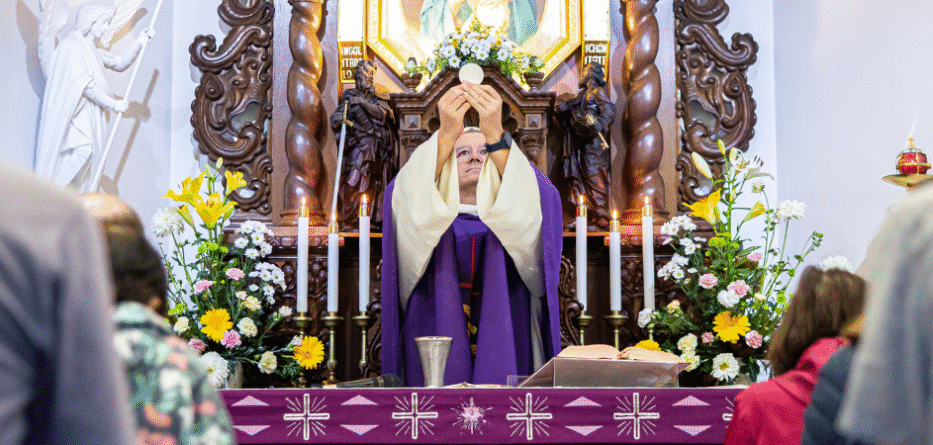
In today’s Gospel, Jesus makes a remarkable promise: “I am the living bread which has come down from heaven. Anyone who eats this bread will live forever; and the bread that I shall give is my flesh, for the life of the world.” These words reveal the heart of our celebration today. On this Solemnity of Corpus Christi, we rejoice in the gift of Christ’s Body and Blood, given for our salvation and offered to us continually in the Holy Eucharist.
Just as our physical bodies need food and drink to sustain life, so too our souls need spiritual nourishment. No one expects to remain physically healthy without eating. In the same way, no Christian can expect to grow in faith, hope, and love without being nourished by Christ Himself. The Eucharist is not simply a symbol or a reminder of Jesus; it is Jesus Himself, truly present under the appearances of bread and wine. In this sacred meal, Christ gives us His very life so that we may remain united with Him and receive strength for our journey of faith.
When we reflect on the experience of hunger, it teaches us something profound about the Eucharist. Without adequate food, our bodies become weak. We lose energy, our health declines, and we struggle to carry out even ordinary tasks. Hunger robs people of dignity and opportunity. It can prevent them from learning, working, and living life to the full. Human history continually reminds us of the tragedy of physical hunger and the suffering it causes.
The same is true in our spiritual lives. Without the nourishment of the Eucharist, our souls become weak. We find it more difficult to resist temptation, to persevere in prayer, and to trust God in times of trial. We can become discouraged, distracted, and consumed by the concerns of the world. Without the Bread of Life, we may gradually lose our desire for Scripture, for worship, and for service to others. We become vulnerable to the false promises of materialism, self-sufficiency, and individualism. The Eucharist strengthens us, heals us, and renews us so that we may become fully alive in Christ.
Every time we approach the altar to receive Holy Communion, we make a profound statement of faith. We declare that our lives are sustained not merely by material things. We do not live by bread alone, nor by wealth, success, entertainment, possessions, or human achievement. We live by every word that comes from God. Our deepest hunger can never be satisfied by the things of this world; it can only be satisfied by Christ, who alone is the Bread of Life.
The mystery of the Eucharist also challenges us to become what we receive. The Word of God became flesh in Jesus Christ, and that same Jesus now gives Himself to us in the Eucharist. Having been fed by His love, we are sent forth to share that love with others. The Eucharist is not only a gift to be received; it is a mission to be lived.
As the Body of Christ in the world today, we are called to become bread for others: bread for the hungry through our generosity to the poor; bread for the oppressed through our commitment to justice and peace; bread for the lonely through our friendship and compassion; bread for the sick through our care and presence; and bread for the discouraged through our words of hope and encouragement. The Eucharist compels us to recognise Christ not only on the altar but also in our brothers and sisters, especially those most in need.
In this spirit, we are reminded of the witness of Saint Albert Chmielowski, a famous Polish painter who later left his artistic career to dedicate his life completely to Christ in the service of the homeless, the poor, and those abandoned by society. Deeply Eucharistic in his spirituality, he saw no separation between worship of Christ in the Blessed Sacrament and service of Christ in the poorest of the poor. He is remembered for saying: “You must be as good as bread.” Bread does not exist for itself; it exists to be broken and shared for the life of others. In the same way, the Christian who receives Christ in the Eucharist is called to become “bread” for others—available, self-giving, and nourishing to those in need.
Today, as we celebrate the great gift of the Body and Blood of Christ, let us renew our faith in His Real Presence among us. Let us approach Holy Communion with reverence, gratitude, and love. And let us ask the Lord to transform us through this heavenly food, so that nourished by His Body and Blood, we may become living witnesses of His love in the world.
May we truly become a Eucharistic people, living on the real food that is Jesus Himself, and finding ever new ways to serve one another in charity, unity, and faith.
Amen.
Fr Pawel Barszczewski OP is the Assistant Parish Priest of St Joseph’s Parish, Kingswood.