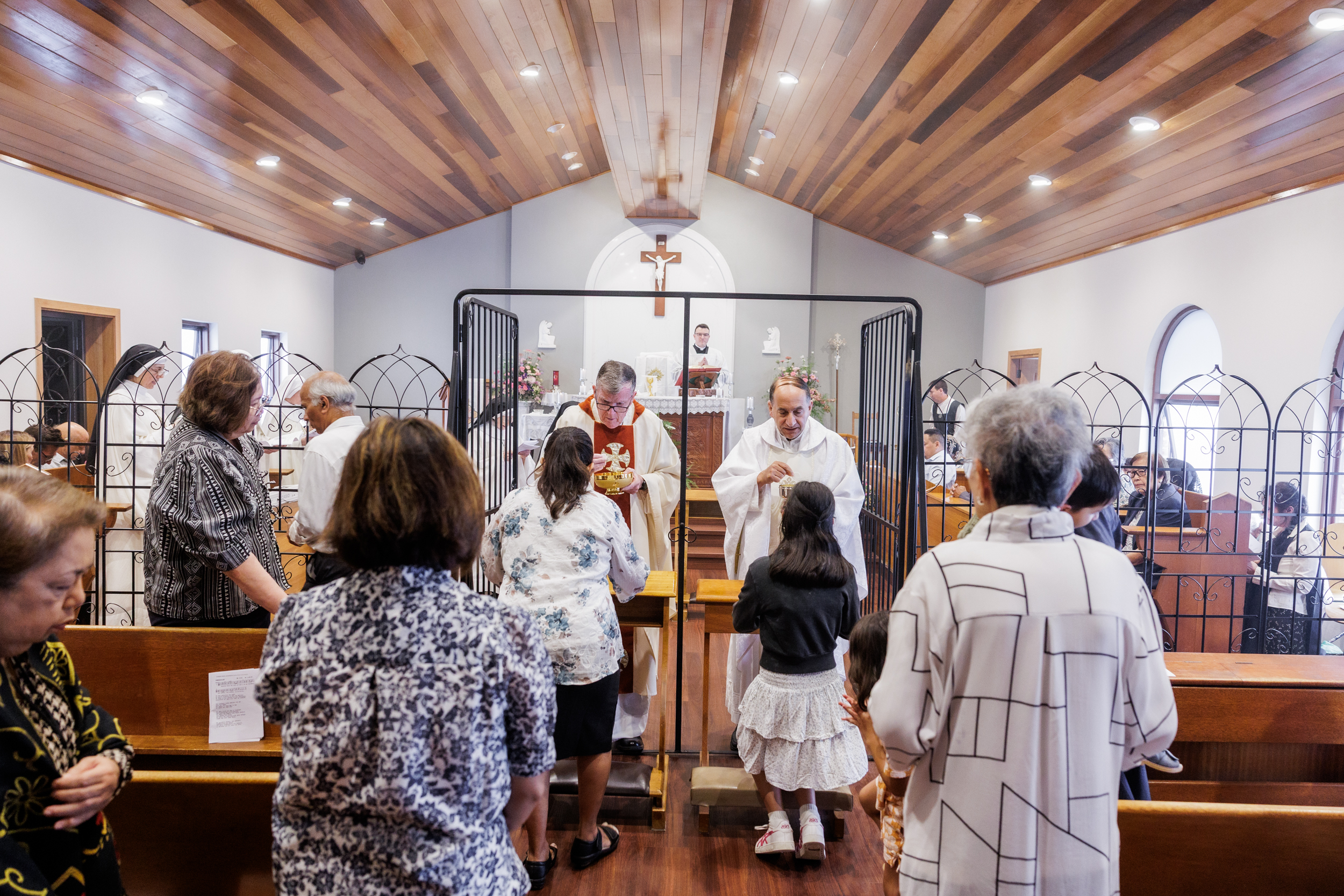


One of the last remaining enclosed monastic communities has accepted its newest member in a ceremony at the community’s new home in Kurmond, west of Sydney.
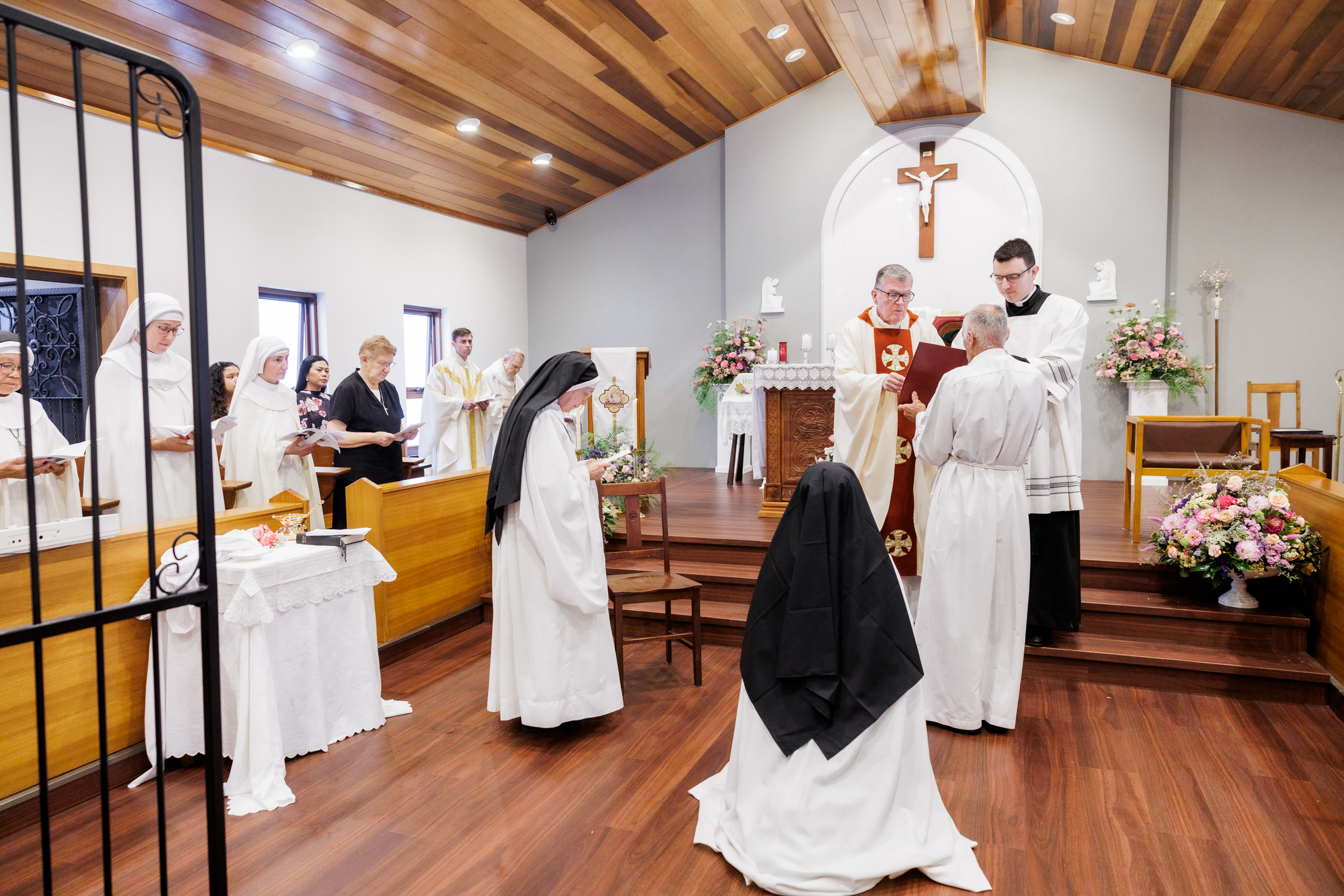
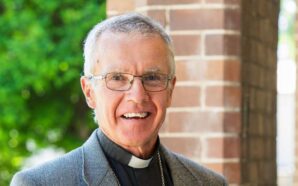
The Tyburn community of nuns, otherwise known as the Adorers of the Sacred Heart of Jesus of Montmartre, welcomed Sr M. Juliana at a solemn ceremony of Temporary Profession on 17 January, in front of her family and friends. The main celebrant was Vicar General of the Diocese of Parramatta, Fr Peter Williams AM.
For Sr Juliana, the ceremony marked the completion of her two-year novitiate, and before that her six months of postulancy, or preparation, before becoming a Sister. After three years as a Sister deepening her discernment and spiritual life, she will be eligible for Monastic Profession of Perpetual Vows.
She said since the lead up to her profession she has felt that God wants a deeper relationship with her. And on the day itself her overwhelming feeling was one of gratitude. “I was actually really relaxed and just so grateful for everything,” she said. “I didn’t really want to expect too much out of it. I just wanted to let the Lord do all the work.”
Living by The Rule
The nuns live by The Rule of St Benedict, which dictates they live a life of strict obedience, poverty, work and prayer – which they do seven times a day – separated from the world in cloistered contemplation. Community members all wear traditional habits and observe silence for much of the day. They are allowed visits by their family once a month. There are seven members living at the Kurmond Priory, in a manner little changed from the days when many religious communities lived that way.

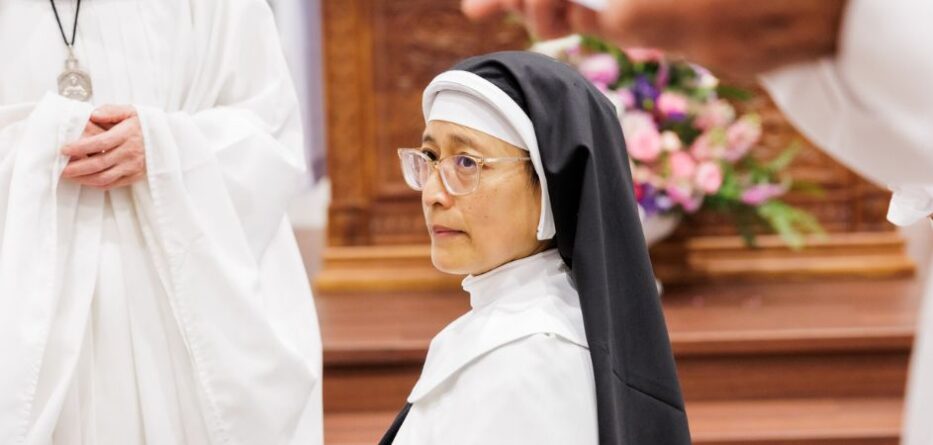
Sr Juliana kneeing during her profession. Image: Supplied
The community moved to the 33-acre property at Kurmond, just west of the Hawkesbury River, in 2024 from their previous home in Riverstone.
Sr Juliana said the biggest decision for her was not whether to join religious life, as “it was really the only place that God was leading me to”. Rather it was to which community should she join? Her central decision to join the Tyburns was their charism of Perpetual Adoration, which was very important to her. “It was the thing that made sense,” she said.
Another important influence was her uncle, a Benedictine Oblate, who had a deep connection with the Tyburn community when they were based at Riverstone. “His prayers helped me to enter,” she said.
The final factor was that the Tyburns followed a “middle path” that was not influenced by modern ideas. “I didn’t want to be modernised,” Sr Juliana said. “For me the Tyburns were a real order.”
A life closer to God
The process of accepting a new member begins with the initial period of postulancy where prospective nuns are given time to see if they can adapt to the strict rules and life of the priory. “We always encourage them, as they can find the life difficult,” says Prioress Mother Dominica OSB. “If someone becomes a postulant but does not have our vocation, the Lord will generally make it clear to them. It is good that women are willing to at least try our life – it is better than trying to discern their vocation without trying.”

Being fitted with her black veil, which she now wears as a sister. Image: Supplied
Sr Juliana likened learning to live under the Rule of St Benedict as not so much on-the-job training as training for life “because everything is different”.
“I had to relearn how I think, how I process things, because the way the world thinks isn’t always the way we have to think,” she said.
“We’re trying to elevate our thinking into this supernatural thinking, where we see God in everything, and that can be quite a long process. I’m still trying to see God in everything.”
She said following The Rule was important because it gave “guardrails” for living a life closer to God. “If we follow The Rule then we’re doing God’s will, so there’s this striving to live more faithfully by The Rule.

Sr Juliana was drawn to the Tyburn order because of their charism. Image: Supplied
“I’m always feeling like, ‘oh, I’m just not getting there’,” she said. “But at the same time, it’s not a depressing thing. It’s quite lovely because you can always talk to Our Lord, even if you don’t think you’re speaking the language that he wants you to speak.”
A busy schedule
Daily life at the priory begins in silence before sunrise. Their Morning Offering is said, then the nuns begin the Divine Office, a series of prayers which are spoken and sung throughout the day. It is only after Mass at 7am that they may talk, although only if it is necessary.
Adoration is held every day from 5am to 6pm or 8pm, and twice a week at night until 2am. Then there is other work to be done in the garden or elsewhere at the priory, which occupies several hours a day. Silence begins again in the evenings after Compline, the final Office, or prayer, of the day.

Sr Juliana and other Tyburn nuns in prayer. Image: Diocese of Parramatta
One of the daily tasks is to collate all the prayer intentions which come flooding in through emails and letters. Everyone who writes to them gets a reply.
“When we have a letter from the outside we answer it as soon as possible,” Mother Dominica said.
“It’s really very busy for us. We are not just nuns with nothing to do.”