

Homily for the 5th Sunday of Lent
Readings: Ezekiel 37:12-14; Psalm 130; Romans 8:8-11; John 11:1-45
Listen at Soundcloud.
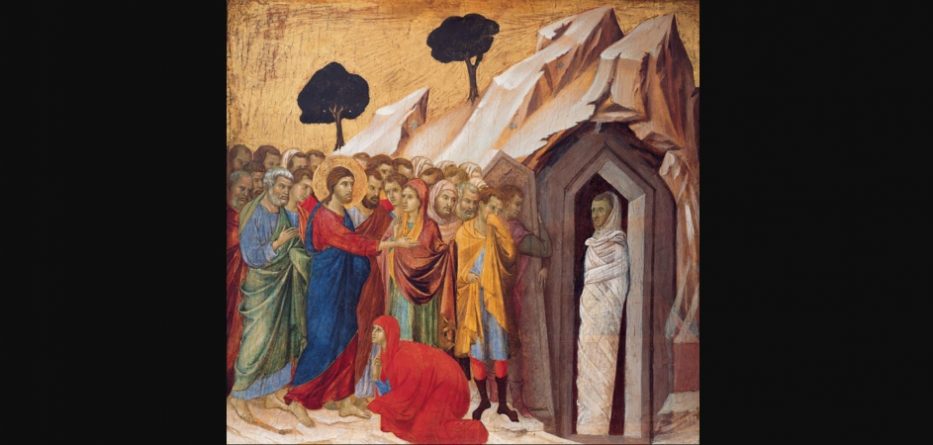
The raising of Lazarus ends with the great declaration from Jesus at the entrance to the tomb: ‘Unbind him, let him go free.’ I daresay we are all feeling bound down at this time with the ongoing uncertainty and catastrophe playing out in the Middle East where neither morality nor law counts for much – a catastrophe impacting on everyone, even those of us on the other side of the world, and impacting on us, not just at the petrol bowser. We long to be set free. We long for life, peace and security in our broken world. But how can we be set free? Who can set us free?
John the evangelist is the master story teller. He describes how Jesus when approaching the closed tomb issued the command: ‘Take away the stone’. When Jesus cries out in a loud voice, ‘Lazarus, here! Come out!’, Lazarus emerges with ‘his feet and hands bound with bands of stuff and a cloth around his face.’
Fast forward to the scene following the entombment of Jesus after his own passion and death. Mary of Magdala arrives at the tomb and sees ‘that the stone had been moved away from the tomb’. Then Peter and the other unnamed disciple arrive at the tomb. The other disciple, arriving first, sees ‘the linen cloths lying on the ground’. Peter then arrives and goes right into the tomb. He sees ‘the linen cloths on the ground, and also the cloth that had been over his head; this was not with the linen cloths but rolled up in a place by itself.’
John is not just presenting us with comparative laundry lists from the tomb of Lazarus and the tomb of Jesus. Lazarus is alive at the entrance of his tomb, having been called forth by Jesus. Jesus’ body is nowhere to be seen at the entrance of his tomb. John wants us to understand that Jesus is the one sent by the Father who has raised Lazarus. Jesus the one sent by the Father then raises himself, removing the stone, untying his own burial cloths and rolling up the cloth which covered his head placing it on its own. The absent body of Jesus could not have been stolen. Thieves would not have removed the linen cloths and rolled up the head cloth and placed it on its own. Neither would any other persons have done so. It could only have been Jesus himself, the one sent by the Father, who unbound himself and set himself free. Though there be no body, we know that Jesus lives, unbound and free.
In the Preface of today’s mass, we proclaim of Jesus: ‘For as true man he wept for Lazarus his friend and as eternal God raised him from the tomb, just as, taking pity on the human race, he leads us by sacred mysteries to new life.’
John goes to great lengths to impress on us the ordinary human friendship of Lazarus and Jesus: ‘Now Jesus loved Martha and her sister and Lazarus’; ‘Our friend Lazarus is asleep’; ‘And Jesus wept’; ‘So the Jews said, “See how he loved him.”’
Yet when Jesus receives news of the illness of Lazarus, he waits another couple of days. He then sets out for Bethany near Jerusalem – the place where the religious authorities were already plotting his death. He sets out on the path to his own death while setting out to bring Lazarus back to life. He tells Martha: ‘I am the resurrection and the life; whoever believes in me, even if he dies, will live, and everyone who lives and believes in me will never die.’
In a short story entitled ‘News from Dublin’, Irish novelist Colin Toibin tells the story of Maurice who confronts his failure to secure medication for his dying brother. Maurice goes into a church and ponders ‘extinction, the great change beyond imagining, which nobody knew about for sure, no matter how strong their faith was, no matter how hard they prayed’. In today’s gospel, Martha says to Jesus, mourning the death of her brother: ‘If you had been here, my brother would not have died, but I know that, even now, whatever you ask of God, he will grant you.’
The familiar love Jesus had for Lazarus, Martha and Mary is the same familiar love he has for you and me. The divine love Jesus had for Lazarus, Martha and Mary is the same divine love he has for you and me. Taking pity on us, he leads us by sacred mysteries to new life. He unbinds us, letting us go free. Today, he offers us freedom and consolation; and in future, the life to come.
With the Lord there is mercy and fullness of redemption.
I trust in the Lord;
my soul trusts in his word.
More than sentinels wait for the dawn,
let Israel wait for the Lord.
With the Lord there is mercy and fullness of redemption.
For with the Lord is kindness
and with him is plenteous redemption;
And he will redeem Israel
from all their iniquities.
With the Lord there is mercy and fullness of redemption.
Fr Frank Brennan SJ AO, Adjunct Professor of Thomas More Law School at ACU and Adjunct Research Professor at the Australian Centre for Christianity and Culture, is a former Rector of Newman College, University of Melbourne, and CEO of Catholic Social Services Australia (CSSA). His latest books include Pope Francis: the Disruptive Pilgrims Guide (ATF Theology, 2025), and Gerard Brennan’s Articles and Speeches: Maintaining the Law’s Skeleton of Principle (2 volumes) (Connor Court, 2025).