

From April 13 to 23, 2026, Pope Leo XIV traveled to Algeria, Cameroon, Angola and Equatorial Guinea on his first apostolic journey to Africa. Over the course of 11 days, he took 18 flights and delivered 25 talks, including speeches, homilies and greetings. The pope spoke in four different languages – English, French, Portuguese and Spanish – depending on the official languages of the countries he visited. In Algeria, where the official language is Arabic, he spoke English and, above all, French. He encouraged the small local Catholic community in this country, traced the roots of the Augustinian family, and took up a leading role in the dialogue with the Muslim world. In Cameroon, Angola and Equatorial Guinea, he met a predominantly Christian population and a Church that celebrates and lives its faith not only with joy and hope, but also with a missionary spirit.
Algeria: ‘Simple gestures, genuine relationships and a dialogue lived out day by day’
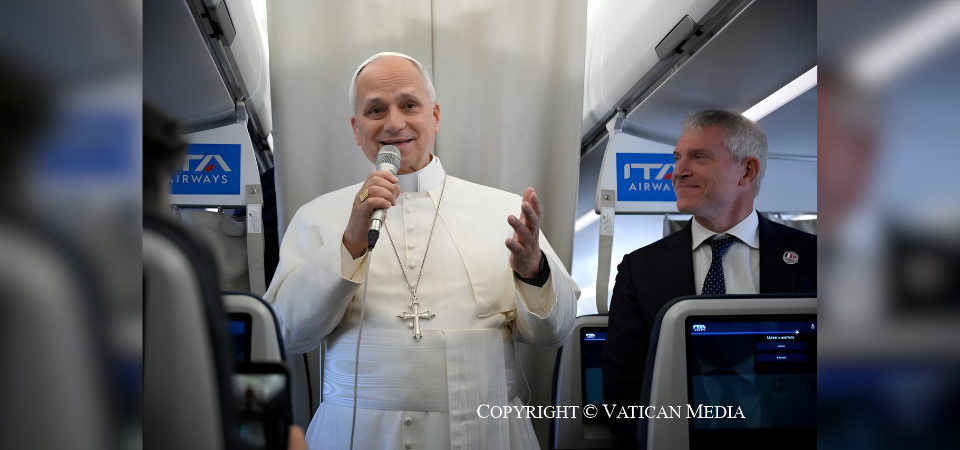
On the morning of April 13, 2026, Pope Leo XIV, accompanied by his entourage and a group of about 70 journalists, departed from Fiumicino Airport on a special ITA Airways flight bound for Algiers.[1] Thus began his third apostolic journey and his first to Africa. During the stop in Algeria – the first time a pope has visited this country – the motto was “Peace be with you,” rendered in Arabic as the greeting As-salamu alaykum. Words that evoke dialogue and encounter between Christians and Muslims, numerically disproportionate, but no less significant for that. In fact, in a population of about 47 million, Catholics are a small minority of approximately 9,000 faithful in a country with an overwhelming Muslim majority.
Upon his arrival at Algiers Airport, he was greeted by the President of the Republic, Abdelmadjid Tebboune. After the welcome ceremony, he visited the Martyrs’ Memorial, a monument inaugurated in 1982 to mark the 20th anniversary of independence from France. There, the pope addressed the Algerian people, recalling his two previous visits as an Augustinian friar and introducing himself, upon his return as the successor of the Apostle Peter, as a brother. He then evoked Algeria’s long and rich history, though marked by periods of violence, and spoke of peace, linking it to reconciliation and forgiveness. This was the first of many appeals for peace that the pope made during his trip to Africa.[2]
This was followed by a courtesy call on the President of the Republic at the El Mouradia Palace. Leo XIV then proceeded to the Djamaa el Djazair Convention Center, where a meeting was held with government officials, civil society representatives, and the diplomatic corps. After the address given by the President of the Republic, Pope Leo XIV revisited and elaborated on several themes addressed at the Martyrs’ Memorial, including peace, fraternity, encounter and reconciliation. He also acknowledged the generosity and hospitality of the Algerian people, which have their roots in the Arab and Berber communities, and then touched on the vicissitudes of Algeria’s history, stating that it will be able to contribute to both envisioning and bringing about greater justice among peoples,” a task all the more urgent “in the face of continuous violations of international law and neocolonial tendencies.” He also urged the authorities to promote “a vibrant, dynamic and free civil society, in which young people in particular are recognized as capable of helping to broaden the horizon of hope for all.” Significantly, he also referred to the Mediterranean and the Sahara, which define Algeria’s geography, as “geographical and spiritual crossroads” hosting “immense treasures of humanity.” Therefore, he warned, “woe to us if we turn them into graveyards where hope also dies!” A clear reference to human trafficking and the exploitation of migrants. Finally, the pontiff issued an appeal for “the healing of memory and reconciliation among former adversaries,” a gift he asked for on behalf of the entire Algerian people.
To end the morning, Leo XIV went to the apostolic nunciature, his residence in Algeria. His first stop in the afternoon took him to the Great Mosque of Algiers, which can accommodate 120,000 worshippers, where he was welcomed by the rector of the vast religious complex. He then visited the Center for Hospitality and Friendship of the Augustinian Missionary Sisters of Bab El Oued to pay tribute to the memory of two nuns from this community who, during the Algerian Civil War, were among the 19 martyrs killed between 1994 and 1996. At the end of the visit, the pontiff went to the Basilica of Our Lady of Africa, built on a 124-meter-high promontory north of downtown Algiers and inaugurated in 1872. It was here that the meeting with the Algerian community took place.
Following the welcoming remarks by the Archbishop of Algiers, the pope listened to four testimonies which, given the diversity of their backgrounds – not only Catholic, but also Pentecostal and Muslim – aptly represented the daily life of the Church in Algeria, characterized by encounter, dialogue and service to the needy. In his address, Leo XIV, after recalling the ancient roots of Christianity in Algeria as well as the martyrs of the 20th century, reaffirmed the importance of prayer, charity and unity as pillars of the Christian presence in the country. The communion between Christians and Muslims, under the mantle of Our Lady of Africa, was also evoked with meaningful words: “In a world where division and wars sow pain and death among nations, in communities, and even within families, your experience of unity and peace is a compelling sign. Together, you spread fraternity.” After the meeting, Leo XIV returned to the Nunciature, where he met with the bishops of Algeria.
The following day, April 14, was dedicated to Annaba, ancient Hippo on the northeastern coast of Algeria, which the pope reached via a special Air Algérie flight. St. Augustine served as bishop of this city in the early 5th century, making it the spiritual home of the Augustinian family. Pope Leo XIV visited the archaeological site of ancient Hippo and went to the home of the Little Sisters of the Poor, who care for about forty elderly people in need, mostly Muslims. At the conclusion of this visit, he was welcomed at the house of the Augustinian community, which has been in charge of the Basilica of St. Augustine since 1933; there he spoke with the religious and stayed for lunch.
In the afternoon, still in the Basilica of St. Augustine, Leo XIV presided over the Eucharistic celebration that concluded the pilgrimage to Annaba. During his homily, while reflecting on the encounter between Jesus and Nicodemus, he invited everyone to be born again from above. St. Augustine, he continued, is an example of this rebirth, first through his conversion and then through his wisdom. He then made a heartfelt appeal to everyone: “Bear witness to the Gospel through simple gestures, genuine relationships and a dialogue lived out day by day: in this way, you bring flavor and light to the places where you live.” After the celebration, Leo XIV returned to Algiers. The next day, April 15, he made a brief visit to the Notre Dame d’Afrique nursery school run by the Missionary Sisters of Charity and proceeded to the international airport, where he bid farewell to the President of the Republic and departed for Cameroon.
Cameroon: ‘In God, in His peace, we can always begin anew’
Cameroon has a population of approximately 29 million, 29 percent of whom are Catholic. A former German protectorate, the territory was divided in 1920 between France and the United Kingdom. The Republic of Cameroon was established in 1961 through the reunification of the French part, which had gained independence the previous year, with the southern area of the British part. Initially, a federal system helped ensure respect for the identity of the two territories. Subsequently, the establishment of a unitary state disrupted this balance. In this context, since 2016 the Anglophone region has been the scene of a violent crisis that has already caused thousands of deaths and the displacement of over one million people.[3] Meanwhile, the far northern regions of the country remain exposed to jihadist violence, which carries out attacks against religious communities, including Muslims who do not accept extremist ideology. Reflecting the complexity of this situation, the motto of the trip, “May they all be one,” already foreshadowed the core of the message the pope wished to convey to the Cameroonian people.
On the afternoon of April 15, the plane carrying Leo XIV landed at the international airport in Yaoundé, the country’s capital. Prime Minister Joseph Dion Ngute welcomed the Pope Leo XIV, who then went to the Unity Palace for a courtesy visit with the President of the Republic, Paul Biya, who has been in office since 1982, and for a meeting with government officials, civil society and the diplomatic corps. Following President Biya’s welcoming remarks, Pope Leo XIV delivered his address, stating that he had come “as a shepherd and as a servant of dialogue, fraternity, and peace.” He then shared his desire to “reach the hearts of all, especially young people, who are called to help shape a world that is more just, including in the political sphere.” Pope Leo XIV then referred to the tensions and violence in certain regions of Cameroon, which cause “profound suffering: lives have been lost, families displaced, children deprived of schooling and young people no longer see a future.” Faced with such a situation, the pope urged people to embrace peace and to “build lasting solutions to problems,” involving civil society, “a vital force for national cohesion.”
Continuing his remarks, Leo acknowledged that security is “a priority, but it must always be exercised with respect for human rights.” He then asked the authorities listening to him to bear witness in two ways: through cooperation between state institutions in the service of the people, especially the poorest; and through integrity of life as a requirement of their responsibilities. He also made an explicit appeal regarding corruption: “The chains of corruption — which disfigure authority and strip it of its credibility — must be broken.” Finally, the pope called for “investing in the education, training and entrepreneurship of young people” as a “strategic choice for peace” and made clear that the Catholic Church “wishes to work in good faith with civil authorities and all those involved in efforts to promote human dignity and reconciliation.” At the end of the meeting, Leo XIV visited the Ngul Zamba Orphanage and, late in the afternoon, met with the bishops of Cameroon at the headquarters of the episcopal conference. He then went to the apostolic nunciature for a private dinner and to spend the night.
The following day, April 16, was entirely devoted to Bamenda, a city located at an altitude of 1,600 meters in the English-speaking region of Cameroon, where the pope arrived on a special flight operated by Camair-Co. Here, in the morning, a meeting for peace took place at St. Joseph’s Cathedral. Following the welcome by the Archbishop of Bamenda, several testimonies were shared regarding the dramatic conflict in the region, its consequences, and efforts to promote peace. In his address, Leo XIV stated with emotion: “I am here to proclaim peace. Yet I find it is you who are proclaiming peace to me, and to the entire world.” In this regard, he recalled that the crisis in the region has brought Christian and Muslim communities closer together, leading to the founding of a Peace Movement that seeks to mediate between the opposing sides. The pope then recalled that “blessed are the peacemakers,” adding forcefully: “But woe to those who manipulate religion and the very name of God for their own military, economic or political gain, dragging that which is sacred into darkness and filth.” At the conclusion of the meeting, in the cathedral square, the pope and other leaders present released seven white doves, a symbol of the peace desired by all. The pontiff then proceeded to the Archbishop’s Palace in Bamenda for a private lunch.
In the afternoon, a Mass for peace and justice was held at the city’s airport, attended by approximately 20,000 faithful. During his homily, the pope referred to the tension between hope for a future of peace and reconciliation and the many problems, among which he listed: “the numerous forms of poverty […]; moral, social and political corruption […]; the serious problems affecting the education and healthcare systems, as well as the large-scale migration to foreign countries, particularly of young people.” To these internal issues, the pope explicitly added “the damage caused from outside, by those who, in the name of profit, continue to lay their hands on the African continent to exploit and plunder it.” He used the same clarity in the appeal he made afterward: “The time has come, today and not tomorrow, now and not in the future, to restore the mosaic of unity […], to create a society in which peace and reconciliation reign.” At the end of the Eucharistic celebration, the pope took his leave of the local authorities and returned to Yaoundé.
The morning of the following day, April 17, was dedicated to Douala, which Leo XIV reached via a special flight operated by ITA Airways. The city is located on the Gulf of Guinea and is considered the country’s commercial capital. The Eucharistic celebration took place in the parking lot adjacent to the Japoma Stadium, in the presence of approximately 120,000 faithful. In his homily, the pope reflected on the multiplication of the loaves and fishes, as recounted in the Gospel of John (cf. John 6:1-15). Faced with very little food for the great crowd following him, Jesus blesses what is there and distributes it. “The multiplication of the loaves and the fish happened while sharing: that is the miracle!” the pope affirmed, before explaining: “There is bread for everyone if it is taken, not with a hand that snatches away, but with a hand that gives.” To the need for food for the body, he reiterated, we must add the “nourishment for the soul, a nourishment that sustains our conscience […]. This food is Christ himself, who always gives his Church abundant sustenance and strengthens us on our journey by giving us his Eucharistic Body.” The pope then addressed a special message to young people, encouraging them to be “the first faces and hands that bring the bread of life to your neighbors,” and inviting them not to give in to mistrust and discouragement. Finally, asking young people to be “good news” for their country and to safeguard the values of their people, he concluded: “Be, therefore, protagonists of the future, following the vocation that God gives to each of you. Do not let yourselves be corrupted by temptations that squander your energy and do not serve the progress of society.”
At the conclusion of the celebration, Leo XIV paid a private visit to the Catholic Saint Paul Hospital, after which he returned to the airport to fly back to Yaoundé in the early afternoon. The day concluded with a meeting with the academic community at the Catholic University of Central Africa. Greeted with great enthusiasm, after the rector’s words of welcome and the testimonies of two students, the pope addressed the academic community. He emphasized the need for “universities – and all the more so Catholic institutions of higher learning – to become true communities of life and research, introducing students and professors alike to a fraternity in knowledge.” Faced with the need to “broaden the overly narrow horizons of a humanity that struggles to hope,” he then urged researchers “to open themselves to interdisciplinary, international and intercultural perspectives.” In particular, he invited the University to “form consciences that are free and endowed with a holy restlessness,” “a condition for the Christian faith to appear as a fully human proposal. Such a faith is capable of transforming the lives of individuals and of society.” Faced with the erosion of moral reference points and the “new things” that should not be feared, the pope asked the university to “form pioneers of a new humanism in the context of the digital revolution. While the African continent is well acquainted with its alluring aspects, it also knows the darker side of the environmental and social devastation caused by the relentless pursuit of raw materials and rare earths.”
Addressing the students, Leo XIV acknowledged the “understandable tendency to migrate, which may lead one to believe that elsewhere a better future may be more easily found.” He countered this tendency with a request: “I invite you, first and foremost, to respond with an ardent desire to serve your country and to apply the knowledge you are acquiring here to the benefit of your fellow citizens.” And to the faculty, he asked: “As well as being intellectual guides, be role models whose scientific rigor and personal integrity form the consciences of your students.” Finally, his last recommendation concerned humility, the principal virtue that must animate the entire university community, because “we are all disciples, that is, fellow learners with one Teacher.” At the end of the day, Leo XIV returned to the Nunciature.
The following morning, April 18, the pope went to Yaoundé-Ville Airport, where he presided over a Mass attended by some 200,000 faithful. In his homily, he encouraged the faithful, drawing inspiration from the words of Jesus who, walking on the water, said to his disciples: “It is I; do not be afraid” (John 6:20). “This is why,” he continued, “we can get up again after every fall, not allowing ourselves to be stopped by any tempest. Rather we go forward always with courage and trust.” He then recalled the social dimension of faith, noting that “what is needed is a communal commitment, which integrates the spiritual and moral dimensions of the Gospel in the heart of local institutions and structures, making them instruments for the common good.” At the end of the celebration, the pope went to Yaoundé International Airport, where he bid farewell to the President of the Republic. He was then accompanied by the Prime Minister to the plane that would take him to Luanda.
Angola: ‘The grace to start afresh and rebuild the future’
Angola has approximately 38 million inhabitants, 41 percent of whom are Catholic. A “large country south of the equator, with a centuries-long Christian tradition, linked to Portuguese colonization,”[4] as Pope Leo XIV recalled on April 29 during the general audience in which he recounted the stages of his trip to Africa. After gaining independence from Portugal in 1975, the country suffered the tragic consequences of a civil war that lasted until 2002, destroying essential infrastructure and crippling the economy. Worn down by the conflict, the population sought refuge in the cities, particularly Luanda, the capital, which today is a large metropolis with about 8 million inhabitants, many of whom live in conditions of great precariousness, despite the country’s natural resources. The motto of the apostolic journey is therefore significant; referring to the pope’s visit, it described him as a “pilgrim of hope, reconciliation and peace.”
In the early afternoon of April 18, the plane carrying Pope Leo XIV landed at Luanda International Airport, where he was welcomed by the President of the Republic, João Lourenço, who has been in office since 2017. From the airport, greeted throughout by people lining the streets, the pontiff proceeded to the Presidential Palace for a courtesy visit with the President of the Republic and, subsequently, to the Protocol Pavilion for a meeting with authorities, civil society, and the diplomatic corps. Here, after the President’s greeting, Leo XIV delivered his address, referring first and foremost to the “treasures that cannot be bought or taken away” of the Angolan people, in particular the “joy that not even the most adverse circumstances have been able to extinguish.” He then broadened his perspective to encompass all of Africa, stating that she is “a reservoir of joy and hope for the entire world” – virtues he described as “political” – because “her young people and her poor continue to dream and to hope. They are not content with what already exists; they strive to rise above, to prepare themselves for great responsibilities, and to take an active part in shaping their own future.”
Leo XIV then referred to “the material riches upon which powerful interests lay their claim,” noting “how much suffering, how many deaths, how many social and environmental disasters are brought about by this logic of extractivism!” He then invited everyone to engage in encounter and dialogue, without fear of dissent, without stifling the visions of the young and the dreams of the elderly, and knowing how to manage conflicts so that they may be transformed into paths of renewal. Reiterating once more that joy and hope are hallmarks of the Angolan people, the pontiff warned against the “despots and tyrants of both body and spirit” who “seek to render souls passive and passions gloomy; they prefer a populace prone to inertia, docile and subservient to power.” Finally, he urged those present to “make Angola a project of hope” in which the Catholic Church “desires to be leaven in the dough and to foster the growth of a just model of coexistence.” After the ceremony concluded, the pope went to the apostolic nunciature for a meeting with the bishops of Angola and to spend the night.
The following day, April 19, Leo XIV presided over Sunday Mass on the esplanade of Kilamba, a new neighborhood on the outskirts of Luanda, in the presence of some 100,000 faithful. During his homily, he compared the discouragement of the disciples of Emmaus (cf. Luke 24:13-35) to the recent history of Angola, a “beautiful yet wounded country, which hungers and thirsts for hope, peace and fraternity.” Angolans too, the pope said, can recall the pain of “a long civil war with its aftermath of enmities and divisions, of squandered resources and poverty” and be tempted to “lose hope and remain paralyzed by discouragement.” Instead, the pontiff continued, the Risen Jesus, just as he did with the disciples of Emmaus, opens our eyes, “granting us the grace to start afresh and rebuild the future.” Finally, he urged everyone to “build together a country where old divisions are overcome once and for all, where hatred and violence disappear, and where the scourge of corruption is healed.” Only in this way, he concluded, “will a promising future be possible, especially for the many young people who have lost hope.”
In the afternoon, Pope Leo XIV traveled by helicopter to the shrine of Mamã Muxima (“Mother of the Heart”), the country’s principal Marian center, located 130 km from Luanda, where an ancient image of the Immaculate Conception is venerated. The church was built in the 16th century by the Portuguese on the banks of the Kwanza River, which flows majestically nearby amid the lush greenery of the forest. On the esplanade in front of the shrine, the pope presided over the recitation of the Rosary as night fell rapidly, as is typical in equatorial regions. Addressing the approximately 30,000 faithful present, he recalled that, in Muxima, many people have prayed “in times of joy and also in moments of sorrow and great suffering” throughout the country’s history. He then continued, stating that reciting the Rosary “commits us to loving every person with a mother’s heart – concretely and generously – and to dedicating ourselves to the good of one another, especially the poorest.” This is what “the heart of Mary – the heart of the Mother of all – teaches us,” the pontiff emphasized. At the end of the celebration, he returned to Luanda, to the apostolic nunciature.
The following day, April 20, Pope Leo XIV departed from Luanda Airport on a special flight operated by the Angolan airline TAAG bound for Saurimo. Located 945 km from Luanda in the northeast of the country, the city sits at an altitude of 1,081 meters and is the capital of the province of Lunda Sul, where the economy is based primarily on diamond mining and agriculture. After his arrival, the pope visited a nursing home for the elderly, followed by a brief prayer stop at the cathedral; he then proceeded to the esplanade for the Eucharistic celebration, in the presence of approximately 60,000 faithful. In his homily, referring to Jesus’s request to his listeners to seek “the food that endures for eternal life” (John 6:27), the pontiff recalled how “in Him the proclamation of our resurrection finds its voice.” This is not disconnected from earthly life, for “every form of oppression, violence, exploitation and dishonesty negates the resurrection of Christ.” Moreover, he continued, “liberation from death, in fact, does not happen only at the end of our days, but every day of our lives.” Listening to the cry of the peoples, Christ “lifts us up from every fall, comforts us in every suffering, and encourages us in our mission,” the pope summarized. Finally, recalling the witness of the martyrs and saints, he reiterated that it “pushes us onto a path of hope, reconciliation and peace,” as the motto of the apostolic journey’s Angolan leg states.
After spending the morning in Saurimo, Leo XIV returned to Luanda, where he went to the parish of Our Lady of Fatima, run by the Capuchin friars, for a meeting with bishops, priests, men and women religious, and pastoral workers. After listening to several testimonies, the pope addressed the assembly with words of thanks for the work of evangelization carried out in the country, “for the hope in Christ sown in the hearts of our brothers and sisters,” and “for your charity to those most in need.” He then encouraged the many young people in seminaries and houses of formation, stating: “Do not be afraid to say ‘yes’ to Christ, to model your lives entirely on his!” He also made a point of mentioning catechists, acknowledging their role, which in Africa “is a fundamental expression of the life of the Church.” To everyone, the pontiff wished to recall the importance of the contemplative dimension, without which “we no longer live in conformity with the Gospel, nor do we reflect the power of the Resurrection.” Significant were the references to service to society, particularly to the proclamation of peace. In the past, the pope said, the Church has “shown courage in denouncing the scourge of war.” Now, it must promote “a renewed sense of reconciliation by educating everyone in the ways of peace” and forgiveness. Finally, the pontiff encouraged the Church to continue to be generous and to cooperate in the integral development of the country, particularly in the fields of education and healthcare: “May God bless you and make your commitment and mission fruitful!” After the meeting, the pope returned to the nunciature, where he spent his last night in Angola.
The following day, April 21, at Luanda International Airport, Pope Leo XIV bid farewell to the President of the Republic and departed for Malabo, in Equatorial Guinea, to begin the final leg of his apostolic journey.
Equatorial Guinea: ‘Toward a Future of Hope’
Equatorial Guinea has a population of approximately 1.98 million, 75 percent of whom are Catholic. It gained independence from Spain in 1968. The country possesses oil reserves that provide it with significant financial resources, but at the same time, there are major social inequalities. Until January 2, 2026, Malabo, on the island of Bioko (formerly Fernando Pó), was the country’s capital and remains its main social and economic hub. Since that date, the role of capital has passed to Ciudad de la Paz, located on the mainland. Still under construction, the country’s administration is expected to move to the new city within a year. The motto of the trip was: “Christ, Light of Equatorial Guinea, Towards a Future of Hope.”
Late in the morning of April 21, the plane carrying Pope Leo XIV landed at Malabo International Airport, where he was welcomed by the President of the Republic, Teodoro Obiang Nguema Mbasogo, who has been in power since 1979. The pope then proceeded to the Presidential Palace for a courtesy visit and to meet with government officials, civil society representatives, and the diplomatic corps. Following the President’s address, Pope Leo spoke, alluding to the project to build the country’s new capital and asking that everyone reflect on which city they wish to serve. He recalled that St. Augustine “holds that Christians are called by God to dwell in the earthly city while keeping their hearts and minds turned toward the heavenly city, their true homeland.” Consequently, it is essential that everyone discern “the difference between that which lasts and that which passes, remaining free from the pursuit of unjust wealth and the illusion of dominion.”
The pope then referred to the Church’s social doctrine as a “guidance to all who seek to address the ‘new things’ that destabilize our planet and human coexistence.” In this very sense, he reiterated that it is part of the Church’s mission “to contribute to the formation of consciences through the proclamation of the Gospel, the provision of moral criteria and authentic ethical principles, all while respecting individual freedom and the autonomy of nations and their governments.” On armed conflicts, Leo XIV used sharp words, stating that their proliferation “is often driven by the exploitation of oil and mineral deposits, occurring with no regard for international law or the self-determination of peoples.” Finally, he urged Equatorial Guinea “to evaluate its own paths of development and the positive opportunities of positioning itself on the international stage in the service of law and justice.” At the conclusion of the ceremony and after a brief stop at the cathedral, the pope proceeded to the Archbishop’s Palace, his residence during his stay in this country.
In the afternoon, Leo XIV visited the National University for the inauguration of the new campus, which bears his name, and to meet with representatives of the cultural community. After welcoming remarks by the rector and testimonials from a student, a professor, and a representative of the cultural community, he delivered his address. Comparing the university’s mission to a great tree with deep roots, he emphasized that it is the university’s duty to be “an institution well rooted in the seriousness of study, in the living memory of a people, and in the persevering search for truth,” a truth that is not fabricated, not manipulated nor possessed like a trophy, but welcomed, sought with humility and served with responsibility.
At the end of his visit to the university, Pope Leo XIV went to the Jean-Pierre Olie Psychiatric Hospital, where he was welcomed by the administrators, staff and patients. In his brief remarks, the pope shared the mixed feelings he experiences when visiting a hospital or a care facility: “On the one hand, I feel the pain or sadness of those people who are suffering” and for their families; “However, I admire and am comforted by all that is done there each day to serve human life.” He also chose to echo the words the director of the institution had spoken in his opening remarks: “A truly great society is not one that hides its weaknesses, but one that surrounds them with love.” Finally, he defined the mission of a hospital, especially one of Christian inspiration: “a place where a person is welcomed just as they are and respected in their frailty, so that they can be helped to get better according to a holistic vision” in which the spiritual dimension is essential. The visit to the hospital marked the end of the pontiff’s public engagements on his first day in Equatorial Guinea. A private meeting with the country’s bishops awaited him upon his return to the Archbishop’s Residence.
The following day, April 22, Leone XIV departed for Mongomo – located in the country’s mainland region, about 320 km from Malabo – on a special flight operated by the local airline CEIBA Intercontinental. The city, nestled in the forest, has become an important economic hub since the discovery of oil in the 1990s. Upon arrival, the pope went to the Basilica of the Immaculate Conception, the largest religious building in Central Africa, to celebrate Mass in the presence of about 10,000 faithful. In his homily, he recalled the 170 years of evangelization in the country, stating that such a history makes the bond with the universal Church visible and now requires the responsibility to become “protagonists in proclaiming the Gospel and bearing witness to the faith.” Therefore, he continued, addressing the assembly directly: “Each and every one of you is invited to make a personal commitment that encompasses your entire life, so that the faith – celebrated so joyfully in your communities and in your liturgies – may also nourish your charitable works and the sense of responsibility toward your neighbor, for building up the common good.” It is a commitment, he reiterated, that “requires perseverance; it demands effort and, at times, sacrifice. Yet it is the sign that we are truly the Church of Christ.”
At the end of the celebration, the pope visited the Escuela Tecnológica Papa Francisco. After a private lunch at the bishop’s residence, Leo XIV boarded a plane once again, heading for Bata, a coastal city founded in the 17th century by the Portuguese, where the French later arrived, followed by the Spanish. From the airport, after a brief prayer stop at the cathedral, the pope reached the Bata prison, where, during his meeting with the inmates, one of the most moving moments of the entire trip took place. Leo XIV himself mentioned it when he reflected on his trip to Africa during the general audience on April 29 in St. Peter’s Square, stating that he could not forget it: “The prisoners sang at the top of their voices a song of thanksgiving to God and to the pope, asking him to pray ‘for their sins and their freedom.’ I had never seen anything like it. And then they prayed the ‘Our Father’ with me in the pouring rain. A genuine sign of the Kingdom of God!”[5] In his greeting to the prisoners, the pontiff drew close to them, stating: “Life is not defined solely by one’s mistakes, which are often the result of difficult and complex circumstances. There is always the possibility to start over, learn and become a new person. […] Do not let the past rob you of hope for the future.”
It was a long day in Bata. After visiting the inmates, Pope Leo XIV paused briefly to pray in front of the memorial to the explosion at a military barracks on March 7, 2021, in which at least 107 people died. He then arrived at the stadium in Bata for the meeting with young people and families, which took place in the rain. After listening to testimonies and songs, the pope addressed those present, beginning spontaneously: “Who is afraid of the rain? Who wants God’s blessing? Thank you for being here; We are going to continue celebrating! The Church needs your enthusiasm!” Still referring to the testimonies he had heard, Pope Leo XIV encouraged the young people who had said yes to a life consecrated to God as priests, religious sisters, religious brothers, or catechists, as well as those preparing for the sacrament of marriage. He asked everyone to let themselves be “inspired by the beauty of love” and to become “witnesses to the love that Jesus has left us and taught us!” After the meeting, the pope went to the airport and returned to Malabo.
The following day, April 23, Leo XIV presided over Mass at the Malabo stadium in the presence of some 30,000 faithful. During his homily, he encouraged the assembly to deepen their reading of the Word of God, which “is always both a personal and an ecclesial act; it is never something done in isolation or in a merely mechanical way” as well as to give thanks for the Eucharist, “the bread of eternal life” that gives us eternal life. At the end, he offered further words of encouragement: “I encourage all of you, as the living Church in Equatorial Guinea, to carry on the mission of Jesus’ first disciples with joy. As you read the Gospel together, proclaim it with passion, just as the deacon Philip did. And as you celebrate the Eucharist together, bear witness through your lives to the faith that saves, so that God’s word may become good leaven for all.”
In his closing remarks at the end of the celebration – which also marked the conclusion of his long apostolic journey to Africa – the pope offered his own personal summary, saying: “I leave Africa with an immeasurable treasure of faith, hope and charity: a great treasure consisting of stories, faces and testimonies, both joyful and sorrowful, which will greatly enrich my life and ministry as the Successor of Peter.” Subsequently, Leo XIV arrived at Malabo Airport, bid farewell to the President of the Republic, and departed for Rome, where he landed in the evening.
***
As the pope stated during the press conference on the flight back to Rome, “this trip should be understood above all as an expression of the desire to proclaim the Gospel, to proclaim the message of Jesus Christ.” In fact, in his remarks, Leo XIV began with the centrality of the Gospel and the following of Christ, while at the same time reminding his audience that faith has social, economic and political implications. Therefore, he spoke candidly, proclaiming, denouncing, suggesting and encouraging his listeners. He spoke openly about poverty, the unjust distribution of wealth, corruption, conflicts, neocolonialism and the exploitation of natural resources. And he called for peace, reconciliation and hope, often addressing young people in particular.
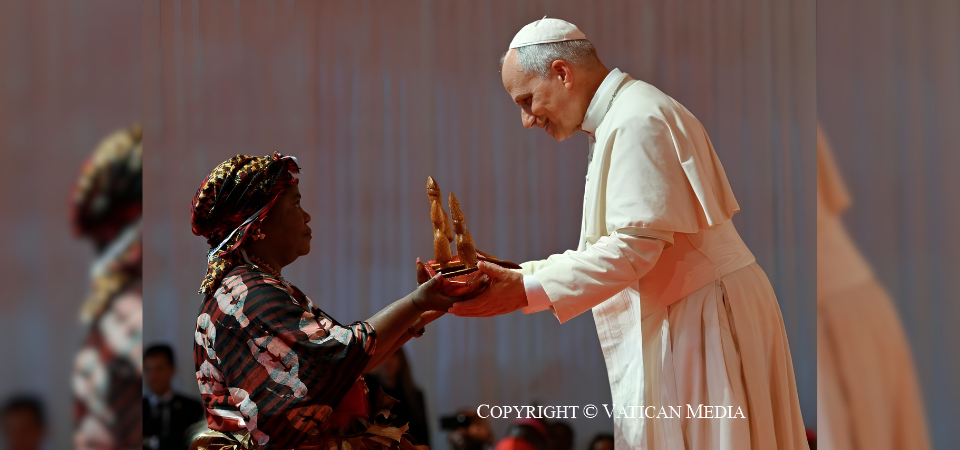
The pope highlighted the Church’s contribution to society and emphasized the positive aspects he encountered, particularly joy and hope, which he called “political virtues.” He acted in the manner that is natural to him, that is, with a form of respect that does not hinder closeness, simplicity, and intimacy, allowing himself to be touched and moved by what he sees and hears. In personal or group encounters, he draws near, shows interest, engages in dialogue, and, if necessary, leans in toward the person he is speaking with to listen. In very different circumstances, through gestures and words, he allowed himself to be drawn into the festive atmosphere that surrounded him everywhere, accepting with simplicity the warm African hospitality and thus helping to make visible the centrality of Africa in the life of the universal Church.
Reproduced with permission by La Civilta Cattolica.
DOI: https://doi.org/10.32009/22072446.0526.2
[1]. ITA Airways also provided flights between the countries visited and back to Rome. Within each country, flights were operated by local airlines, with the exception of one flight in Cameroon, which was operated by ITA Airways.
[2]. The pope’s remarks and photos from the trip can be found at https://www.vatican.va/content/leo-xiv/en/travels/2026/documents/africa-13-23aprile2026.html
[3]. Cf. M. Bomki, “The Conflict in Anglophone Cameroon”, in Civ. Catt. English Edition April 2026, https://www.laciviltacattolica.com/the-conflict-in-anglophone-cameroon/
[4]. Leo XIV, General Audience, April 29, 2026.
[5]. Leo XIV, General Audience, April 29, 2026.