

The canonisation of St Peter To Rot, from Papua New Guinea (PNG), was hailed at Sunday Mass in many parishes around the Diocese of Parramatta on the day Pope Leo XIV made him a saint, along with six others.
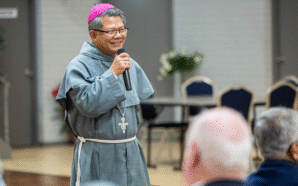
But for the priest and nuns who gathered at one small chapel in Harris Park on that day, 19 October, their Mass was entirely devoted to PNG’s first saint. All had spent many years ministering in the same region of PNG where Peter To Rot lived and were overjoyed that his long road to sainthood had come to fruition.
Fr John Goulding, who led the Mass at the Chapel of James Dixon House with nuns from the Missionary Sisters of the Society of Mary, spent nearly 30 years as a teacher and priest in the Archdiocese of Rabaul where Peter To Rot and his family lived. He is still a priest of the archdiocese and was involved in organising the beatification of Peter To Rot in 1995 by Pope John Paul II, in the PNG capital Port Moresby.
He said he hoped that through canonisation, Peter To Rot would become a model for young people in PNG and around the world to live the same kind of life that he lived – devoted to faith, spreading the good news of the Gospel and of sacrifice for others.
“Faith is dying in so many places today, but we can look at him and say that here was a man of faith, who had all the goodness that comes from that gift of faith,” Fr John said.
Defender of marriage
Peter To Rot was born in 1912 in Rakunai, a village on the island of New Britain. From an early age, he took a deep interest in his Catholic faith and at 18, enrolled in a mission school to become a catechist, a role that was to define his life.

St Peter To Rot, by Spanish artist Raul Berzosa Fernandez, is shown holding his Bible in one hand and wedding rings in the other. Image: Courtesy of Missionaries of the Sacred Heart
After the Japanese occupied PNG during World War II, they interned all the clergy, religious and other staff of the Missionaries of the Sacred Heart from Peter’s region in a concentration camp. This left Peter as the only person in charge of the religious life of his village. Undeterred, he undertook prayer services, baptisms, marriages and funerals, as well as distributing Communion to the faithful. He would also deliver food to the imprisoned missionaries, who would then give him consecrated Hosts to distribute to parishioners at Holy Communion. He even built a makeshift church to replace the one destroyed by the Japanese.
He was warned several times by the Japanese to stop these activities, but it was when he publicly denounced their reintroduction of polygamy that he was arrested and murdered in 1945.
“I think most importantly, he will be known for his defense of Christian marriage,” Fr John said. “He was a martyr for his faith.”
‘He refused to abandon God’
Archbishop Rochus Tatamai, the present Archbishop of Rabaul and grand nephew of Peter To Rot, told Vatican News that “Peter To Rot’s story is not just my family’s story; it belongs to the whole of Papua New Guinea.
“He stood firm in faith at a time when our people were under immense pressure. His witness, simple but profound, he refused to abandon God, his family, or his community and continues to inspire us,” he said.
Fr Floyd Gatana SM, Assistant Priest at St Andrew the Apostle Parish, Marayong, who was born on the nearby island of Bougainville, made special mention of Peter To Rot’s canonisation during his Mass on Sunday, 19 October. He told Catholic Outlook that it was an exciting and proud moment for the people of PNG.
“Looking back on his story, he played an important role building community through prayer,” Fr Floyd said.
“He strengthened the faith in the country, especially between different denominations, all of whom are proud of his example, especially his defense of marriage.”
Fr John, who ministered in Peter To Rot’s village several times during his years in PNG, said the church and shrine in the village where Peter To Rot is interred has become a popular site for pilgrims from all over the country.
He is hopeful that eventually Saint Peter To Rot will also become the patron saint of catechists. “With Rome’s assent we hope that will happen.”
These celebrations of St Peter To Rot align with our Diocesan Pastoral Plan priorities of Community, Prayer and Mission. Visit Synodality to learn more.