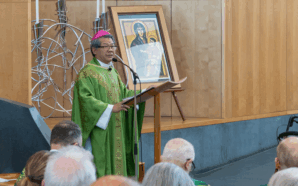


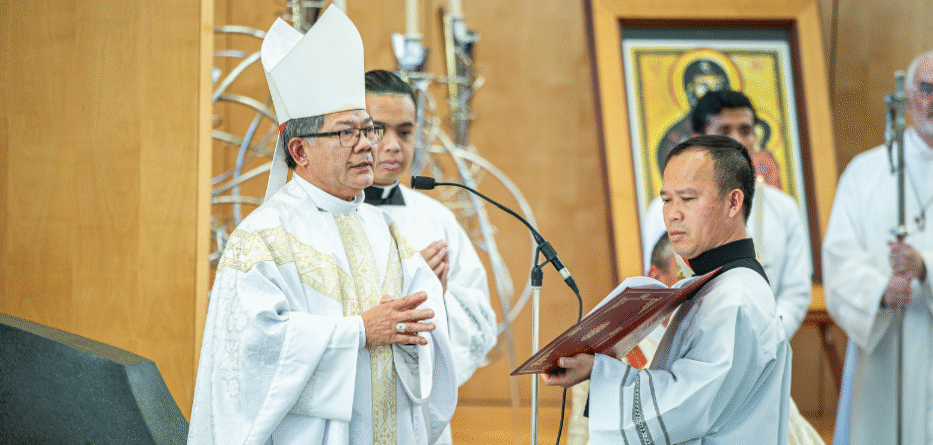
Most Reverend Vincent Long Van Nguyen OFM Conv DD STL, Bishop of Parramatta
2026 Celebrating 40 years of the local Church sharing life and love of the Trinity
The Solemnity of The Most Holy Trinity
Readings: Exodus 34:4-9; 2Cor 13:11-13; John 3:16-18
Dear brothers and sisters,
It is with a deep sense of gratitude, joy and hope that we have gathered at St Patrick’s Cathedral for the 40th anniversary of the foundation of our diocese. St John Paul II formally established this diocese on April 8th, 1986. However, long before the Diocese was created, Parramatta was known as the Cradle of Catholicism in Australia. From our earliest colonial history, our faith took root and was nurtured by humble generations of Catholics, many of whom were Irish convicts. They mirrored the life of Jesus -the stone rejected which became the cornerstone.
We take pride in the fact that the first Catholic school in Australia was set up in this precinct 200 years ago. Our pioneers championed a radical alternative system of equity, inclusion, solidarity and preferential option for the poor. They built not just schools but above all Catholic communities, to carry hope into a new and uncertain future. A collective witness to the Gospel of hospitality, generosity and compassion rose up against the background of a trickle-down, sectarian and merit-based society.
Today is, therefore, a day we look back to the past with thanksgiving in our hearts. We honour the Traditional Custodians of the lands on which the Diocese of Parramatta stands. We give thanks for the Darug and Gundungurra peoples for their resilience, faith, storytelling, and care for creation. We give thanks for our Catholic pioneers, including many missionary priests and religious who like St Patrick adopted a distant country as their home and left an indelible mark of the Gospel spirit in this place. They defied the odds and modelled a way of being together that is firmly anchored in Christ and the inspirational Church of our origins.
It is with pride that we can say Parramatta has set the tone for an inclusive, welcoming and courageous Australia. Waves upon waves of refugees and migrants who have made their home here since the first settlement continue to attest to the best that this country can be. As you can see, we are the Church of new Australians, beginning with the sitting bishop himself. We not only host a variety of races, cultures, and traditions; we also endeavour to demonstrate the richness, vitality and beauty of diversity like the first Pentecost. The story of reversal -like the Magnificat of Mary- is being demonstrated again by those who came here with nothing but the indomitable spirit of resilience, love of freedom and opportunity, especially the drive for the future. They are like the stones rejected that became the driving force of this local Church and indeed the quite engine for this country.
The story of the Diocese of Parramatta is, above all, a story of people. People who welcomed strangers, helped the vulnerable and stood together in times of joy and challenge. Speaking of testing times, who can forget the fire that gutted this Cathedral in 1996. Incredibly, we witnessed the mobilising of the community spirit and the best of the Australian character that were on display during the devastation and the subsequent rebuilding of this unique architectural marvel.
Today, we celebrate the core of our Christian faith: the God of love in whose image and likeness we were created; the God who sustains all of creation and enables every living being to flourish in the communion of life and love. In celebrating the Trinity, we are moved to become a community that reflects the God of love among all peoples. Just as the Trinity is a dynamic power of transformation, we are called to walk the transformative journey until all things come to unity in Christ.
In the first reading, God reveals to Moses as full of tenderness and compassion in spite of the betrayal and hardness of the heart on the part of his people. God is closely bonded with his people throughout the ebbs and flows of history. He delivered them from oppression and slavery in Egypt. Therefore, they are to form a post-exodus society, which would reflect the God of communion and love. This new society would be marked by concern for the God-given dignity of all and special attention to the most vulnerable.
In the Gospel, Jesus like Moses is depicted as one who leads humanity to freedom. However, the freedom he offers is not just socio-political but a freedom from within. Hence, he challenges Nicodemus who thinks he is a free man but in fact is enslaved. Nicodemus was a person of social distinction, privilege and entitlement. He was also a Pharisee who believed in self-made righteousness. Jesus’ challenge of being born again amounts to a conversion from self-entitlement to self-emptying. It is a breaking free from earning one’s privilege to caring for the underprivileged.
Dear sisters and brothers,
In celebrating the Trinity, we are to mirror the relational model of the Trinity that is revealed in Jesus’ style of radical self-emptying love, solidarity, simplicity and unity. In him, we see a God whose modus operandi is the antithesis of the power structures of this world that is tilted towards the privileged, the rich and the strong.
The Christian way of living cannot be other than the way shown in Jesus’ radical simplicity, solidarity and communion with God’s people and creation. Incidentally, this is also the message of Pope Leo in his first encyclical Magnifica Humanitas. We are all beloved children of God and this divinely given dignity must not be devalued in the name of technological progress. Like his namesake Pope Leo XIII who championed the rights of workers during the industrial revolution, the Augustinian Pope warns against the distorting effects of digital revolution, including AI. Growth, efficiency and development are hollow without ethical and social conscience. He indicts ideological interests and economic arrangements that exploit and disadvantage the powerless, the poor and the marginalised. It is in our Christian DNA, as St Paul reminds us in the second reading, to love and care for one another, especially those who are reduced to being a burden to the society.
Our celebration today is a time of gratitude, trust and joyful hope in the future. As we give thanks to God, to the pioneering men and women, to our bishops, clergy and religious that gave so much of themselves, let us also be resolved to respond to carry forward what we have inherited. As the Africans say, let us sit on the old mat and weave the new. May we be inspired to cultivate a future of hope and a civilization of love or in the words of the late Pope Francis “to be a church where everyone can feel welcomed, loved, forgiven and encouraged to live according to the Gospel.” Happy Anniversary to everyone!