

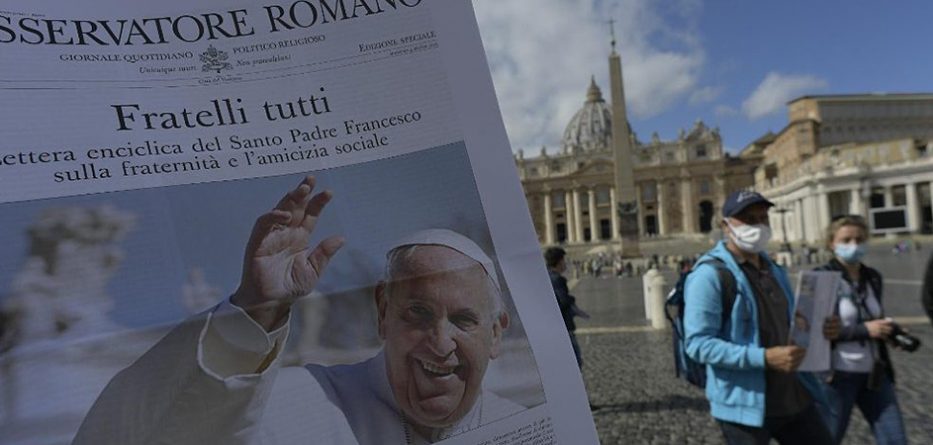
Since its release five years ago in October 2020, Pope Francis’s encyclical Fratelli tutti (“Brothers and Sisters All”) has proved prophetic. Its portrait of a broken world rife with inequality, nationalism, hatred, and war resonates today. And its call for human fraternity, social friendship, and a culture of encounter has lost none of its salience.
Fratelli tutti’s analysis of the migration issue is particularly relevant given the aggressive deportation campaign underway in the United States. Shortly before his death last April, Francis criticized President Donald Trump’s sweeping effort to deport millions of undocumented immigrants, including long-term, law-abiding residents. In a public letter to the U.S. bishops in January, the pope warned that “the act of deporting people who in many cases have left their own land for reasons of extreme poverty, insecurity, exploitation, persecution or serious deterioration of the environment, damages the dignity of many men and women, and of entire families.” Francis recognized the right of nations to monitor their borders, but called for greater openness to migrants and refugees. The common good is served, he underscored, when a nation “welcomes, protects, promotes and integrates the most fragile, unprotected and vulnerable.”
Francis’s insistence on both the right to migrate and the legitimacy of just border controls has been a cornerstone of Catholic social teaching since the refugee crises after World War II. “The émigré Holy Family of Nazareth, fleeing into Egypt, is the archetype of every refugee family,” Pius XII wrote in the opening sentence of his 1952 apostolic constitution on the topic. His successors have all emphasized the moral obligation to welcome the foreigner—prominent in both the Hebrew scriptures and in Jesus’s Parable of the Last Judgment—while also acknowledging a role for government in regulating migration flows. John XXIII set out the Church’s position succinctly in his 1963 encyclical, Pacem in terris. “Among man’s personal rights we must include his right to enter a country in which he hopes to be able to provide more fittingly for himself and his dependents,” he wrote, while also recognizing “the duty of State officials to accept such immigrants and—so far as the good of their own community, rightly understood, permits—to further the aims of those who may wish to become members of a new society.”
In its treatment of migration issues, the most detailed by any pope since Pius, Fratelli tutti explored the tensions between the rights of the migrant and the challenges faced by host countries—and suggested practical ways to address them.
Throughout his pontificate, Francis insisted on the right to migrate but did not advocate for open borders. He emphasized the costs of migration for all concerned: the migrants who risk their lives, the origin countries that lose them, and the host countries that must integrate them. The decision to migrate, Francis insisted, should be seen not as a selfish act but as a painful decision to pull up roots, often in response to war, persecution, and natural disasters. Migrants “experience separation from their place of origin, and often a cultural and religious uprooting as well,” he wrote in Fratelli tutti, adding that “fragmentation is also felt by the communities they leave behind, which lose their most vigorous and enterprising elements.” Francis, like Pope Benedict before him, asserted the right “not to emigrate,” stressing the difficulty of leaving one’s country and favoring a world where mass migration would not be necessary.
Francis also recognized the problems that migration can generate in host countries. While he insisted that immigration, in general, is a boon, bringing in talent, ideas, and diversity and enriching economic and cultural life, he was aware of its potential to generate resistance. “I realize that some people are hesitant and fearful with regard to migrants,” he wrote in Fratelli tutti, referencing those wary of losing jobs and a sense of community. “I consider this part of our natural instinct of self-defence.” Not responding to such concerns, he warned, could benefit populist demagogues who exploit fear for political purposes. “I ask everyone to move beyond those primal reactions,” that can make people “intolerant, closed and perhaps even—without realizing it—racist,” Francis wrote. He reiterated an appeal he had made to Europe in 2016, to “find the right balance between its twofold moral responsibility to protect the rights of its citizens and to assure assistance and acceptance to migrants.”
Fratelli tutti explored the tensions between the rights of the migrant and the challenges faced by host countries—and suggested practical ways to address them.
Fratelli tutti suggests a practical mechanism for addressing the tensions between the rights of migrants and the interests of host countries: a culture of encounter. Only by patiently engaging with others while acknowledging deep differences, Francis argued, can individuals and groups come to know and trust one another. Too often, “migrants are not seen as entitled like others to participate in the life of society,” he noted. “It is forgotten that they possess the same intrinsic dignity as any person.” Open interactions in a spirit of mutual recognition and respect can foster rapprochement over time, building a shared culture of encounter that integrates without eliding lines of difference. Among his examples of such a dynamic was Latino culture, “a ferment of values and possibilities that can greatly enrich the United States.”
The culture of encounter is closely related to another of Francis’s key concepts in Fratelli tutti: social friendship. Social media and ideological polarization have divided our societies, he observed, making it more difficult to forge bonds of friendship and trust with those beyond our inner circles. We tend to treat not just immigrants, but most others as well, as anonymous “associates.” Francis’s elaborate discussion of the Parable of the Good Samaritan at the heart of Fratelli tutti was an appeal to extend bonds of friendship beyond our immediate circle, including to the foreigners in our midst. The Samaritan’s willingness to help a foreigner who has been ignored by his own countrymen illustrates the possibility of social friendship that radiates outward. If taken to heart, Francis suggested, the parable might “affect those who organize themselves in a way that prevents any foreign presence that might threaten their identity.” Over time, both openness to encounter and social friendship, to be encouraged in an active and open civil society, have the potential to bridge divides between migrants and their host communities.
The calls for encounter and social friendship in Fratelli tutti relate to the encyclical’s overarching theme of human fraternity. For Francis, it is not enough to assert that we are all brothers and sisters, children of the same God. An abstract idea of human unity will not reach those afraid that migrants threaten their livelihoods and communities—fears that are stoked and exploited by populist demagogues. Fraternity cannot be called upon on demand; it is the product of the hard work of encounter. “Only by cultivating this way of relating to one another,” Francis insists, “will we make possible a social friendship that excludes no one and a fraternity that is open to all.” Basic Church teaching on migration for Francis—his four-fold call to “welcome, protect, promote and integrate”—is not a matter of ethical commands or top-down policy. It involves “undertaking a journey together, through these four actions, in order to build cities and countries that, while preserving their respective cultural and religious identity, are open to differences and know how to promote them in the spirit of human fraternity.”
Pope Leo has not yet intervened directly in the American immigration debate. But his strong alignment with Francis and his personal experience with migrants, in both Latin America and the United States, suggest openness to Fratelli tutti’s focus on encounter, friendship, and fraternity. This July, in his fullest statement on migration to date, Leo built on Francis’s approach, calling on us to appreciate the rich experiences that migrants bring to our communities. “In a world darkened by war and injustice, even when all seems lost, migrants and refugees stand as messengers of hope,” he said. “Their courage and tenacity bear heroic testimony to a faith that sees beyond what our eyes can see.” When we recognize migrants as members of our communities to be appreciated for their life’s journeys, we open ourselves to the hard work of genuine encounter, social friendship, and human fraternity—and move one step closer to the ideal of St. Francis echoed by Pope Francis: “Brothers and sisters all.”
Reproduced with permission by Commonweal.