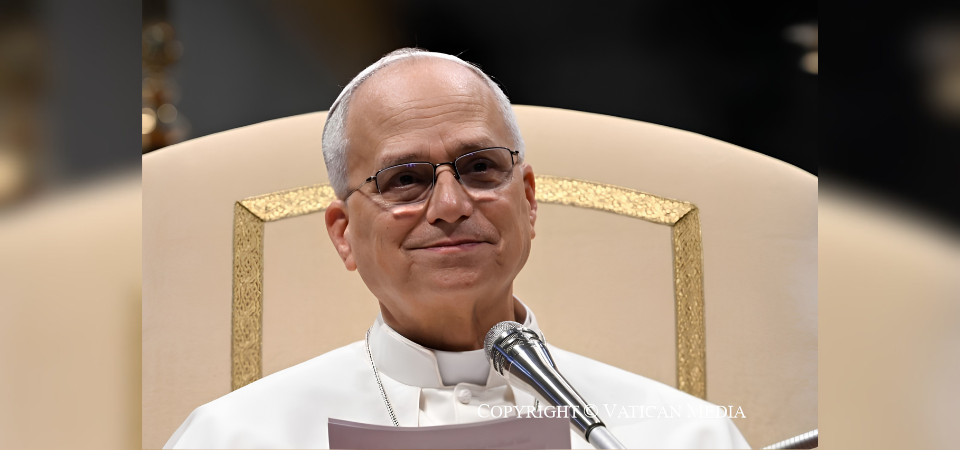


In the aftermath of U.S. Defense Secretary Pete Hegseth’s recent Pentagon prayer and Pope Leo XIV’s Palm Sunday homily, much of the public commentary has settled into a familiar framework. A conservative official invoked God in the context of war and a supposedly liberal pope rebuked him. The exchange is then cast as a political disagreement, or at most as an instance of religion being deployed on both sides of a geopolitical conflict.
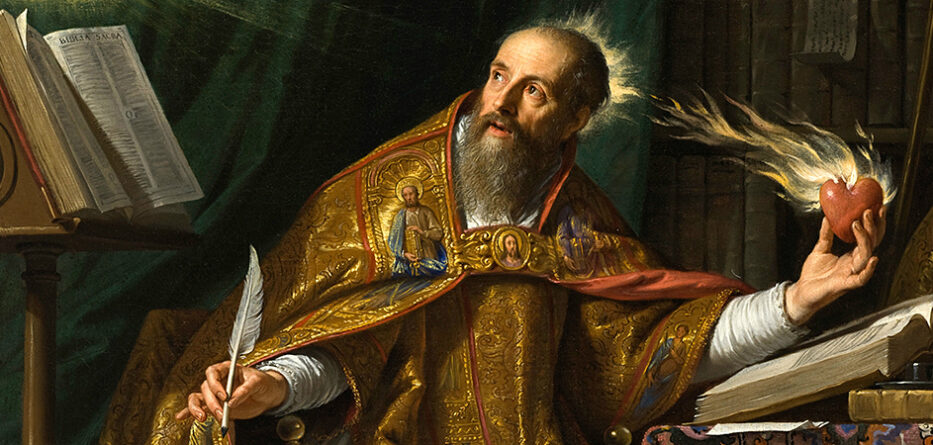
This account is inadequate. What is unfolding is not a political dispute but a theological one, and its terms are ancient, not modern. In order to understand the public dialogue taking place between Hegseth and Leo, we need to turn to St. Augustine.
To begin, it is essential to note that Hegseth’s Pentagon prayer, widely circulated in recent days, is not original — either to him or to the chaplain who he claims sent it to him. It is, instead, a compilation, largely made up of verses from the Hebrew Scripture. Its language borrows most heavily, though without attribution, from what are known as the imprecatory Psalms — prayers that call for divine judgment on enemies, sometimes in violent terms.
Hegseth began his prayer with the words: “Almighty God who trains our hands for war and our fingers for battle.” This line is taken directly from Psalm 144 which begins, “Blessed be the Lord, my rock, who trains my hands for war, and my fingers for battle.” When Hegseth asks God to “break the teeth of the ungodly,” he is repurposing both Psalm 3:7 and Psalm 58:6, both of which refer to God “breaking the teeth of the wicked.” And when he implores “Pour out your wrath upon those who plot vain things and blow them away like chaff before the wind,” he is combining language from as many as five Psalms (1, 2, 35, 69 and 79) while still managing to add the decidedly modern language of “blow [them] away.” There is more, but these examples will suffice.
The imprecatory Psalms are among the most difficult texts in the Bible, which is why they have, for millenia, been interpreted by Christians through a particular theological hermeneutic. From the first century onward, the Christian tradition has not treated them as straightforward calls for vengeance. In the words of Origen of Alexandria (circa 185-circa 253) in First Principles, “By the history of wars, and of the victors, and the vanquished, certain mysteries are indicated to those who are able to test these statements.”
To continue reading this article, click here.
With thanks to National Catholic Reporter and Karen E. Park, where this article originally appeared.