

We live in chaotic times—times in which analysis seems to yield more and more ground to emotional reaction, especially outrage. And yet, paradoxically, analysis proliferates. Pope Leo has called for clarity in identifying the true causes of conflict and urged us to overcome them. He has also warned us to reject “spurious causes, born of emotional simulations and rhetorical theater,” and to unmask them decisively. In doing so, he has touched the exposed nerve of our era: on the stage of international politics, the boundaries between governance, spectacle, and narrative have become porous—almost indistinguishably so.
Enter Donald Trump. On this global stage, he does not merely act; he directs. He is not a statesman, but a showrunner. Not a negotiator, but a narrator. The presidency, under his vision, becomes a sprawling production, a reality show performed on the set of history. Trump does not seek to persuade; he seeks to perform. And he does so with a language that, for all its surface simplicity, carries a surprisingly poetic undercurrent.
Is Trump a “poet”? Not in any academic sense. But in the primordial realm of language—the pre-rational space that acts directly on the collective imagination—his mode of expression evokes something deeply mythic. He speaks in an idiolect all his own: polarizing, instantly recognizable, and oddly resonant. It’s not what he says, but how he says it, that gives his speech its force. His words don’t argue; they echo. They don’t explain; they reverberate.
His rhetorical style thrives on short bursts, repetition, and directness. What may seem childish is, in fact, rhythmically sophisticated. His language has punchline precision, a staccato syntax, and alliteration deployed like a snare drum. In The Beautiful Poetry of Donald Trump (2017), Rob Sears demonstrates that when Trump’s tweets and offhand remarks are rearranged, they form a kind of unconscious free verse—full of rhythm, anaphora, and hyperbole. Sears’s book is only one among several poetic volumes that draw from Trump’s verbal output. “I predicted Apple’s stock would fall / I will build a great, great wall / I build buildings that are 94 stories tall / My hands aren’t—are they small?” These lines, both bombastic and minimal, carry the bold assertiveness of incantation. Read uncritically, they might recall Allen Ginsberg’s visionary tones—or even the ironic readymades of conceptual poets like Kenneth Goldsmith or Vanessa Place, where found language becomes a form of art.
If Trump’s form is poetry, his content is myth. His rhetoric is steeped in religious symbolism and apocalyptic imagery. He casts himself as the savior of a fallen America, the one who will restore a lost golden age. It is a messianic discourse—potent, but brittle. Because if the promise is broken, the prophet becomes a fraud. Trump invokes God not to submit to him but to replace him. In this secular theology, the leader becomes the incarnate word of an immediate and material salvation. It’s the rhetoric of his personal brand of prosperity gospel.
Trump operates on two levels: the spoken word and ritualized sacredness. His vocabulary is pared down to essentials—blunt, almost primitive. But within this minimalist framework, he builds total visions. Words like “always,” “never,” and “total disaster” are not descriptive; they are dogmatic. They function as media-age liturgy. Enemies are demonized, allies divinized, and every event is cast in an epic register. His is a binary, performative poetics that aims not at understanding but at mobilization.
Trump’s politics is performance. As The New Yorker’s Susan Glasser has observed, he fulfilled his secret ambition to become a Broadway producer: every gesture is stagecraft. From the gilded Oval Office to ceremonies reimagined as reality television, his presidency presents itself as an ongoing drama.
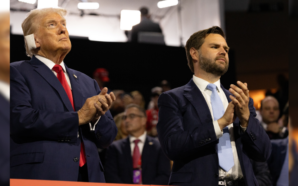
Diplomacy, under Trump’s direction, has become theater. His meeting with Volodymyr Zelensky at the White House was a case in point. The conventional codes of international relations gave way to the crafting of a compelling narrative. Whether it was true or false was secondary to whether it worked. Beside him now sits J. D. Vance, author of Hillbilly Elegy, a bestselling memoir–turned–Netflix feature. Vance is not a policy wonk; he’s a storyteller. And his presence reinforces the Trumpian aesthetic of the White House: not a center of governance but a narrative factory.
The same structure played out during the Iran crisis: an attack, a thank-you to the enemy, a strategic reversal rebranded as victory. And then, the theatrical coup de grâce: “MIGA!”—Make Iran Great Again. It was a slogan, a punchline, and a surreal, dystopian stage cue all at once. The war became an episode of Trump! The Musical. Actual bloodshed was relegated to the wings, its reality blurred beneath the lights, the pain it caused eclipsed by the spotlight.
Meanwhile, offstage, reality persists. In Gaza, children die waiting in line for bread. In Be’er-Sheva, Israeli families huddle in bunkers. Here, the most chilling face of narrative power emerges, one in which suffering is left on the cutting room floor. Tragedy is fragmented, made invisible. The goal of dominant storytelling is to be so overwhelming that it paralyzes. The viewer is left catatonic, incapable of response. Or, worse, one reacts with outrage—only to see even one’s own indignation absorbed into the performance.
That is why we need new narratives. The only possible salvation lies in a counterpoetic act—a poetics that resists fiction and insists on the truth of facts. Trump has exposed, with brutal clarity, that contemporary politics can no longer be interpreted solely through Enlightenment rationality, administrative competence, or institutional procedure. His enduring appeal—despite scandals, indictments, impeachments, and electoral losses—demonstrates that power today is primarily exercised in the realm of the imagination. Those who master it, who know how to narrate it mythically and seductively, win more than arguments: they win allegiance.
Trump has taken political communication to an extreme—one that bypasses reason and speaks directly to the symbolic unconscious: archaic fears, unmet desires, deep cravings for belonging. He understands that identity is not a given; it is a story. And he has chosen to write it with the tools of theater, rhythmic poetry, and religious language. He has restored a sacral and ritual function to political speech, transforming each rally into a faith performance, every gesture into liturgy, every foe into a ritual scapegoat.
In this sense, his aesthetics of power are profoundly regressive—yet uncannily effective. He revives the ancient techniques of mythmaking in an age ruled by instant media. Whether what he says is true does not matter—what matters is that it feels true. Trump is not merely a liar; he is a fabricator of narrative reality, working within a postmodern logic in which truth is subordinated to effect. His language is performative: it doesn’t describe the world—it constructs it in his image. The political challenge of the twenty-first century lies precisely here: it is no longer enough to fight with data, laws, or facts alone. We must also contend with forms, with visions, with words capable of rebuilding a shared imaginary.
If politics has become an aesthetic battlefield, then we need a new aesthetic—one not of spectacle but of depth, not of division but of relationship, not of simplification but of complexity rendered lucid. Pope Francis understood this with prophetic clarity when he wrote: “In this time of crisis in the world order, of war and great polarization, of rigid paradigms, and of urgent climate and economic challenges, we need the genius of a new language—powerful stories and images, writers, poets, and artists.”
We need a counter-narrative. A new poetics of responsibility. Because today, in the grand theater of the world, those who cannot tell a story are doomed to silence. In the age of Donald Trump and the strongman revival, poetry may once again become a tool for political discernment. The essential question of our time, then, is not merely who governs but who tells the story. Who has the voice to name the world—and with what words? And, most urgently: What imaginary will be capable of sustaining, in human consciences, a future democracy?
Trump has shown us—painfully, unmistakably—that politics can become a total work of art.
Fr Antonio Spadaro SJ is undersecretary of the Dicastery for Culture and Education of the Holy See. He is a member of the board of directors of Georgetown University and an Ordinary academic of the Pontifical Academy of Fine Arts and Letters of the Virtuosi al Pantheon. He was editor-in-chief of La Civiltà Cattolica for twelve years. This article originally appeared in the Italian newspaper Avvenire.
Reproduced with permission from Commonweal.