

Homily for the 4th Sunday of Easter 2026
Readings: Acts 2:14a,36-41; Psalm 23; 1 Peter 2:20b-25; John 10:1-10
Listen at: soundcloud
Today is Good Shepherd Sunday. In today’s gospel from John, Jesus describes himself as the good shepherd: ‘the sheep follow because they know his voice. They never follow a stranger but run away from him: they do not recognise the voice of strangers’. Jesus also describes himself as the gate of the sheepfold: ‘Anyone who enters through me will be safe; she will go freely in and out and be sure of finding pasture’.
On Tuesday we marked the first anniversary of the death of Pope Francis who was fond of telling pastors that as shepherds they should have the smell of the sheep. But this was not just a task for ordained clergy. It is the call of the evangelising community – each one of us who hears this gospel today. In his first apostolic exhortation, Evangelii Gaudium, Francis said:
“An evangelising community gets involved by word and deed in people’s daily lives; it bridges distances, it is willing to abase itself if necessary, and it embraces human life, touching the suffering flesh of Christ in others. Evangelisers thus take on the “smell of the sheep” and the sheep are willing to hear their voice. An evangelising community is also supportive, standing by people at every step of the way, no matter how difficult or lengthy this may prove to be. It is familiar with patient expectation and apostolic endurance. Evangelisation consists mostly of patience and disregard for constraints of time.”[1]
Marking the anniversary of his predecessor’s death, Pope Leo said: ‘We still hear his exhortations, expressed in eloquent words, to make the Good News more accessible: mercy, peace, brotherhood, the odour of the sheep, the field hospital and many others. Each of these expressions leads us back to the Gospel he lived out in a new language that proclaims the same Gospel as always.’[2]
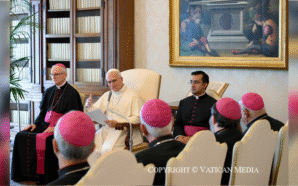
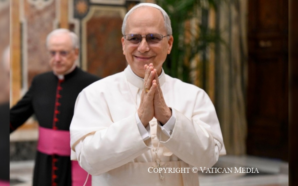
In recent weeks, there has been a lot of attention on the Pope’s role as shepherd in proclaiming a message of peace, and urging an end to all war. Some of the pope’s critics, including some Catholics, think this new pope has taken sides or failed to maintain sufficient balance in his comments about the US-Israel-Iran war. Leo has been unapologetic declaring: ‘I have no fear – neither of the Trump administration nor speaking out loudly of the message of the Gospel, which is what I believe I am here to do, what the Church is here to do.’
Ever since Pope Paul VI addressed the United Nations at the time of the Second Vatican Council, it has been customary for popes to declare ‘Never again War!’ In the lead up to the Iraq War in 2003, Pope John Paul II declared: ‘ “NO TO WAR!” War is not always inevitable. It is always a defeat for humanity. International law, honest dialogue, solidarity between States, the noble exercise of diplomacy: these are methods worthy of individuals and nations in resolving their differences.’ Addressing the specific threat of a US-led war against Iraq, John Paul said: ‘war cannot be decided upon, even when it is a matter of ensuring the common good, except as the very last option and in accordance with very strict conditions, without ignoring the consequences for the civilian population both during and after the military operations.’[3]
The pope has a distinct role as universal pastor proclaiming a message of peace for all, and in all situations of conflict. In the last couple of weeks, we have seen different shepherds in our church performing their distinctive tasks. While the pope has been calling for peace, the three leading American cardinals have spoken out as American citizens and as leaders of their American dioceses contributing to public discussion about the whether the just war criteria have been satisfied by their government in making the decision to go to war. Let’s remember it was the US and Israel which decided to go to war, not Iran.
In my humble opinion, both the pope and the three leading US cardinals have done superbly in their distinctive roles. We need both. And the Catholic Church is at its best when it provides both – a pope who proclaims in season and out of season the need for peace and the end of war; and national bishops who scrutinise their own nation’s decision to go to war.
We thank God for those shepherds with familiar voices who win our trust and assure us of their commitment to our well-being. And we thank God for those gates of the sheepfold that keep us safe so that all might come and go, finding green pastures. As members of the evangelising community, we all have our role to play.
The Lord is my shepherd; there is nothing I shall want.
The Lord is my shepherd; I shall not want.
In verdant pastures he gives me repose;
beside restful waters he leads me;
he refreshes my soul.
The Lord is my shepherd; there is nothing I shall want.
He guides me in right paths
for his name’s sake.
Even though I walk in the dark valley
I fear no evil; for you are at my side.
With your rod and your staff
that give me courage.
The Lord is my shepherd; there is nothing I shall want.
Fr Frank Brennan SJ AO, Adjunct Professor of Thomas More Law School at ACU and Adjunct Research Professor at the Australian Centre for Christianity and Culture, is a former Rector of Newman College, University of Melbourne, and CEO of Catholic Social Services Australia (CSSA). His latest books include Pope Francis: the Disruptive Pilgrims Guide (ATF Theology, 2025), and Gerard Brennan’s Articles and Speeches: Maintaining the Law’s Skeleton of Principle (2 volumes) (Connor Court, 2025).
[1] Evangelii Gaudium #24
[2] See https://www.vatican.va/content/leo-xiv/en/messages/pont-messages/2026/documents/20260412-messaggio-anniversario-papafrancesco.html
[3] See https://www.vatican.va/content/john-paul-ii/en/speeches/2003/january/documents/hf_jp-ii_spe_20030113_diplomatic-corps.html