

The image of Hung Cao in Hanoi — no longer a refugee but US Deputy Secretary of the Navy — captures that truth
Fifty years after the end of the Vietnam War, the wounds it left are still visible — not only on the land, but also in the collective memory of its people.
The war claimed millions of lives and divided a nation, forcing countless Vietnamese to flee on fragile boats in search of freedom.
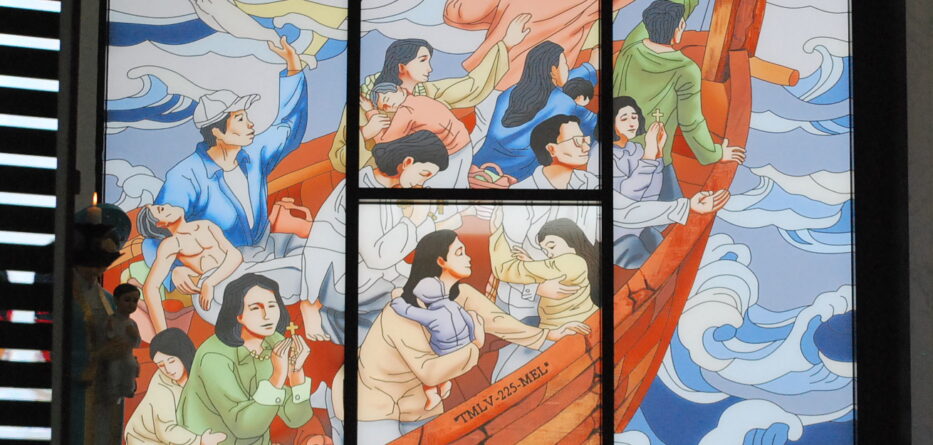
These “boat people” braved storms, pirates, starvation, and death, clinging to the hope that they might one day reach safety, though few dared to dream of ever returning home.
Half a century later, one of those who once shared their fate has returned — not as a refugee, but as a high-ranking US official.
Hung Cao, the US Deputy Secretary of the Navy, visited Hanoi this November as part of an American delegation. His presence carries symbolic weight: a man who once fled Vietnam as a child is now welcomed back by the country he left behind.
The image captured something larger — the slow but profound reconciliation between the Vietnamese diaspora and their homeland.
A gulf carved by war and ideology
For decades after 1975, those who fled were seen as traitors by the new government, while many in exile viewed the regime as their enemy. Families were split, letters censored, and returning home was unthinkable.
Even after Vietnam and the US normalized relations in 1995, the divide persisted.
The diaspora — especially those in the United States, France, and Australia — carried deep scars of loss and exile.
Many built communities rooted in anti-Communist identity, holding onto memories of the old Republic of Vietnam.
Inside the country, suspicion lingered. The word Việt kiều (“overseas Vietnamese”) was often spoken with both affection and caution, reflecting shared blood but divided loyalties.
This psychological gulf between those who stayed and those who fled became one of the most enduring legacies of the war.
Three decades of globalization and reform have redrawn that landscape.
According to Vietnam’s State Committee for Overseas Vietnamese, more than 5.3 million Vietnamese now live in 130 countries. Remittances reached between US$16 and $18 billion annually, about 4 percent of GDP, making Vietnam one of the world’s top ten recipients.
But the diaspora’s contribution extends far beyond money.
In education and science, Vietnamese scholars abroad such as Professor Vu Ha Vana, professor of Mathematics at Yale University and scientific director of Vingroup Big Data Institute, and Professor Nguyen Thuc Quyen, a professor of Chemistry and Biochemistry at the University of California, have forged research links and returned to mentor younger scientists.
In business, more than 4,000 overseas-funded projects worth $11 billion operate across technology, logistics, and agriculture. Abroad, Vietnamese communities help foster mutual understanding and trust between Vietnam and major powers.
The transformation is perhaps most visible in the arts. What was once taboo is now celebrated.
Singers such as Bang Kieu and Thu Phuong, once barred from performing in Vietnam, have since returned to national stages. Their concerts attract large audiences and are broadcast on television.
Music that was once labeled hải ngoại (“overseas”) has become part of the shared soundscape of a reconciled nation.
Replacing memories of fear with trust
Generational change has softened ideology. Vietnamese youths born after the war have grown up in a borderless, digital world.
On YouTube and Spotify, they listen to both domestic and overseas artists. Online, they collaborate with peers from California, Paris, or Sydney.
For them, “inside” and “outside” are no longer moral categories — just geography.
Meanwhile, second- and third-generation Vietnamese abroad are rediscovering their roots. Language courses, summer camps, and volunteer programs in Vietnam attract hundreds of young people each year.
They come not to reconcile politics, but to understand where their parents came from — to experience the culture and to belong.
This quiet curiosity is the true foundation of reconciliation. When people stop judging one another through the lens of ideology, they begin to meet as equals — as family.
Once viewed with suspicion, the diaspora is now seen by the government as a strategic resource — “an inseparable part of the nation.” Their impact spans every field.
Economically, remittances help stabilize the financial system and sustain millions of households. Even during the Covid-19 pandemic, remittance inflows grew, reflecting the diaspora’s lasting attachment.
In science and technology, Vietnamese researchers abroad have brought advanced methods and ethics, helping universities adopt global standards.
Culturally, the success of Vietnamese chefs, filmmakers, and entrepreneurs worldwide has redefined how foreigners perceive Vietnam — not as a poor or war-torn country, but as creative, confident, and resilient.
In diplomacy, Vietnamese professionals in Western governments and international institutions have acted as bridges, building goodwill and human connections that formal politics cannot.
What began as a story of displacement has quietly become a story of renewal.
Learning how to return
Reconciliation rarely happens through official statements. It unfolds through countless small gestures — a business opened in one’s hometown, a concert uniting artists from both sides, a scientist returning to teach, or a US Navy officer named Hung Cao walking through the city his family once fled.
Such acts embody a universal truth: forgiveness is not forgetting, but moving forward together. As Scripture reminds us, “Forgive one another, as God forgave you.”
For Vietnam, this means embracing those who once left, not as outsiders but as partners in the nation’s future.
When a people can remember their past without hatred and welcome back their own with dignity, the wounds of history begin to heal. The image of Hung Cao in Hanoi — no longer a refugee but a bridge — captures that truth.
Half a century after boats drifted into the open sea, the children of those voyages are finding their way home. And in that homecoming, Vietnam itself may finally discover a deeper freedom — the freedom to forgive, to belong, and to begin again.
*The views expressed in this article are those of the author and do not necessarily reflect the official editorial position of UCA News.
With thanks to the Union of Catholic Asian (UCA) News and Alex Hoang, where this article originally appeared.