

Religion has returned to the center of the global public square as a grammar of power.
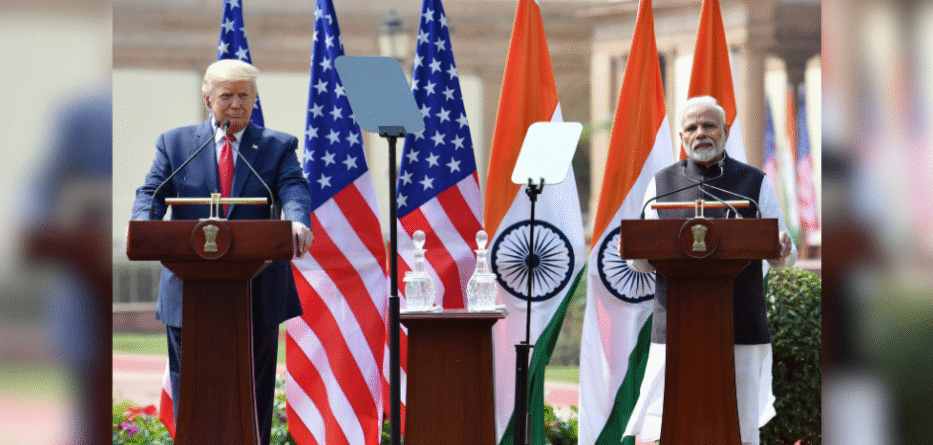
In the United States, biblical language has entered presidential rhetoric: the country as the object of a providential design and the adversary as a figure in a spiritual conflict.
In Russia, the Moscow Patriarchate has given the war a metaphysical cover, setting a pure world against a corrupt West.
In India, religious belonging has become the criterion of effective citizenship.
Different mechanisms, converging effect: religion ceases judging power and becomes one of its functions.
Power achieves what politics alone can no longer produce: legitimacy that cannot be contested because it cannot be argued. Religious communities gain visibility, protection, and access to decision-making.
The price is paid by faith and reduced to an identity marker: it says who we are and against whom.
In Christianity, the paradox is sharper. It arises from an experience that crosses borders, from Pentecost to the house of the centurion Cornelius; catholicity resists being identified with a people, a nation, or a civilization.
When the name of God traces a frontier, the Christianity that results is mutilated.
Here lies the misunderstanding about civil religions and identity revivals, which ask Christianity to serve as glue and supply roots. The request can be met only by emptying the faith.
Its most politically useful versions are the theologically poorest: apocalyptics without mercy, moralisms without a cross.
In Peter Thiel’s political-theological reflection, categories such as the katechon and the eschaton become keys to geopolitical strategy. The Apocalypse ceases to be revelation and becomes a manual of culture war.
Constructions of this kind, in which nationalism and technological power are welded together, select their themes and pages of Scripture.
There is, however, a mirror-image trap. If power can enlist the Church as its chaplain, the opposing front can enlist it as its banner.
It is the temptation to read every word of the pope as a blow against the leader of the day, and the magisterium as a partisan editorial.
❝The Church does not need to win. It needs to remain free. A Church that no one can enlist is the only one that anyone can still hear.
A pontificate is applauded for what it seems to strike rather than for what it announces. Even if, and this must be said plainly, prophecy today may rise to tones of firm condemnation in a world in pieces, where the extermination of peoples goes without a firm and decisive response.
Faith has public consequences for labor, migration, prisons, wars, and the use of resources; yet it has no single party.
The Church makes a difference when it offers criteria and names concrete situations; it loses its effectiveness when it becomes a voting bloc. Its autonomy is not a distance from public life but a difference of origin: it is not born of consensus and therefore does not depend on it.
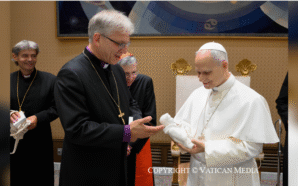
The pontificate of Leo XIV situates itself within this tension, beginning with the name.
Leo XIII intervened when the social question was redefining the relationship between capital and labor; today, that redefinition passes through machines that imitate intelligence and through the concentration of technological power.
Magnifica Humanitas, Leo’s first encyclical, was signed on the anniversary of Rerum Novarum: the social question has moved from the factory to the algorithm, and with it the question of who governs power, and in whose name.
The dignity of the person once again becomes a matter of economic order, not of abstract anthropology. The “disarmed and disarming” peace that Leo announced on his first appearance at the Loggia of the Blessings already signaled the register of the pontificate: a word that offers itself to no one as a weapon.
For Pope Francis, this freedom was a hinge in his vision of international politics. The “third world war fought piecemeal” was not a map of two opposing blocs but an atlas of wounds to be read from the peripheries.
Hence his refusal of the binary logic of an axis of good and an axis of evil, his dialogue with everyone, and his wariness toward ready-made alliances.
In Kazakhstan, Francis articulated the principle: “May the sacred not be a prop for power, and may power not prop itself up with sacredness.”
Fraternity, a culture of encounter, and patient diplomacy were his means of withdrawing God from the justification of conflicts and of keeping the Church free to speak the truth to every power.
Then there is a fact that outweighs many declarations. A pope born in the United States, at a moment when religion is the raw material of American polarization, continues to speak of migrants, the poor, and war.
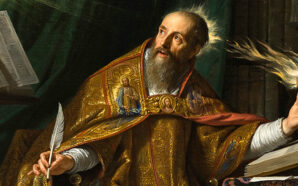
His Augustinian formation helps interpret this posture: the two cities remain intertwined in history and never coincide; no regime can claim to be the city of God, least of all when it believes itself to be.
The moral greatness of a political community is measured, first and foremost, by its capacity to sustain the most vulnerable. This is the point at which every political theology and every theological politics reveals whether it serves God or power.
The Church does not need to win. It needs to remain free. A Church that no one can enlist is the only one that anyone can still hear.
With thanks to Global Catholic and Antonio Spadaro SJ, where this article originally appeared.