

1 October is the Memorial of St Thérèse of the Child Jesus (Lisieux)
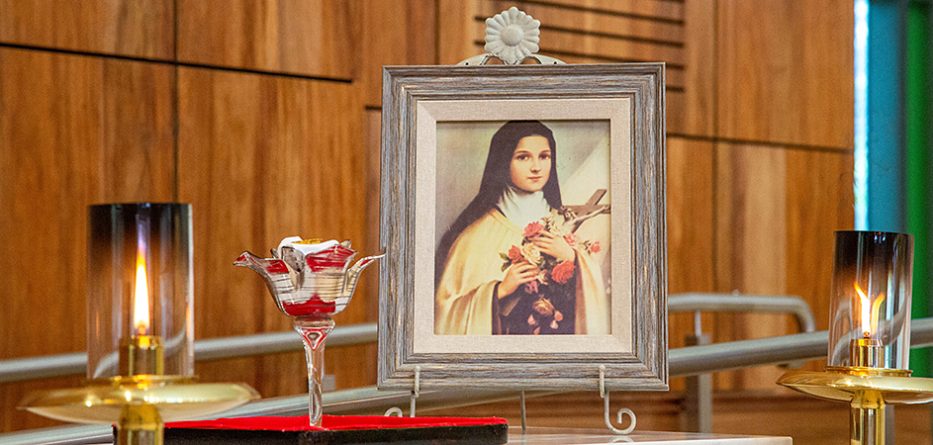
Statues of Thérèse of Lisieux usually represent her in immaculate brown, white and black Carmelite robes holding a crucifix and roses. Her face is untroubled, as we might at first expect in a saint whose five surviving sisters became Religious, four of them in the same French Carmelite monastery. Among them was Thérèse, who applied to join at nine, was admitted when 15, and lived her life in the monastery until she fell ill and died aged 28. The Martin family was certainly devout. Their father and mother had wanted to become Religious and brought up their five children in a world in which the Church, prayer and liturgy were at the centre. Both parents and Thérèse herself were canonised as saints by the Church, and her sister Céline’s cause is also under consideration. A story, it seems, where holiness was untroubled.
The substance of Thérèse’s short life, however, was complex. As a small child, she was lively and self-willed. When she was four years old, however, her father moved a hundred kilometres from Alenҫon to join his sister-in-law’s family in Lisieux. Thérèse became withdrawn and self-conscious. Until she was eight, she was first homeschooled and then sent to a monastic school where she was bullied and became even more self-conscious. She lost self-esteem and felt rejected by God. At Christmas in 1886, she experienced a dramatic conversion. From being terrified at a ceremony of gift giving and her unworthiness, she found joy in focusing on others and experienced it as a gift. She was attracted to the Imitation of Christ and became a perceptive and non-judging observer of people. A year later, she went with her family on a pilgrimage to Rome, met the Pope and pressed him unsuccessfully to allow her to enter the convent. She also noticed the worldly lives of many priests and made praying for them a lifetime’s business.
When Thérèse was 15, the Prioress, a domineering noble woman within a convent of mainly elderly and largely uneducated nuns, admitted Thérèse into the convent. She had to negotiate her own spiritual independence among older sisters and respond to her father’s early signs of dementia. At the time of her Profession, she was full of doubt, but returned to her focus on littleness and being receptive to God’s love.
In 1896, she contracted Tuberculosis, then a death sentence, and lived with intense pain and darkness of spirit, but found in the depths of her abandonment her own smallness and Jesus’ overwhelming love for her.
During her time in the Monastery, she had been asked to write two autobiographical accounts and also sent a short letter to her sister in which she focused on the importance of being small and leaving space for Jesus. These were put together after her death and heavily edited to fit with a conventional understanding of sanctity. The publication of the unedited version revealed her paradoxical strength in the midst of her weakness.
Perhaps the unedited heart of Thérèse’s spirituality, its simplicity and strength and its rejection of prevailing rhetorically more elevated versions can be found in a letter to her sister, which Pope Francis quoted in his Encyclical on the Sacred Heart. To her sister, who accepted the conventional emphasis on making sacrifices and heroic actions, Thérèse wrote:
“My desires of martyrdom are nothing; they are not what give me the unlimited confidence that I feel in my heart. They are, to tell the truth, the spiritual riches that render one unjust, when one rests in them with complacence and one believes that they are something great… what pleases [Jesus] is that he sees me loving my littleness and my poverty, the blind hope that I have in his mercy… That is my only treasure… If you want to feel joy, to have an attraction for suffering, it is your consolation that you are seeking… Understand that to be his victim of love, the weaker one is, without desires or virtues, the more suited one is for the workings of this consuming and transforming Love… It is confidence and nothing but confidence that must lead us to Love”.
The statues of St Thérèse represent a conventional view of holiness in which everything had its place. Her way displaced the place.
Fr Andrew Hamilton SJ writes for Jesuit Communications and Jesuit Social Services.