

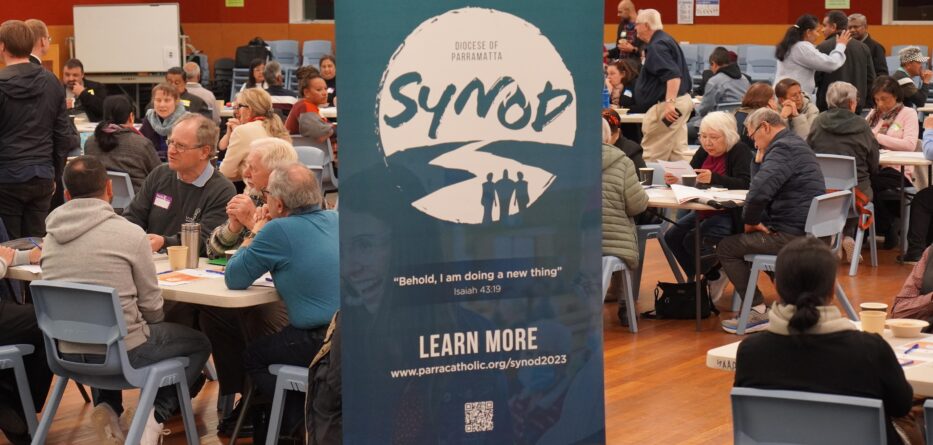
Participants at a Catalyst for Renewal reflection morning at Hunters Hill on 11 April 2026 were invited to move beyond understanding synodality as a Church “process” and to experience it instead as a deeply spiritual way of living the Christian life.
The morning’s reflection, The Momentum of Synodality: a spiritual practice of conversion and vulnerability, was presented by Alison Ryan, Formation and Engagement Facilitator in the Mission Enhancement Team, in the Diocese of Parramatta. Drawing on Scripture, Catholic theology, contemporary research, and personal reflection, Alison explored how synodality has emerged as a fruit of the Second Vatican Council and how it calls each baptised person into ongoing conversion.
At the heart of Alison’s presentation was a clear and challenging thesis:
“Synodality is the ecclesial form that encompasses all that arose from the Second Vatican Council – the teachings and developments in what we believe and how we practice it – all that the movement of the Holy Spirit did in the life of the Church 60 years ago, finds its expression in synodality today. But what does it mean to actually live in this way?”
Beginning with the legacy of the Second Vatican Council, Alison traced how the Church’s self-understanding shifted from a primarily hierarchical model to one rooted in communion, participation, and mission. Vatican II’s emphasis on the People of God, the dignity of baptism, and the co-responsibility of the laity laid the foundations for what the Church today names as synodality – literally “walking together”.
Alison reminded participants that synodality is not a program or governance reform, but “the everyday posture of the whole People of God: listening, discerning, and responding to the realities of the world in the light of the Gospel”. This posture, she emphasised, requires more than structural change. It demands what Pope Francis repeatedly called for: personal and communal conversion.
Central to the synodal journey are three interrelated movements: listening, discerning, and responding. Alison highlighted how authentic listening means creating space for every voice to be heard – lay and ordained, young and old – trusting that the Holy Spirit speaks through the lived faith of God’s people.
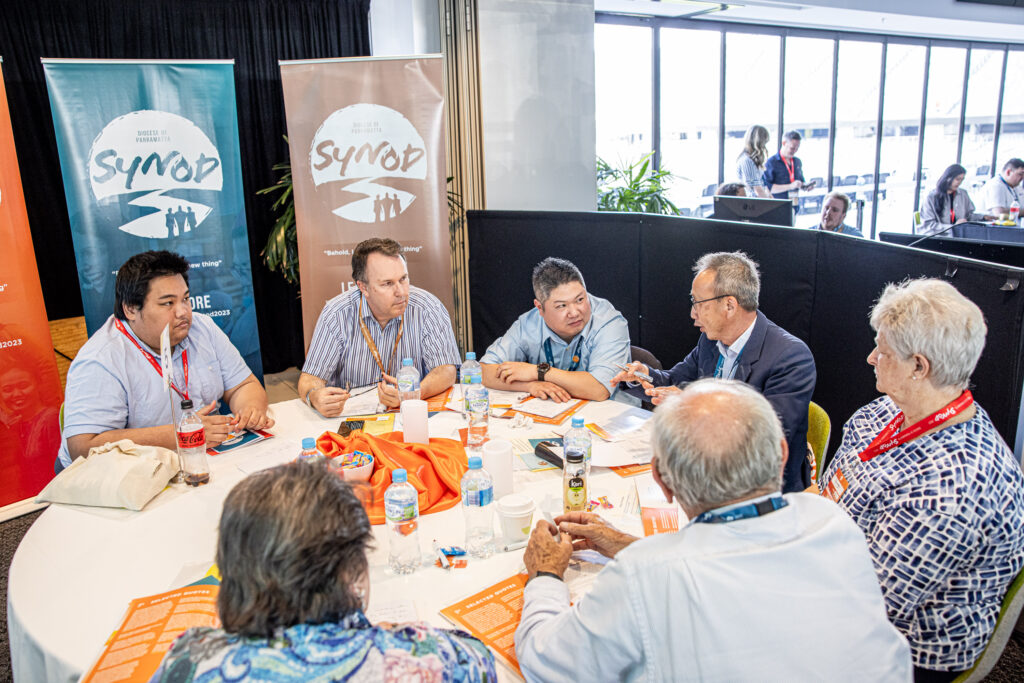
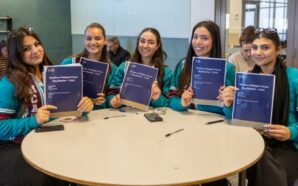
A discussion session during the Diocesan Synod at CommBank Stadium, Parramatta, in 2023. Image: Diocese of Parramatta
Discernment, she explained, is not about asserting personal preferences but about humbly seeking God’s will together. It is a prayerful process grounded in Scripture, tradition, dialogue, and attentiveness to the signs of the times. Only then can the Church respond in concrete, missionary ways that embody communion and co-responsibility.
It was in this context that Alison spoke about synodality as a “movement with momentum” already active in communities across the world, asking participants to reflect on how they are personally called to take part.
In the second session, Alison explored a less comfortable but essential dimension of synodality: vulnerability. True dialogue, she suggested, always involves risk, because it opens us to being changed by encounter with the other.
Drawing on contemporary communication research, Alison explained how every conversation carries emotional, practical, and relational dimensions. Genuine listening depends on recognising what kind of conversation we are in and meeting one another there with empathy and openness.
Vulnerability, however, is often misunderstood as weakness. Alison challenged this assumption both pastorally and theologically, pointing to the Incarnation and the Cross as the most powerful expressions of God’s vulnerability. In Christ, God enters fully into human weakness, suffering, and risk not despite divine strength, but as its truest expression.

The Synod formed the foundation of the Diocesan Pastoral Plan for a Synodal Church. Image: Alphonsus Fok/Diocese of Parramatta
This perspective resonated deeply with participants. One attendee reflected afterwards:
“I have never really taken the passage from St Paul to the Corinthians seriously. But I see now that he really means it when he says, ‘whenever I am weak, then I am strong’. It is quite a challenge, and I’ll spend some time really reflecting on it.”
The impact of the reflection morning was evident in the conversations that continued after the reflection morning ended. Participants spoke of renewed clarity, hope and challenge as they considered synodality, not as an abstract Church initiative, but as a spiritual practice shaping everyday relationships.
One participant described the morning as insightful: “For me it was the best presentation on synodality that I have heard and understood. So much more meaningful now that I can reflect on its meaning as a spiritual practice.”
As the universal Church continues its synodal journey, gatherings like this serve as important reminders that synodality is not something “out there” or “for others” to implement. It begins in the hearts and lives of every one of us, in the conversations and courage of ordinary believers willing to listen deeply, walk together in discernment, and respond in faith. In this way, the momentum of synodality will continue to grow in the life of the Church all around us.
To find out more about Catalyst for Renewal reflection mornings and other events go to catalystforrenewal.org.au.
This reflection morning is an example of the Diocesan Pastoral Plan priorities of Prayer, Formation, Listening Dialogue and Discernment. Visit Synodality to learn more.