

Homily for the 20th Sunday in Ordinary Time
Readings: Isaiah 56:1,6-7; Psalm 67; Romans 11:13-15, 29-32; Matthew 15:21-28
Listen at soundcloud
In today’s gospel from Matthew, we hear one of the great robust dialogues between Jesus and the Canaanite woman who was a person in need, though not a member of the Chosen People. She was an anxious mother pleading for her daughter who was possessed by a demon. Jesus was minded to ignore her plea with the cutting observation: ‘It is not right to take the food of the children and throw it to the dogs.’ She gave back as good as she got: ‘Please, Lord, for even the dogs eat the scraps that fall from the table of their masters.’
For the Matthean community, it was important to emphasise that Jesus came primarily for his fellow Jews, and not the Gentiles. But by the time Matthew had written his gospel, his listeners included Jews and Gentiles. Scripture scholar Daniel Harrington tells us: ‘Relations between Jews and Gentiles were a very sensitive topic for the Matthean community. Though the majority of the community seems to have been Jewish by birth, some were Gentiles by birth. The conversation between Jesus and the Canaanite woman would have functioned as a model or at least a causal explanation why Jews and Gentiles could exist together in the same Christian community.’[1]
In the biblical tradition, salvation was to come from the Jews. During his earthly ministry, Jesus had told his disciples: ‘Go nowhere among the Gentiles.’ But after the resurrection, Jesus tells them: ‘Go, therefore, make disciples of all the nations … And know that I am with you always; yes, to the end of time.’ As Harrington says: ‘The roots of Christianity are Jewish. Gentile Christians have been grafted onto the olive tree.’[2] Christianity can take root and thrive in all cultures. We have all been grafted on to that olive tree. Salvation through Christ is available to all peoples and can be expressed through all cultures.
On Thursday we celebrated the requiem mass for one of the great modern apostles of this message of universal salvation. Sister Rosemary Crumlin was a Sister of Mercy in the Parramatta Diocese. She was an artist, educator, writer and curator of fine arts. I was privileged to accompany her travelling around remote Aboriginal communities in 1991 as she collected works for display in an exhibition of Aboriginal Art and Spirituality. The exhibition was held in the High Court of Australia during the World Council of Churches Assembly.
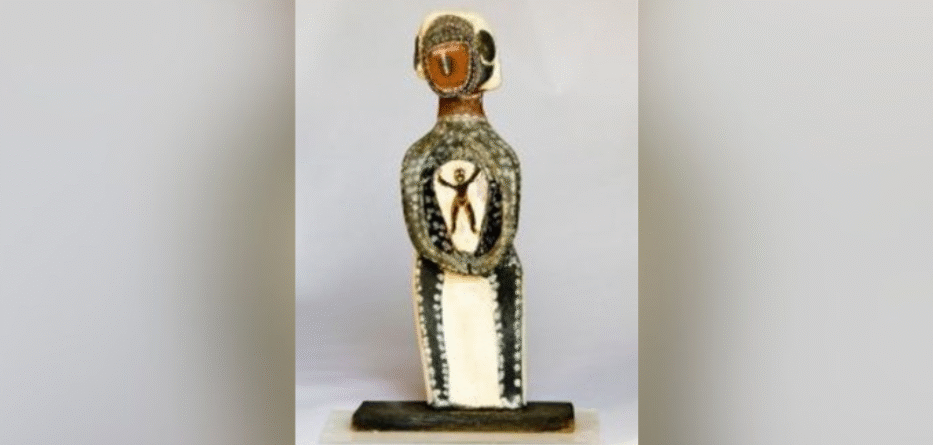
One day we flew by light plane into the Warmun Aboriginal Community at Turkey Creek in the Kimberley. Walking through the Catholic primary school, we came upon a hot water cistern. On top of the cistern was a wooden sculpture covered in cobwebs and dust. Rosemary stood transfixed, declaring: ‘That is worthy of Picasso’. The sculpture Mary of Warmun was carved by Paddy Mung Mung. Rosemary chose it as the centrepiece for the exhibition.
Some months later when we were in the foyer of High Court setting up the exhibition, word came from the north that George had died. Rosemary wept. Years later, Rosemary put on another exhibition entitled Beyond Belief at the National Gallery of Victoria. Once again, George’s sculpture was to be the centrepiece.
Introducing the catalogue for the exhibition, Rosemary wrote: ‘The idea for this exhibition and book was born of a simple question. What would happen if it were possible to bring together some of the great religious works of the century – and to them bring some of the thinkers of the century? From this came other questions. For instance, would the power of the art stimulate new insight into what the century has been and who we are as we stand at the brink of a new Millennium?’[3] She said, ‘Beyond Belief came, as a phrase, to point to the capacity of art itself to become symbol, a vessel of the Sublime, and to speak in a way that refuses to stir the ashes but rather attempts to light the fire.’[4]
After George Mung Mung’s death, fellow artist Hector Jandany described him in this way:
‘He was looking forward to a black fella way
and a Kartiya way
He was a two-way man
He was a very clever man for the Dreaming.’
Describing George’s sculpture in the catalogue for Beyond Belief, Rosemary wrote:[5]
The wood for this sculpture… was cut by Mung Mung from a tree deep in the remote Bungle Bungle ranges of Western Australia. The tools were an old car spring and an ordinary knife. The purpose was to make “a Mary that will never break” (for the old plaster image of Mary had broken when the table was knocked over by the community dogs). The result is a sculpture that is at once deeply religious and immensely powerful. To create it, Mung Mung entered into his consciousness ‘two-way’. He went down into his Aboriginal roots – into his belief in his ancestor spirits, in his responsibility to maintain right relationships with the land and his position as elder in the small community at Turkey Creek. But he also reflected deeply on his Catholicity, on the meaning of Mary as the mother of Jesus and on the Incarnation. The work is a stunning reconception of the meaning and image of the Christian mother and child.
Rosemary brought George Mung Mung’s profession of faith to our awareness and within our comprehension. As we hear Rosemary’s description of the sculpture, we are aware that with the Lord’s words in today’s first reading from Isaiah have relevance for us in Australia in the 21st century:
The foreigners who join themselves to the Lord,
ministering to him,
loving the name of the Lord,
….them I will bring to my holy mountain
and make joyful in my house of prayer;
…..for my house shall be called
a house of prayer for all peoples.
In today’s gospel, Jesus concedes and tells the Canaanite woman: ‘O woman, great is your faith! Let it be done for you as you wish.’ Her daughter is cured. Jesus is open to our profession of faith whatever our culture, whatever our level of education, whatever our place in the world. We can be grateful for the unexpected little things that contribute to the breakthroughs in faith, understanding and expression – like the dogs that eat the scraps that fall from the table of their masters, and the dogs that knock over the table with the plaster Mary.
O God, let all the nations praise you!
May God have pity on us and bless us;
may you let your face shine upon us.
So may your way be known upon earth;
among all nations, your salvation.
O God, let all the nations praise you!
Fr Frank Brennan SJ AO, Adjunct Professor of Thomas More Law School at ACU and Adjunct Research Professor at the Australian Centre for Christianity and Culture, is a former Rector of Newman College, University of Melbourne, and CEO of Catholic Social Services Australia (CSSA). His latest books include Pope Francis: the Disruptive Pilgrims Guide (ATF Theology, 2025), and Equality, Reconciliation and Social Cohesion: The Inspiration of Sir William Deane (Connor Court, 2026).
[1] Daniel J. Harrington, The Gospel of Matthew, Sacra Pagina Series (Collegeville, MN: Liturgical Press, 2007), 237.
[2] Ibid, 238.
[3] Rosemary Crumlin, Beyond Belief: Modern Art and the Religious Imagination, National Gallery of Victoria, 1998, 9.
[4] Ibid, 11.
[5] Ibid, 128.