

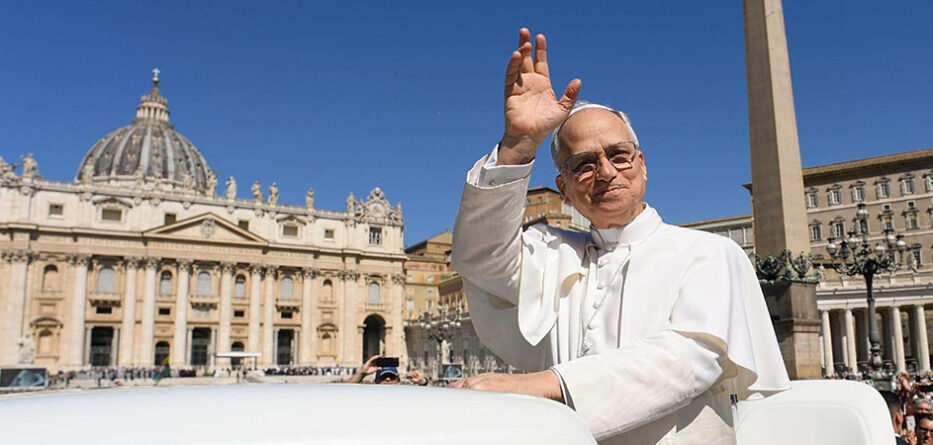
Pope Leo XIV’s Sept. 25-28 visit to France takes as its motto a line from the Gospel of John: “That the world may have life.”
The Pope arrives in a country that has just enacted a law permitting assisted dying, and the phrase can hardly be heard as neutral. Yet the itinerary keeps its distance from the battlefield.
On his first day, Leo will meet President Emmanuel Macron and the institutions of the republic at the Élysée, but he will address end-of-life issues in Lourdes, among the sick and the elderly, according to the trip’s chief organizer.
The defense of life is entrusted, in other words, to proximity to those who suffer before it becomes an argument with the law.
Alongside secular France, there is another France, one that doesn’t appear in surveys of churchgoing: the France of adults seeking baptism.
This past Easter, there were more than 13,000 of them, over three times as many as a decade ago, and most were under forty. Four in ten came to faith after an illness or a death.
The youth vigil at the Stade de France and the meeting in Paris with catechumens and the newly baptized were planned with them in mind, as was the vespers service with the clergy in the rebuilt Notre-Dame, where a weary Church will learn how ready it is to answer the door.
The problem waiting for the Pope is a practical one: How can graying parishes with few priests make room for people who arrive with no Christian inheritance at home and questions the old catechism never anticipated?
What Leo is expected to offer is less a word of encouragement than a sense of how to accompany this growth.
Lourdes is the heart of the journey: the Pope stays there from Sept. 25 evening until dawn on Sept. 28, longer than in any other city.
He will meet the bishops, the sick cared for at the sanctuary, and, in private, a number of abuse victims. The same ground thus holds the frailty of bodies and the wounds inflicted by the Church itself.
The hope rekindled by the newly baptized does not cancel the debt owed to those who were betrayed, and the credibility of Christianity in France depends on that as well.
At UNESCO, where an agreement marking 75 years of relations with the Holy See will be signed, the theme of life broadens to include education, art, and artificial intelligence, with promised references to Magnifica Humanitas, Leo’s encyclical.
Here, human dignity steps beyond the confines of bioethics and bears on how a civilization shapes its people and decides what to hand over to machines.
The last stop is Metz, in a region that changed hands between France and Germany four times over seventy years.
After an interreligious gathering that concludes with a joint declaration, the pope will speak about Europe’s roots, peace, and the continent’s unity.
There is war on the Union’s borders, and a pope from the far side of the Atlantic has chosen a frontier land to remind Europeans of the wars from which their life together was forged.
With thanks to Global Catholic and Antonio Spadaro SJ, where this article originally appeared.