

Jesuit astronomer Brother Guy Consolmagno explains, among other things, how a false narrative of the Galileo incident continues to pitch the Church against science even in modern-day discussions.
In the following interview, Consolmagno, a planetary scientist, author, and gifted communicator, also demonstrates how false that narrative is, and establishes that rigorous scientific inquiry and deep religious faith are complementary rather than contradictory.
Consolmagno, who currently works with the Vatican Observatory, was born in Detroit, Michigan, in 1952. He developed an early fascination with astronomy and studied Earth and Planetary Sciences at the Massachusetts Institute of Technology, earning a bachelor’s degree in 1974 and a master’s in 1975. He also earned a PhD in Planetary Science from the University of Arizona in 1978.
Consolmagno joined the Jesuits in 1989 and took his vows as a brother in 1991. He chose to remain a brother rather than pursue the priesthood, believing his vocation lay in scientific research, education, and public engagement.
He joined the Vatican Observatory in 1993 and has worked there ever since. During his more than three decades with the Observatory, he served as its director for ten years, from 2015 to 2025.
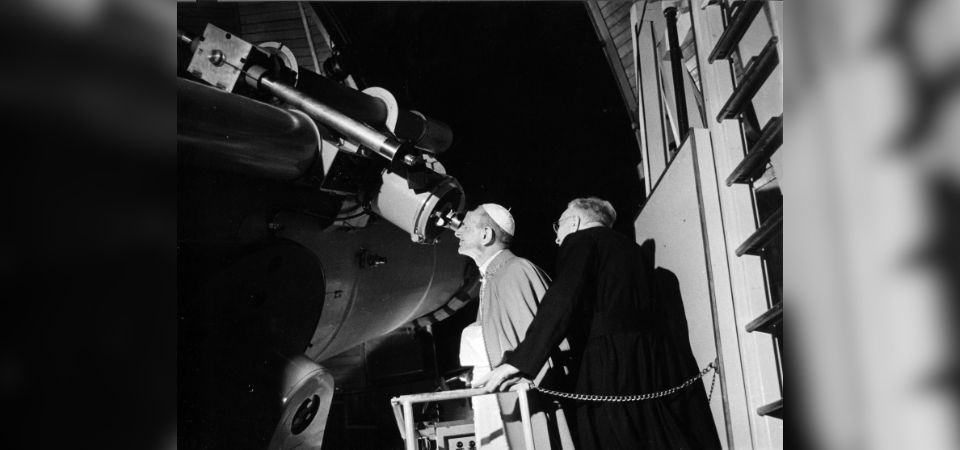
The Observatory is among the world’s oldest astronomical institutions, with roots in papal astronomy dating to the sixteenth century and formally re-established by Pope Leo XIII in 1891.
Journalist Peter Tran spoke with Consolmagno for Global Catholic on a wide range of subjects, including his work with the Vatican Observatory, its collaboration with the University of Arizona, and the establishment of the Mount Graham International Observatory in Arizona. The following is an edited version of the interview.
How does the Vatican Observatory help ordinary Catholics in parish pews?
The Catholic Church has a long history of interest in the sciences, especially astronomy. The beauty of the stars is a recurring theme in our prayers and meditations on God’s glory. Science itself was born in the medieval universities.
Historically, astronomy, or what we’d call cosmology, had an essential foundation in philosophy and theology. Astronomy also played a role in setting the liturgical calendar and, through that connection, in the Gregorian calendar reform of 1582.
But by the end of the 19th century, with new technological developments, “scientist” began to emerge as a career independent of philosophy, leading some people to suppose that science would soon supplant religion.
The Church’s opposition to the false promise of eugenics fed into political pressures — fueled by the growth of nation-states in Europe and the massive immigration of Catholics into America — that led to efforts to undermine the Church by claiming it was anti-science.
In 1891, Pope Leo XIII established a formal Vatican Observatory as the “national observatory” of the Holy See to show the world that the Church did not oppose science.
Astronomy was chosen to play this role because of the strong reputation of earlier astronomers in Rome, most notably Fr. Angelo Secchi, SJ. From his observatory on the roof of the St. Ignatius Church in Rome, he conducted pioneering studies of solar astronomy, the nature of planets, and the spectra of stars.
A national observatory also served as a reminder that the Holy See regarded itself as a nation separate from Italy!
The world of science has changed significantly since the 1890s. Today, few scientists, even those who do not follow a religion, believe that their technical work is a substitute for religion.
The myth of a war between science and religion is still all too prevalent among the people in the pews. Too often, our children are getting the message that they need to choose, somehow, between faith and science. The observatory continues to declare to them that the Christian religion supports science.
The false dichotomy between religion and science is harmful to both faith and science. Losing young people who believe the Church is anti-science is a tragedy. Likewise, having faithful members of the Church turn their backs on science denies them a rich way of knowing the Creator.
The same impulse that led the authors of Scripture to see God in the glory of the heavens (see Psalm 19) remains true today. The more science uncovers the workings of creation, the more we can appreciate the glory of the One who created.
The amazing images that science brings us of the Universe, including, but not limited to, the results from the latest space missions, are an incentive to worship with both mind and heart.
When did the Vatican Advanced Technology Telescope on Mt Graham come into existence?
When Pope Leo XIII established the observatory in 1891, its telescopes were mounted on the walls surrounding the Vatican. As the city lights of Rome made that location untenable, and with the return of the Papal territories in Castel Gandolfo to the Holy See in 1929, new telescopes were constructed there atop the Pope’s summer residence.
But even Castel Gandolfo eventually became enshrouded in city lights. By the 1980s, it was inevitable that a new location would be needed to continue the Vatican Observatory’s telescope observations.
During those years, the director of the Vatican Observatory was an American, Fr. George Coyne, SJ, who had previously worked at the University of Arizona in Tucson. His clever solution was to open a residence in Tucson and arrange for the Vatican astronomers to use the University’s various telescopes, located on mountaintops surrounding Tucson.
But then a remarkable and unexpected opportunity arose. One of the Arizona astronomers, Roger Angel, had devised a clever new way to make telescope mirrors: he melted glass in a round mold inside a spinning oven, allowing the glass to form itself into the parabolic shape needed for a telescope’s mirror. Having successfully made one such mirror, he came to Fr. Coyne. The deal: the University would provide the mirror, the Vatican would build a telescope around it, and the two entities would share the use of the telescope.
And thus the Vatican Advanced Technology Telescope — the VATT — was born, with the added feature that its mirror had been made by “an Angel!” The telescope saw its “first light” in 1993 and has been in operation for more than thirty years, located among a cluster of three telescopes atop Mt. Graham in southeastern Arizona.
Who works there? What do they do?
Currently, five Jesuit astronomers regularly use the telescope. Father Richard Boyle SJ observes star clusters; Father Chris Corbally SJ takes the spectra of unusual stars; Father Jean Baptiste Kikwaya Eluo observes small asteroids, including those approaching Earth. Fathers David Brown SJ and Pavol Gabor SJ have programs focused on searching for and characterizing planets orbiting other stars. Of these five, Boyle and Brown are Americans, Kikwaya is Congolese, Corbally is British, and Gabor is Slovakian. Ours is a very international community!
Thanks to our partnership with the University of Arizona, this telescope can also be used by any astronomer affiliated with an Arizona university, including Arizona State and Northern Arizona Universities. Time on the telescope is allocated to each group based on their planned observations.
Could you describea “day in the life” of Jesuit astronomers?
Typically, an observing team will head off for the mountain (stopping on the way to pickup a week’s worth of groceries) and reach the summit about four hours after they’ve left Tucson. There’s a full kitchen and four comfortable bedrooms, adjacent to the telescope.
The first evening they start their observing procedures, taking background images in the fading sky light after sunset, and then proceeding to observe their list of targets through the night, along with well-known standard stars for comparison. At sunrise they go to bed; by early afternoon they’re up, cooking a light meal in the kitchen, and then it’s another night staying up until dawn.
All data are collected electronically. Once observing begins, no one is allowed in the silo housing the telescope; the heat from a person near the mirror would blur the images. Likewise, the telescope is kept at the same temperature as the outside air. Each image is saved as a computer file, and at the end of the night the files are transmitted over the internet back to the University. It’s a quiet, sometimes lonely, sometimes monastic experience.
After the allotted number of nights is complete, it’s time to head down the mountain as the next team of astronomers arrives. The work has only just begun, however; it can take months at the computer to “reduce” the images, removing camera artifacts and comparing the observed objects against standard stars.
That, at least, is the traditional way the telescope has been used. For some projects, that’s still the procedure. But new equipment has been installed, allowing observers to do all this work remotely. No more need to drive four hours each way on rough mountain roads and through uncertain weather. But, alas, it also means no more monastic experience on the mountaintop, awaiting the dawn.
What does the Vatican Observatory Foundation (VOF) do? How does it help lay people?
The Vatican Observatory Foundation is a way that lay people can participate in the work we do.
First and foremost, the Foundation—a nonprofit corporation of the state of Arizona— is a legal entity that owns and runs the Vatican Advanced Technology Telescope (VATT), along with the Steward Observatory of the University of Arizona.
That means the VOF is responsible for covering our share of its operating expenses each year and for keeping the cameras and other support equipment up to date so they can be used by the Vatican’s astronomers and our colleagues. Likewise, it supports other scientific research activities of the Observatory within the United States.
The VOF also participates directly in the Observatory’s other work… supporting not only the science we do but also fulfilling the other half of our charge from Pope Leo XIII in 1891: to “show the world” that the Church supports science. It does so in a number of ways.
The Foundation funds the Vatican Observatory Summer Schools (VOSS), held every two years in Castel Gandolfo. At these schools, we bring in the best astronomy students from around the world to spend four weeks attending lectures on a specific topic in astrophysics. The competition to get in is fierce — we typically have about 200 applicants for 25 slots.
Also fierce is the competition among teams of astronomers vying to teach those students. Typically, for any given school, we’ll have up to half a dozen teams of world-class astronomers vying to teach these students. Both students and faculty know that being part of the VOSS means membership in an elite group of scientists. Among our past instructors, one has gone on to win a Nobel Prize. Among our alumni is the new president of Cal Tech.
Closer to home, we run the Astronomy for Catholics in Ministry and Education (ACME) program every other January at the Redemptorist Renewal Center north of Tucson. The program is designed for Catholics who teach science in our schools and parishes.
One of our newest programs is the Jesuit Observatory Experience (JOE). Astronomy students at various Jesuit-affiliated universities are being given the opportunity to use the VATT remotely for their own research programs, under the guidance of an astronomy professor at their school and one of our Vatican astronomers in Tucson. The recent robotic upgrade to our telescope (called “Don”) allows these students to observe the stars in the clear skies over Arizona no matter the weather where they live.
Astronomers and lay volunteers with the Foundation are currently partnering with educators and evangelization specialists at a dozen dioceses across the country to develop programs tailored to the needs of their locations.
The goal of all these initiatives is to spread the word about the Vatican Observatory and how it demonstrates the true accord between faith and science.
The VOF website has a Faith and Science Resource Center with hundreds of articles and videos along with images and short articles illustrating both the history and present-day science done with our telescopes and other Vatican Observatory facilities.
Could you briefly touch on the Galileo controversy and how the Church was accused of not supporting science?
When I became a Jesuit, I knew people would ask me about Galileo. So I began an intensive study of the affair, trying to understand what went wrong and why. What I discovered was shocking. No doubt, the Church was wrong to put Galileo on trial; that injustice is what Pope John Paul II apologized for in 1993.
But the history of what happened is nothing like what we’ve been told in so many popular accounts.
The theory that the Earth goes around the Sun had been proposed by Copernicus (1473–1543) nearly a century before Galileo and a few years before the Council of Trent (1545-1563). But that Council never found it worthy of comment, much less condemnation.
Most of the arguments against that theory had nothing to do with religion or the Bible but were based on the best science of the day, which seemed to show that the theory failed several tests. And Galileo himself had been writing about it — without adequately addressing those scientific challenges — for more than twenty years before his infamous trial in 1632.
If you read the trial transcript itself (like most of the relevant documents, it is readily available in translation), you discover that the issues discussed there had little to do with faith or science. Indeed, Galileo offered to revise his writings to appease those prosecuting him, but he was never given that chance.
And even more puzzling, at the end of the trial, Galileo was not found guilty of heresy but only of “suspicion of heresy.” When he renounced his writings, he agreed to reject “anything in my writing that is contrary to the Church teaching” without ever having to specify what those things might be.
He was then placed under house arrest at the palace of the bishop of Siena, an old friend. Eventually, he was allowed to return to his comfortable estate outside Florence, where he continued to write and publish some of his most important work on the nature of physics.
So what really happened to Galileo, and why? No one knows for sure. One theory is that he cleverly made Pope Urban VIII look like a fool in his book, which is true, but Urban had been his friend. Another theory ties the trial itself to the politics surrounding the Thirty Years’ War, which was reaching a crisis point just as the trial occurred. We may never know for sure.
What seems to have happened, however, is that anti-Catholic writers in both America and Europe at the close of the 19th century — some 250 years after the event — took the Galileo trial out of context to create the myth of a war between faith and science. Galileo became the famous example of the Church opposing science… mostly because they couldn’t find any other examples to cite!
Could you tell the story of how you came to work with astronomy and the Vatican Observatory?
I’ve told my story so many times that I no longer know whether I’m remembering what actually happened or just what I said the last time I told it. So let me share three short scenes that I don’t think I’ve written up anywhere before.
The first took place at my parochial grade school in the northern suburbs of Detroit around 1962. The father of one of my classmates showed up with a new-fangled “portable TV” — must have weighed some 20 kilograms, black-and-white, of course — and set it up on the teacher’s desk so we could watch one of the Mercury astronauts being launched.
That I remember it so clearly just shows how much of a space-crazy kid I was — like every one of my generation. Growing up in an affluent suburb (portable TVs!), with college-educated parents, encouraged by the Sisters of Charity who taught there, I had all the opportunities to indulge that passion for astronomy… eventually earning my two MIT degrees and a doctorate.
The second scene is on a cold January morning, 1988, standing at the shore of Windermere, in England’s Lake District. I had flown to England to drop off the manuscript of an astronomy book, Turn Left at Orion, that my friend Dan Davis and I had written for the Cambridge University Press. Afterward, taking a week’s vacation, I had headed off for a week’s vacation in the English lakes… a favorite place, but at a most unseasonable time. There, alone at the side of the frosty lake, I had time to think about where I was and where I wanted to be.
Now I was a professor, teaching at a small college in Pennsylvania. I loved it. I was happy. But it wasn’t enough. My dating life had just experienced yet another break-up; could I face trying to make another relationship work?
Looking at the lake, pondering what’snext, I realized then that I didn’t want that. I wished instead that I could just teach astronomy… while standing for something bigger than just my own career. Perhaps at a Jesuit school. As a Jesuit brother?
Final scene… spring of 1993. I’d just finished two years of philosophy and theology studies as a young Jesuit and was hoping for a teaching assignment at Loyola College in Maryland, where I had been a novice. But anywhere would be fine. Except… not the Vatican Observatory, please…
I knew all about the Observatory. I had known its director, Father Coyne, when I was a student in Tucson. I knew they were building a telescope in Arizona… and I remembered how I hated living in Arizona when I was a student. Too hot, too dry, too many cowboys!
And I had no desire to live overseas in Rome, either… far from friends, struggling with a foreign language. Been there, done that: two years with the Peace Corps in Africa. Moreover, I had spent five years of my life as a research scientist at the highest levels — Harvard and MIT — and that had long since lost its appeal. That’s why I had joined the Peace Corps!
I had made all of this clear to my Jesuit superiors. So I was stunned when the letter arrived, assigning me to the Vatican Observatory. No getting around it; it was signed by Father General himself. How did he even know I existed? Of course, no one would believe me if I complained about living in the Papal Palace in a beautiful setting in Italy… but honestly, it felt like a real hardship to me.
And that’s when I experienced a small miracle: a remarkable joy in knowing I was being asked to do something for God that I didn’t really want to do.
My “yes” has meant that I have been able to do so many things that most people never get to do. I’ve met four Popes. I’ve traveled around the world three times, visiting every continent including Antarctica (two months on the ice collecting meteorites).
I’ve published a bunch of books, been featured on the front page of the New York Times twice and lots of other newspapers and magazines, including in the pages of The New Yorker. I have appeared in movies, and on TV with Stephan Colbert. I’ve also learned, firsthand, how ephemeral such fame is.
But there are so many things I will never do, never know.
I don’t know what it’s like to be married or to have children. I don’t have a place I call “home.” I don’t have a garden, a boat, a golf handicap, a dog, or a favorite restaurant. Those are all gifts I didn’t receive.
And that’s OK. What I do have is the knowledge that (for the most part) I am living where God wants me to be and doing (at least a little bit) what God wants me to do. I feel such freedom and such joy in the life I have been given. What more could anyone ask?
With thanks to Global Catholic and Paul Tran, where this article originally appeared.