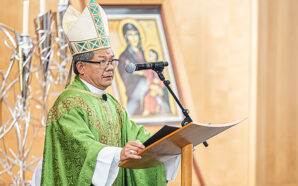


Most Reverend Vincent Long Van Nguyen OFM Conv DD STL, Bishop of Parramatta
Homily for the 16th Sunday in Ordinary Time
Readings: Gen 18:1-10; Col 1:24-28; Luke 10:38-42
Formed into a community of radical hospitality
Dear friends,
It is not an exaggeration to say that we are living in an environment of fear, suspicion and mistrust. The conflict in the Middle East that pits one country against another and strains community relations even here in Australia; the mass movement of migrants and refugees that triggers strong reactions; the geopolitical tensions that often give rise to the friend or foe mentality. In the midst of all this, it can be hard to practice a life of radical hospitality or in the words of the late Pope Francis, to work towards a globalisation of hope. Yet, this is precisely the call of the followers of Jesus, because to follow him is to go to that place where strangers are family and enemies are our table guests. This is the call to a global solidarity that unseats us from our perceived securities and our dangerous suspicions, and places us on the journey of trust, self-giving, and other-loving.
Scriptures this Sunday provide us with a lesson in deep listening, attentiveness and contemplation that lead to purposeful living. In the first reading, we hear the story of an encounter between Abraham and the strangers at the Oak of Mamre. Though there were three of them, Abraham addressed them as “My Lord”. Christians later would see these three visitors as a foreshadowing of the Trinity. Abraham was keenly aware of the divine presence. His response showed the depth of his faith: “My Lord, I beg you, if I find favour with you, kindly do not pass your servant by”. We can hear the echo of his words of humble faith and trust in the centurion’s response to Jesus, which we ourselves repeat before Communion.
Abraham and Sarah were themselves vulnerable sojourners in a foreign land. Yet they were extraordinarily hospitable and generous to the strangers. This characteristic would become the distinguishing feature of the chosen people. They were to treat foreigners, outsiders and other marginalised minorities with hospitality because they were strangers themselves. Thus, maintaining an alien or pilgrim identity and showing solidarity with the vulnerable are inseparable to being God’s people. Today, we are the living testament of the covenant community. Radical hospitality is part of our spiritual DNA. Christians are indeed summoned to form an alternative society, an oasis of hope -like the tent of Abraham and Sarah- that is an antidote to the mindset of fear, self-interest and exclusion. We are the vehicle of God’s plan for a shared destiny of hope, solidarity and life-flourishing for all.
The story of Martha and Mary gives us further insight into how we ought to live the sacrament of the present moment in order to be fully engaged with the manifestations of the Spirit. They welcomed Jesus into their house. But while Mary was intent on listening and conversing with her guest, Martha was like one of the contestants in My Kitchen Rules. She came to a point of frustration and asked Jesus to intervene. To her surprise, Jesus affirmed Mary’s stance. This stance was more radical than modern readers may realise. In Jewish culture, women weren’t allowed to be at a rabbi’s feet. By welcoming Mary as a pupil, Jesus flipped that cultural script on its head.
The Gospel story is a reminder to Christians of the need to live life deeply, sacramentally and contemplatively. We need to see life through the filter not of competition, success and achievement. Rather, it is the prism of God’s love and concern for his people; it is the Kingdom and its righteousness, which ought to be the ultimate driving force of our lives. Paul in the second reading showed us something of this passion when he spoke of his sufferings as a result of the Gospel. The sufferings he alluded to had much to do with the battle he had fought against those who insisted circumcision on Gentile Christians. It was the inclusiveness of the Kingdom and the radical acceptance of everyone in the Church of God that made Paul into the faithful steward of the Good News. Paul’s hard-fought victory that all are loved by God, all are of equal value, Jew or Greek, male or female, circumcised or uncircumcised, needs to be revisited again and again as we engage with many contemporary social issues.
Dear friends,
God’s call for us to show hospitality to the poor, the needy and the stranger is naturally connected to seeing ourselves as poor, needy strangers to whom God displays hospitality, despite our weakness and even our resistance. We show hospitality to others because God has shown immense hospitality to us. Ultimately, Christ is the stranger, and we are told that we encounter Christ through those we welcome. This is powerful motivation for opening the doors of our hearts, homes, churches, communities, and countries to those who are strange to us.
Like Abraham and Sarah, we learn to recognise God disguised in the strangers. Like Martha and Mary, we learn the art of generous welcoming, deep listening and attentive living. Let us as the Body of Christ become like the tent at Mamre and the house at Bethany –a community of prayer, hospitality and hope. May Our Lady who is the model of listening and acting on God’s Word inspire us to treasure his life-giving relationship above everything else.