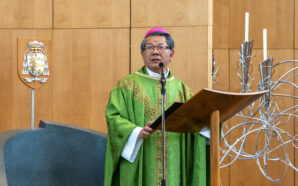


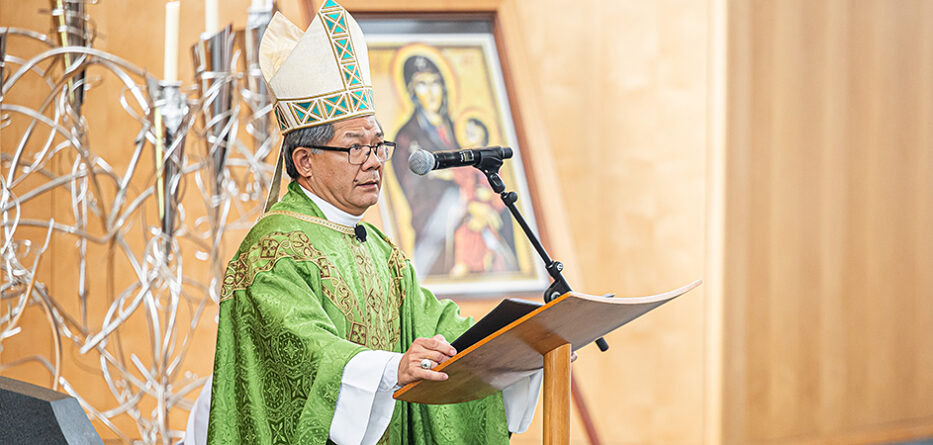
Most Reverend Vincent Long Van Nguyen OFM Conv DD STL, Bishop of Parramatta
Homily for the 30th Sunday in Ordinary Time Year C
Readings: Ecclesiasticus 35:12-14, 16-19; Psalm 33(34): 2-3, 17-19, 23; 2 Timothy 4:6-8, 16-18; Luke 18:9-14
26 October 2025
The merit-based system versus the relational model of the kingdom
My dear people,
If we are honest with ourselves, we must admit that few of us are free from prejudice. We often have preconceived ideas about people who are unlike us in some ways. In times of uncertainty, hardship and crisis, we tend to single out certain groups as being responsible for our predicament. Thus, the scapegoating of marginalised minorities is often the collective default response. We resort to a self-preservation mode at the exclusion of those we deem less worthy.
The Word of God today provides a wake-up call to our social conscience. We are taught the unexpected ways of God and invited to live a life of deep humility, empathy and service. The God that Jesus revealed impels us to be less concerned with ourselves, to advocate for justice, to promote the common good and to be on the side of the disadvantaged.
The book of Ecclesiasticus, also known as Sirach, is a collection of ethical teachings gleaned from various sources over the centuries. They show a profound knowledge of the human heart, a caution towards power and wealth, a deep empathy with the poor and the oppressed. In today’s episode, it issues a warning against the rich and powerful that God judges without partiality and even regard for the person’s position. Conversely, “he does not ignore the orphan’s supplication nor the widow’s plea.” In other words, God does not follow the logic of the world. His favour rests with the poor and his sympathy with the powerless.
This warning is consistent with the biblical tradition. In God’s scheme of things, it is often the small beginnings, insignificant events and people, which lead to the fulfilment of God’s purpose. Whereas might is right according to the logic of the empire, it is faith in vulnerability, powerlessness and smallness that wins the day according to the logic of the Bible.
In the Gospel, Jesus tells the parable of the Pharisee and the tax collector in a way that cuts through layers of human prejudices. The Pharisee is often held up as an example of moral uprightness. However, his prayer reveals his inner attitude: “I thank you, God, that I am not like everyone else”. This is fundamentally a corrupted attitude. The Pharisee feels himself justified before God, and precisely for that reason, he becomes a judge who despises and condemns those who aren’t like him. He is trapped in his own sense of self-entitlement and narcissism.
The tax collector, in contrast, only happens to say: “God, be merciful to me, a sinner”. This man humbly recognises his sin. He can’t pride himself on his life. He gives himself over to God’s compassion. He doesn’t compare himself with anyone else. He doesn’t judge everyone else. He lives in the truth of himself before God.
The parable is a penetrating criticism that unmasks a false religious attitude that lets us live sure of our own innocence before God, while condemning from our supposed moral superiority anyone who doesn’t think or act like us. It challenges the notion that we deserve more than others because of what we have inherited or earned: our talents, gifts, contributions or our race, religion and other accidents of birth.
Jesus consistently tells us that God does not see things the way we see nor judge people the way we judge. “Everyone who exalts himself will be humbled, and the person who humbles himself will be exalted.” He goes on to challenge his followers to abandon the relational model of the world and adopt that of the kingdom. The former has to do with competition, self-entitlement and self-centred behaviour, whereas the latter has to do with love, generosity, and service towards others.
Dear brothers and sisters,
Hearing this parable time and again, we could develop a dislike of the Pharisee and a spontaneous sympathy for the Publican. The characterisation of the Pharisees in the Gospel as self-assured and even hypocritical may even incline us to be biased against them. Paradoxically, the story could awaken in us this sentiment: “I give you thanks, my God, that I’m not like this Pharisee”. This would betray the purpose of the parable, which is not to see ourselves as better than others.
Jesus does not say that the Publican is exemplary, and the Pharisee is bad. He only says that the first “was justified,” that is, was made just by God. The second returned home with all his undeniable good works, but with his inflated ego unchanged. He is enslaved to a culture of entitlement that makes us into rivals and competitors instead of companions and carers. Jesus invites us to a new paradigm of mercy, inclusion and relational transformation. The world operates out of merit-based system that disadvantages the needy and discards the outsiders. God calls us to be people who care for the vulnerable and the common good.
May we learn to be a humble, loving people who support one another to live the Good News of Jesus. May we learn to free ourselves from a narrow vision of self-interest in order to practice an integral ethic of concern and care for all of God’s people and creation, to be a community of empathy, compassion and inclusion.