

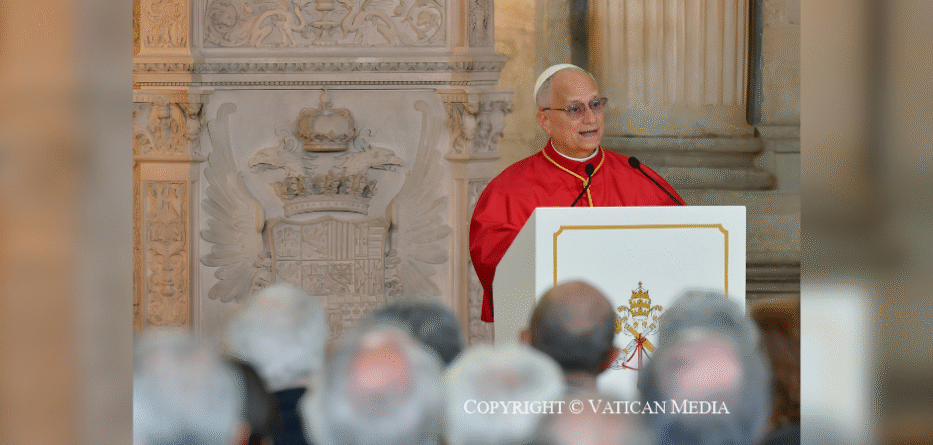
Pope Leo is in Spain. His six-day visit will end on June 12. The richness of what he has said resists summary: his addresses move in a spiral, grafting the great themes of the pontificate onto one another and drawing them upward—toward the spiritual register so dear to this Augustinian Pope.
Yet with the journey still underway, one thread already stands out as plainly important.
Leo has come to Spain at a moment when the country, like Europe itself, seems lost amid its divisions. He has reached for an old, almost artisanal image: weaving. Not the raising of walls, not the moving of pieces across a chessboard, but the weaving of networks.
At the Royal Palace, before the assembled authorities, the Pope began with a night. He invoked John of the Cross and his “dark night”—the hour when we lose our maps and find ourselves without bearings. This, Leo said, is our condition.
But it is also the hour when a light can be born. What is needed, then, is a mysticism with open eyes: not a flight from the world but a gaze that reaches the heart of reality.
Hence, his pointed appeal to a polarized nation was to abandon the narratives that divide and move from facile simplifications to a complexity inhabited as a blessing. Córdoba, Toledo, the school of translators: Spain knows what it is to let languages, faiths, and forms of knowledge live side by side.
At the Movistar Arena, amid culture, art, commerce, and sport, the thread becomes visible. Weave networks, he said again: encounter, listening, dialogue, respect. A society knows how to produce, to innovate, to communicate; what it must learn is to safeguard the soul of what it makes. Become, he urged, new threads.
And then the highest moment of all: his address to the Spanish Parliament, a first. Here, the speech turned political in the fullest sense. Leo looked upward to the skylight that illuminates the chamber and made of it a parable—politics, too, must acknowledge a measure that precedes and exceeds it.
The dignity of the person comes before the state; it does not hang on the majorities of the hour. From Salamanca, from Francisco de Vitoria, the old idea of a totus orbis resurfaces—a human community larger than any single power.
And here his words grew bold. What troubles him, the Pope said, is the return of rearmament — in Europe, too — as a response treated as all but inevitable. Yet weapons, he said, can impose a temporary silence; they can never build a lasting peace. Real security is born of justice and dialogue, not of arms and walls.
He called for safe passage for migrants and for the right not to have to leave at all. He asked that we disarm our language, since words open roads or close them.
A law, he concluded, is not great because it has been passed; it is great when it can stand before the dignity of the person without shame.
Here is what is original in Leo. He does not divide the spiritual from the political. He carries Teresa of Ávila’s interior castle into the parliamentary chamber, making interiority the root of public life and discernment a civic virtue.
His is a geopolitics of weaving: not the clash of pieces on a board but the patient art of interlacing differences.
In a time that fears the unknown and raises walls, the Pope points upward—not to flee the earth but to look more deeply at those who, on earth, have the least voice.
With thanks to Global Catholic and Antonio Spadaro SJ, where this article originally appeared.