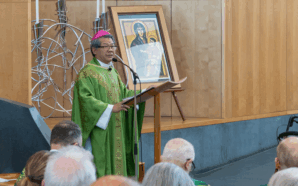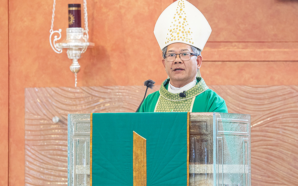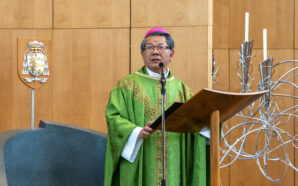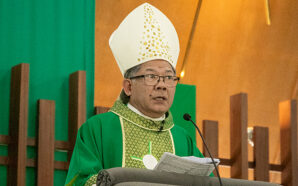


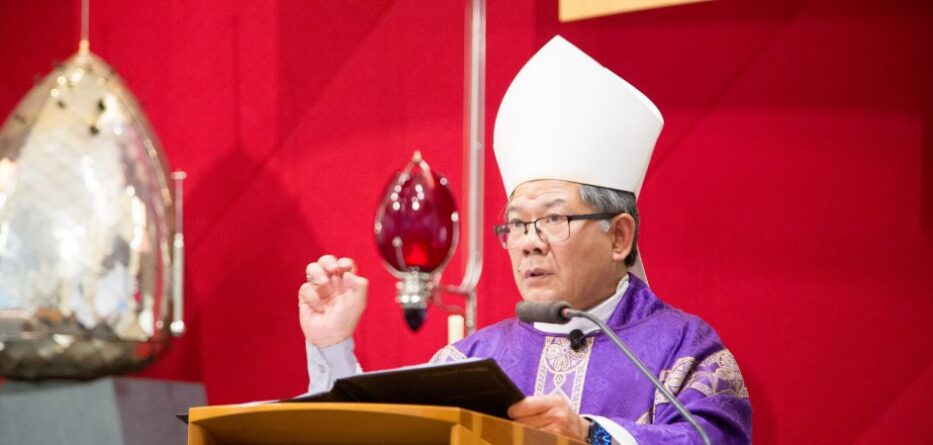
Most Reverend Vincent Long Van Nguyen OFM Conv DD STL, Bishop of Parramatta
Homily for the 3rd Sunday in Lent, Year A
Readings: Ex 17:3-7; Romans 5:1-8; John 4:5-42
8 March 2026
A journey of vulnerable trust, solidarity and covenantal fidelity
Dear brothers and sisters,
It is a very distressful and devastating time for many people on account of the escalating war in the Middle East. The other day, I came across a lady sitting by the statue of Our Lady in the Cathedral. She was sobbing uncontrollably. Upon inquiry, she told me that her family and relatives were caught up in the bombing in Iran. Her pain and anguish – though far removed from the scenes of destruction and devastation in her native country – enabled us to see the human face of the war.
This latest conflict is a sobering reminder to us that the world is still dictated by the might of the military-industrial complex rather than by dialogue and diplomacy. In the midst of the collapse of rules-based order, Pope Leo has rightly appealed for a disarming peace, saying “that true security does not come from control fuelled by fear but from trust, justice and solidarity among peoples.” As people of faith, this is our counter-witness to solutions rooted in the survival-of-the fittest mindset. Building God’s kingdom that seeks true justice and solidarity is our commitment. We can be the voice of social transformation, focused on those in need and inequity.
The Word of God on this third Sunday in Lent speaks of the importance of trusting in God and living by his way. Faith at its deepest level is not synonymous with security, control and self-gain. Rather, it is a journey of vulnerable trust, solidarity and covenantal fidelity. Thus, to follow this God is to walk the path of surrender, self-emptying and the cross of the Suffering Servant.
This is what the People of God were called to do as they made their pilgrim way to the Land of Promise. The exodus was a roller coaster of a journey. Our Jewish ancestors were subject to extraordinary highs and lows: euphoria and excitement as well as hardship and despair. In today’s episode, they succumbed to their basic survival instincts.
They wanted to go back to the slavery in Egypt. They failed to persevere on the journey of transformation which was to become the beacon of the new humanity. This failure was in sharp contrast to the way Jesus responded to the temptations in the wilderness. Whereas the Israelites acted with fear and nostalgia for the past, Jesus did not falter in the face of adversity. He showed us the power of vulnerable trust. He transcended survival instincts. He transcended the human limitations and lifted us into a deeper experience of the living God.
The story of the Samaritan woman at the well also reflects Israel’s journey of transformation. She was branded with stigma and destined to a life of social isolation. Yet Jesus reached out to her and enabled her to grow from a complete outsider to a witness for him. She began the encounter as a curious inquirer and ended as a disciple of conviction. Her growth in faith is reflected in her appreciation of Jesus, first as a Jew, then a prophet, a Rabbi and finally as the Christ.
The story begins with her search for drinking water and finishes with her leaving behind her vessel, going into the city, and inviting others to their own encounter with Jesus, the vessel of living water. That is one extraordinary transformation, one which we are all invited to undergo. Our faith, like that of the Samaritan woman, needs to grow beyond its present limitations to higher levels of interiority and maturity. She is no longer inhibited by her gender, ethnicity, culture and social status. Transformed by Jesus, she is emboldened to share her faith experience with others. She breaks through moral strictures and social conventions to become a witness for Jesus in the same way that Mary of Magdala later became a witness for him after the resurrection.
Dear friends,
Lent is a time when we resist the temptation to have things at our disposal. Whether it is food, drink, entertainment or more weightier matters like power, might, possessions and all things human, our default position is to possess them and use them for our benefit. This is often how we are wired to act individually and collectively. The people of Israel succumbed to this temptation. The Samaritan woman on the other hand was drawn into a deeper experience of the living God in Jesus, despite her limitations.
In this Franciscan Jubilee, we reflect on the life of St Francis who understood and lived the Gospel imperative of powerlessness. His central intuition was to have absolute trust in God and this trust was expressed in such terms as “My God and my all” or “sino proprio” which is a Latin phrase for without anything of one’s own. This fundamental charism was understood as a way to follow the poor, humble and suffering Servant of God. It would permeate the attitude, behaviour and lifestyle of the Poverello. (As a Franciscan parish), let us personify God’s closeness to the poor and marginalised. In a world where might is right, let us form ourselves into a force of solidarity and compassion with God’s children wherever they are oppressed and deprived of their human dignity. May we – like the Samaritan woman – become disciples of conviction for Jesus who came to invite all to the fullness of life in him.