

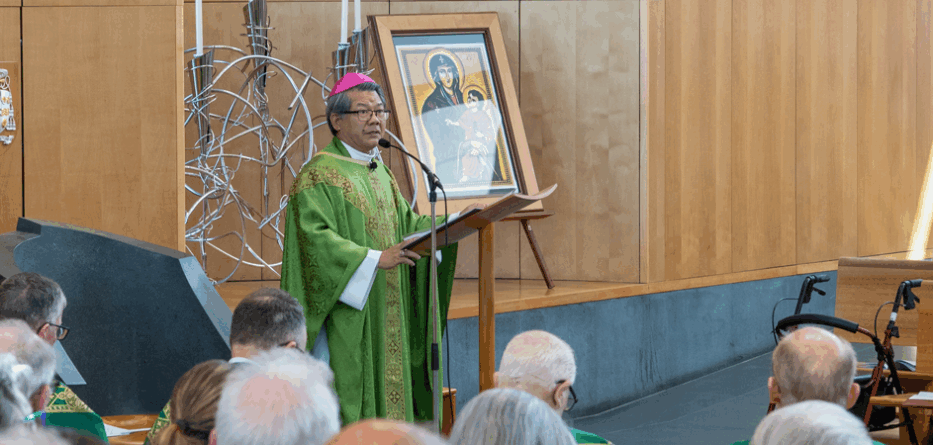
Most Reverend Vincent Long Van Nguyen OFM Conv DD STL, Bishop of Parramatta
The 3rd Sunday of Ordinary Time, Year A
Readings: Isaiah 8:23-9:3; 1Cor 1:10-13,17; Matt 4:12-23
Companioning and serving others in the new Galilee
Dear sisters and brothers,
After the summer break, I am back in my natural habitat where I feel a deep sense of belonging and mission. Though I miss our family home where my parents lived and died, this is my home and you are my family. I am conscious that this is my 10th year, a personal milestone that I am grateful to have been walking with you.
What I have been doing in Parramatta is encapsulated by my motto “going out into the deep”. “The deep” is the peripheries that the late Pope Francis often challenged us to venture into and to encounter the marginalized. It is what Martin Luther King Jr called the place where the victims of injustice languish and where the Church ought to be as a headlight leading them and the rest of humanity to higher levels of justice and emancipation. Tomas Halik, the Czech priest and speaker, uses the metaphor of the new Galilee to speak of the terrain where the modern seekers of meaning, truth and faith traverse. “The deep” is also where we discern the call to be prophetic and challenge the status quo as the catalyst of the Kingdom. Whether it is the engagement with disenfranchised groups, social justice, interfaith, indigenous reconciliation or ecological awareness, we are called to bridge the gaps between the call of the Gospel and the sinful human condition.
Scriptures on this third Sunday in Ordinary Time speak to us about the God who does not remain sheltered in safe harbour but who ventured out into the deep in order to companion his people, especially the insignificant and the forgotten. He leads us and empowers us to move beyond our fears to live a life of faith, hope, love and service. In Jesus, he calls us and forms us into living embodiment of the God who cares for his people.
In the first reading, we hear a hopeful message from the prophet Isaiah who ministered during a very tumultuous time in Israel’s history. The golden era of David and Solomon was over. Israel became a house divided and a pawn for much more powerful kingdoms such as Babylon, Assyria and Persia. The small tribes of Zebulun and Naphtali, which occupied the northern edges of Israel were the first to fall to these foreign forces. They were presumed lost and forgotten.
But in God’s scheme of things, no one and especially no one who is insignificant should be lost and forgotten. This is the underlying message of Isaiah. Against the background of imperial domination where it matters to be powerful, the prophet speaks of a God who pays attention to the weak. Zebulun and Naphtali are not forgotten. They the least of the tribes of Israel who have been trampled upon by the mighty will be restored to honour. Isaiah addresses a message that has become familiar to us at Christmas time: “The people who walked in darkness have seen a great light; those who lived in a land of deep darkness- on them a light has shone.” Hope for the remnants remains God’s unshakeable covenant throughout the ages.
In the Gospel story, we see the fulfilment of Isaiah prophecy through the actions of Jesus. It tells us of how he goes about proclaiming the reign of the kingdom and acting in favour of that kingdom despite the rampant presence of evil. John’s arrest should have served as a warning to him. Yet instead, it was a catalyst for Jesus’ full immersion into a life of service and witness. Jesus refused to sit back and allow sin, evil, injustice, oppression to crush humanity. He went to those places that Isaiah foretold and fulfilled the prophecy concerning the hopes of the oppressed people. He called the twelve apostles who represented the twelve tribes of Israel. He was the embodiment of the God who came to restore what was lost.
It was not incidental that Jesus began his mission in Galilee. For Galilee was emblematic of Jesus’ radical, inclusive and boundary-breaking mission. It was also in Galilee that he instructed his disciples to go and make disciples of all the nations.
Today, more than ever, we as the community of disciples must not stay put in a cocoon of familiarity, security and comfort. We must respond with courage to the risen Lord’s urging to minister with him in the new Galilee. We can’t be siloed in a tribal mindset while the world is rich with intercultural and interfaith encounter. Being in Galilee can only mean to be immersed with the coalface realities of today: the plight of the homeless, refugees, people with their diverse gender identities and other vulnerable groups in our community.
Dear sisters and brothers,
We are the people who have seen the great light of Christ. We are called like the disciples of Jesus to witness to the kingdom, that is an antithesis and an alternate reality to the imperial model of domination and oppression. In a world of darkness and despair, we are called to be the living embodiment of God’s love that is stronger than hatred. We are called to restore what was lost and gather what was scattered.
May the celebration of Australia day move us to heal the wounds of our past, to bring justice our present and prosper our future. May we follow the footsteps of Jesus who proclaimed the Good News of the Kingdom and engaged with people at the periphery of life. May we also find strength to walk with the seekers of truth, meaning and faith in the thresholds and crossroads where the risen Lord beckons.