

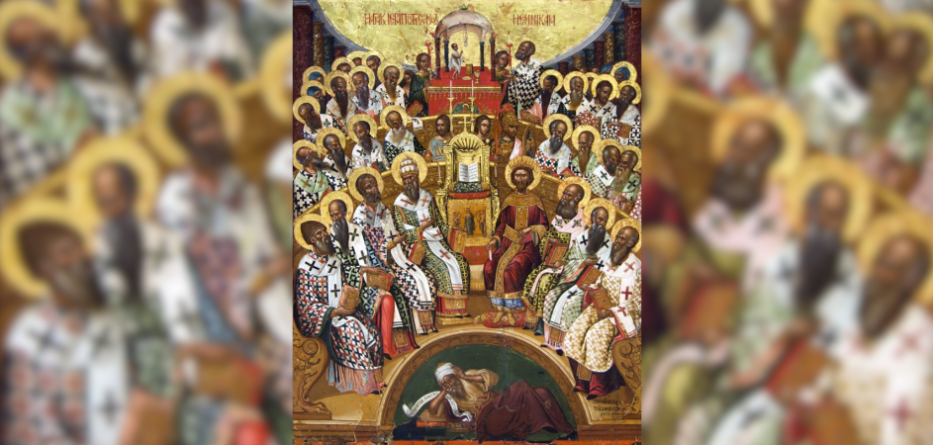
Jesuit theologian Father Alban Massie praised the Vatican’s new document, released April 2, for drawing inspiration from the Council of Nicaea’s approach to unity and dialogue. The document, titled Jesus Christ, Son of God, Savior, was released to mark the 1,700th anniversary of the historic council.
Father Massie highlighted the document’s distinctive method: “The document proceeds with a methodological inversion,” he told La Croix‘s Gilles Donada in an interview. “Normally, we start by questioning God, but here, we begin with how we address God—how we pray, live in his presence,” said the director of New Theological Review, a scholarly journal dedicated to theological discourse. He emphasized that the Creed is not just a statement of beliefs but “a living profession of faith in Christ.”
According to Father Massie, the text presents Nicaea’s model of moving from division to consensus as a valuable lesson for the modern Church, urging “dialogue, respectful disagreement, and communal discernment.” The document serves as a call for unity and reflection in today’s Christian communities.
What is this new document about?
Alban Massie: The commission’s role is to advise the pope, bishops, and Vatican department heads, as well as the wider faithful, on key theological issues. This document isn’t doctrinally binding, but it offers guidance. It commemorates the Council of Nicaea in 325, when bishops from across the Christian world gathered to define their shared beliefs. What sets this text apart is that it doesn’t merely look back in a historical or doctrinal way. It offers a spiritual and ecclesial reading of the council, viewing it as an “event of wisdom.”
What makes its approach unique?
The text emphasizes that the Creed isn’t just a list of truths—it’s also a prayer of praise and a living profession of faith in Christ. Ever tried praying the Creed? The word “immensity” comes up repeatedly. Isn’t it remarkable that we can speak about God not only with biblical terms but also with concepts drawn from our human culture? The Council of Nicaea was a turning point in Christian history—what the document calls “an unprecedented opening to God that transformed human thought.” A kairos, or opportune moment, for reason itself.
“The Creed isn’t just a list of truths—it’s also a prayer of praise and a living profession of faith in Christ.”
The language of the Creed blends theological depth with poetic and everyday expression—think of phrases like “consubstantial” to describe the unity between Father and Son, or “light from light.” But perhaps most striking is the document’s method.
What’s different about the methodology?
It flips the traditional approach. Normally, theology starts with questions about God and then explores how that relates to us. This document does the opposite: it begins with how we relate to God—how we pray, how we live in God’s presence, personally and in community. It starts from the lived experience of faith, including in the liturgy, and works up to an understanding of the Trinity.
From my own faith journey, I can “ascend” to the Trinity. I can reflect on God’s unity by starting with what I experience in the Church. From this perspective, a child’s faith is just as meaningful as a theologian’s insights. The Church is where faith becomes tangible—it’s where we’re baptized, hear the Word, and celebrate the sacraments. Starting with ecclesiology, the document reflects the real-life path of many believers, where lived faith comes before formal theological understanding.
What else does the Council of Nicaea teach us today, according to the document?
The council took place amid fierce debates, especially over Arius’ denial of Christ’s divinity. The bishops at the time found a way to move from division to consensus—through the mediation of the Church. The document recalls how the early Christians at the Council of Jerusalem, as described in the Acts of the Apostles, prayed together, listened to testimony, referred to Scripture, and entrusted the drafting of a binding text to chosen leaders. That same spirit shaped the recent Synod on Synodality—another time of communal prayer, listening, and mutual transformation.
The document sees Nicaea’s method as a model for today’s Church: a way to address internal tensions and foster a culture of dialogue, respectful disagreement, and communal discernment. Church consensus isn’t just a political compromise—it’s a fruit of the Spirit, born of prayer and community.
Are there other key takeaways?
Yes, especially the affirmation of Christianity’s deep roots in Judaism and the vision of a God who is both one and capable of plurality. “God exceeds anything we can conceive or imagine, because his Oneness includes a real plurality that doesn’t break that Oneness.” The document references Jewish historian and philosopher Daniel Boyarin, author of The Jewish Gospels, and urges a renewed theological and liturgical connection between Easter and Passover.
The issue of when to celebrate Easter is also raised.
It’s a beautiful ecumenical challenge—what if Catholics and Orthodox Christians could once again celebrate Easter on the same date, not just by chance? That would send a powerful message of unity to a divided world. The document also reflects this ecumenical spirit in its sources. It draws heavily on the early Church Fathers—figures shared by both Catholic and Orthodox traditions. While it doesn’t directly address papal authority, it does quote Paul VI, Benedict XVI, and Pope Francis.
What’s next for this document?
It’s an invitation to dialogue—among Catholics, between different Christian traditions, and between Jews and Christians. Its core message could be summed up this way: “Let’s not get stuck on differences in vocabulary or concepts. We can understand each other. We did it at Nicaea, and we can do it again today.”
Reproduced with permission by La Croix International.