

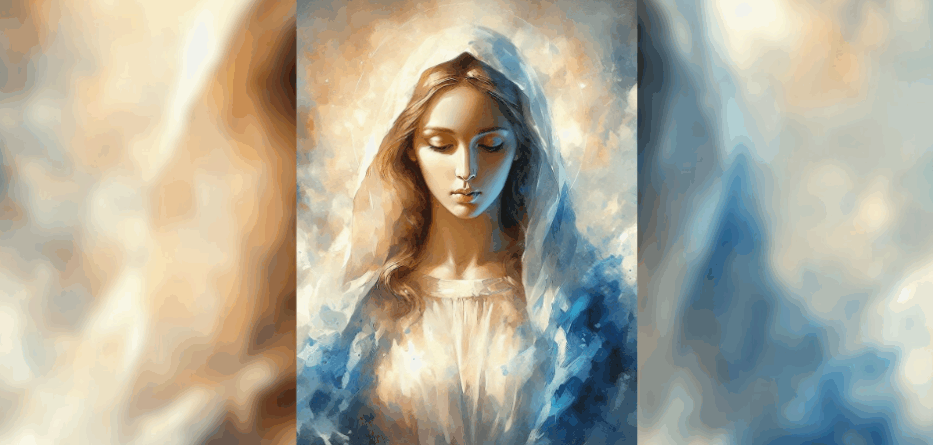
Somewhere in ancient Israel, a baby girl takes her first breath, and the universe holds its breath with her. No trumpets sound. No kings arrive bearing gifts. She was born to parents who had almost given up hope. That birth, on Sept. 8, as tradition tells us, would eventually crack history wide open.
The powerful men writing chronicles had no interest in recording the birth of an ordinary girl child. But here is what those chroniclers missed: they were witnessing the arrival of someone who would reshape the world not through conquest or politics, but through the radical act.
This oversight feels painfully familiar in India, where countless daughters have been born into silence, their potential dismissed before they can even walk. Yet Mary’s story whispers something subversive to anyone willing to listen: the girl child you barely notice might be carrying the seeds of transformation in her small fists.
In remote villages of India, where Catholic missions have taken root, you will discover something remarkable. The people who built schools from nothing, who taught children to read under banyan trees, who held dying strangers in their arms — many of them were women whose names history forgot to record. They understood intuitively what Mary knew: the most profound changes happen not in palaces, but in the quiet spaces where love meets need.
Consider the countless Catholic nuns who arrived with little more than faith and determination. They learned local languages, ate unfamiliar food, slept on hard floors, and somehow convinced entire communities that education was worth pursuing.
They proved that one person choosing compassion over comfort could change the course of hundreds of lives.
But the real magic happened in the spaces between the official stories. In Kerala fishing villages, women gathered children for catechism classes on sandy beaches. In Himalayan settlements, female catechists trudged through snow to reach isolated families. In Mumbai slums, laywomen organized feeding programs from their own modest kitchens. Their work was invisible to those who write reports, but it was visible to every child who learned to read, every family that found hope, and every community that discovered its strength.
These women shared something profound with Mary: they understood that true power often wears ordinary clothes. Mary didn’t need a crown or a title to change everything; she just had to trust that her yes mattered, even when she couldn’t see where it would lead. The women carrying forward Catholic missions in India embody this same mysterious courage. They say yes to teaching children who might never thank them. They say yes to caring for the elderly who have no one else. They say yes to standing up for justice when it would be easier to stay silent.
What strikes you, if you really look, is how these women have consistently chosen the harder path. They could have taken easier routes, safer choices, and more comfortable circumstances. Instead, they chose to pour themselves out like water on thirsty ground. They believed that their small acts of love could somehow make a difference in a world that often seems indifferent to love.
This is where Mary’s nativity becomes more than just a joyful celebration. It turns into a declaration that every girl born carries within herself the same capacity for transformative love.
Not because she is meant to become famous or powerful in traditional ways, but because she is meant to be fully human, and being fully human means having the ability to choose love over fear, service over selfishness, hope over despair.
The tragedy is how many daughters in India never get the chance to discover this about themselves. Poverty, discrimination, and cultural restrictions conspire to make girls believe they are worth less than their brothers. But Mary’s birth declares that God looked at all creation and chose to enter the world through a young woman’s courage. If that doesn’t speak to the infinite worth of daughters, what does?
Today’s Church in India is gradually recognizing what should have been clear from the start — that women are not just helpers in the mission, they are central to it in many communities. They are the ones uniting communities, passing on faith to the next generation, and coming up with creative solutions to problems that confuse expert committees.
When we celebrate Mary’s nativity, we are not just remembering something that happened long ago. We are recognizing something that occurs every time a girl is born anywhere in the world. We acknowledge that the next person to change everything might be taking their first breath right now, in a hospital in Chennai, a village in Assam, or a city in Punjab.
The question isn’t whether girls can transform the world — Mary already proved that. The real question is whether we have the wisdom to see that potential and the courage to support it. Every daughter should know what Mary knew: that her yes matters, that her voice is important, and that her dreams are worth chasing.
In celebrating Mary’s birth, we honor every girl who will ever be born with divine fire in her heart, waiting for her moment to illuminate the darkness.
*The views expressed in this article are those of the author and do not necessarily reflect the official editorial position of UCA News.
With thanks to Union of Catholic Asian (UCA) News and John Singarayar, where this article originally appeared.