

Most Reverend Vincent Long Van Nguyen OFM Conv DD STL, Bishop of Parramatta
Homily for the ordination of Luke Huynh to the Diaconate on 11 April 2026
‘Ordained to serve like Christ the wounded healer’
Readings: Acts 4:32-35; 1 John 5:1-6; John 20:19-31
“This is the day the Lord has made. Let us rejoice and be glad!”
Dear friends,
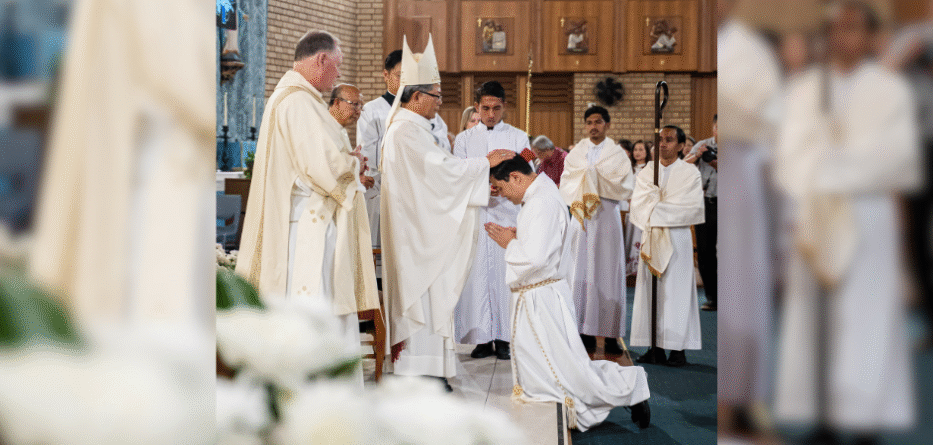
This evening, we gather in Easter joy to give thanks and to pray for our brother Luke, one of the three seminarians from our Holy Spirit, who after an 8-year-long process of study, discernment and formation are to be ordained to the order of deacons. God has worked in mysterious ways to shape him into his instrument. His openness to the stirrings of the heart and the promptings of the Spirit has led him on a vocational journey far beyond the tranquil shores of his childhood. Luke was born to and raised by very devout parents. They provided a caring, faith-filled and perhaps somewhat protective environment for him. This was strengthened by his many years of involvement in the popular Eucharistic Youth Movement in Vietnam.
Luke moved to Sydney as an overseas student. After completing a degree in accounting, he applied and was accepted into our seminary. The God who formed him in your mother’s womb continues to guide him, through unexpected ways at times. Dietrich Bonhoeffer captured the essence of Christian vocation, saying that that there is hidden meaning in every journey that is unknown to the traveller. It is in generously responding to the God of surprises that we are shaped into the person who are meant to become.
Scriptures on the Second Sunday of Easter invite us to grow to higher levels of spiritual consciousness. Living the Christian faith at its deepest level does not always mean we have access to power, influence and ability to problem-solve at our fingertip. Rather, it is a journey of vulnerable trust. It is a discipleship of humility, powerlessness and vulnerability. Faith enables us to grow not necessarily through prosperity, security and certainty but often times through trials and tribulations. Growth germinates not in tent dwelling but in upheaval, not in withdrawing to safe harbour but venturing out into the deep.
We are inspired by the early Christian community, who shows us the way out of the darkness of despair and disillusionment in the wake of the crucifixion. In fact, right throughout the Easter season, the scriptures focus our attention on the fledgling Church and how it transforms itself into a shining instrument of the Gospel. What is presented in today’s account is a rather idealistic picture of the early Christian community. It is one of faith, peace and generosity. Though marginalised and persecuted, it is a powerhouse of prayer, internal cohesion and solidarity. For this reason, many were attracted to join them.
Incidentally, many dioceses this year also report an increase in the number of new converts. While this may be too early to conclude that we have turned the corner and a religious revival has begun, we can imitate the early Christian community in being the force of spirituality, compassion and solidarity. It is the church of our origins which was at its best because it was few in numbers, poor, humble, synodal and aligned with the Gospel. It is this model community rather than the dominant, powerful imperial church of Christendom that we endeavour to emulate.
The Gospel today tells us the story of Jesus showing himself to his disciples after his resurrection. The evangelist is very clear that even in his risen state, the crucifixion wounds do not disappear. The resurrected body of Christ remains marked by his earthly suffering, forever. It is not until the disciples see the wounds of Christ that they recognise Jesus for who he is. Thomas who saw these wounds exclaim: “My Lord and my God.”
As the late Pope Francis often reminded us that what the Church needs most today is to heal wounds, to warm hearts and to offer closeness to those who suffer. We embody the wounded Lord and minister to his wounds in the poor, the sick, the captive, the disadvantaged. The Church without wounds and Christian faith without wounds are not compatible with the Gospel. Our ministry as wounded healers can only be authentic when we immerse ourselves in the liminal places of pain, ambiguity, struggle and despair. Indeed, our shared suffering with others is the precondition for the preaching of the Good News. For that was the way of Jesus.
Dear Luke,
You are ordained to diaconal ministry today in the context of changing times. We face considerable head winds going forward. Yet like the disciples in the Upper Room, we have the presence of the Lord, wounded, risen and vindicated. We are strengthened by his power and his example to be the wounded healers beyond our own faults and limitations. Your ordination today brings joy, hope and renewal to us. The Church here and beyond is reinvigorated by your passion for the Gospel and enriched by your gifts. Your fellow clergy and God’s people are strengthened by your companionship. May your work for the faith in Jesus Christ be blessed abundantly. May Mary our Mother surround you with her maternal love, inspire you with her faithful discipleship and support you with her intercession.