

Today we celebrate Father’s Day. My warmest congratulations to all fathers and grandfathers.
Today’s Gospel isn’t much to laugh about. It says that one can only follow Jesus if one renounces one’s father and mother. How can one celebrate Father’s Day with this reading. Added to this is Jesus’s admonition: “You shall not call anyone on earth your father, for you have one Father, who is in heaven.” (Matthew 23:9).
Jesus wasn’t a typical family man either. He says that family ties often hinder commitment to the Kingdom of God, in which there is no longer any rule of man over man, but all are brothers and sisters through God. Jesus calls God only “Abba.” This is an Aramaic term of endearment for a tenderly loving father.
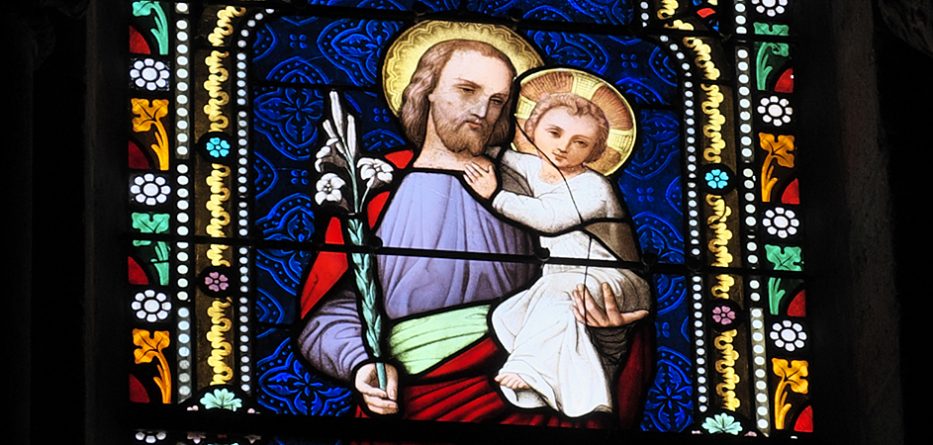
And what about Saint Joseph?
According to the biblical narrative, the carpenter from Nazareth assumed the human fatherly role for Jesus. He is not a fearsome “patriarch.” Rather, he is portrayed as a sensitive, attentive, faithfully caring man. This is perhaps the human experience behind why Jesus, later in his preaching, can easily call God “Father,” a loving and merciful Father indeed. A Father who allows freedom, but also discreetly seeks out the “lost” and opens up new opportunities for them. In short: God the Father as the “friend of life,” as the Book of Wisdom already states (Wisdom 11:26).
In the second reading, Paul presents himself as the father of Onesimus. Paul refers to himself as the spiritual “father” of Onesimus in the Book of Philemon because Paul converted Onesimus to Christianity, making him his “son in the faith” rather than his biological son. This “father” and “child” relationship is a common metaphor in the Bible and ancient cultures to denote a spiritual mentor who leads someone to faith in Christ.
This also gives us an important clue to what a father can be: a man who, in addition to providing materially, also excels spiritually.
And here lies the answer to Jesus’ statement already mentioned. He is using hyperbole to illustrate the steep cost of following him. Any prospective follower must be glad to give up everything, to love him unreservedly—to sell all to have him as your highest treasure (Matt. 13:44–46). Our affections for Christ must be of such an intensity and quality that, by comparison, all other loves seem like hate.
The phrase “Every father is first a disciple of Christ” is not a quotation from the Bible, but a theological statement or a metaphorical paraphrase that says that all fathers, just like other people, are called to follow Jesus and learn from him.
But as a disciple, every father also prays to our Father in heaven. The Lord’s Prayer is, first and foremost, a disciple’s prayer. Every line is about Jesus’ followers forgetting their own desires and life plans and wanting only what God wants.
But this is precisely the wisdom of which the second part of the Gospel. It is about the wisdom of faith that is required to excel and prosper in life. What is decisive for the success of a life project is not the good intention, but the actual ability to have the means necessary for the successful implementation of the project.
Perhaps fathers and grandfathers could, in addition to their wisdom of life, also pass on wisdom of faith to their children so that they too can prove themselves in the faith.
In the book of Deuteronomy, this is also recommended to fathers: “You shall teach them diligently to your children, and shall talk of them when you sit in your house, and when you walk by the way, and when you lie down, and when you rise up.” (Dt 6:6-7)
The Bible shows us that every father should diligently teach his children how to walk in the ways and words of God to ensure the spiritual development and well-being of the child. The Christian father is an enormously important tool in God’s hand. The human father should never pretend to be the final authority in determining truth and duty. Only when we make God our teacher and ruler can the goals of education be achieved.
Have a wonderful Father’s Day.
Fr Joe.
Joseph Lam PhD STD
Parish Priest of Baulkham Hills Parish
1 Chapel Ln, Baulkham Hills NSW 2153