

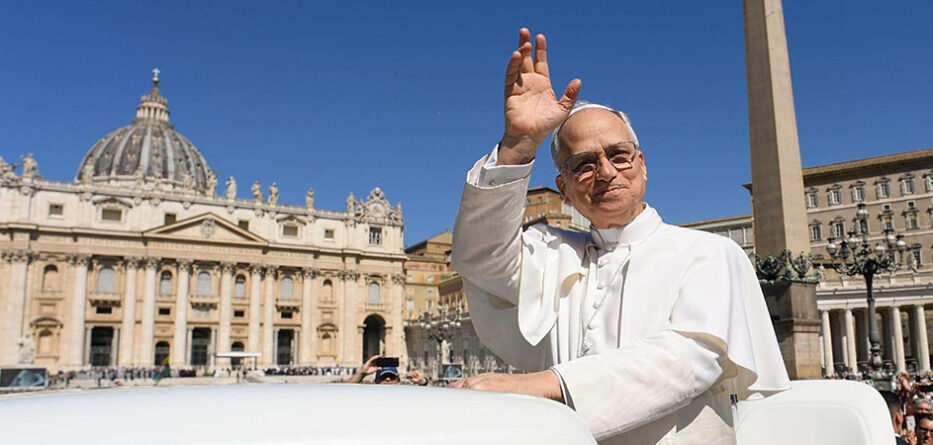
The American monthly magazine Vanity Fair has just released a best-dressed list, and among the Hollywood stars and the power couples is also Pope Leo XIV.
In December 2025 – just a few months after his election – Leo already found himself featured alongside A$AP Rocky and Bad Bunny in Vogue’s best-dressed list, while the New York Times named him as one of its 67 “Most Stylish People of 2025”.
What would St. Augustine say?
What we can say is that, in just a few months, and despite the Trump administration, the pontificate of Pope Leo has improved the chemistry of relations between the USA and the Vatican.
President Trump, his administration, and the MAGA galaxy are moving in a disjointed manner compared to the gravitational forces now realigning this transatlantic relationship, which is crucial for the Vatican, global Catholicism, and the US Church.
For twelve long years, influential sectors of American Catholicism formed the political, financial, and media centers of the opposition to Pope Francis: a movement that began very early in his pontificate, in the spring and summer of 2013, and lasted until his death.
Today, those same sectors that were the second- or third-line in the anti-Francis front (not the first line, like Steve Bannon, Peter Thiel, and the like) have adopted a more conciliatory and businesslike approach.
The Vatican is paying attention. In an article published on Aug. 17, Dutch theologian and journalist Hendro Mustermann investigated “how Pope Leo XIV dined in secret with wealthy American donors” after a July 29 prayer for peace in the papal gardens of Castel Gandolfo.
The USA and the Vatican: from friction to rapprochement
This rapprochement happened for different reasons: Pope Leo is American, and right-wing Americans know that frontal opposition against him would be counterproductive. Many Americans are genuinely proud and excited about the first pope from the USA.
Those with an entrepreneurial mindset (in business, sports, academia, and the cultural industry) are also excited about the opportunities this pontificate offers.
There is also another factor: Leo’s teaching has adopted a more pragmatic and realistic tone.
An example of the reframing of US-Vatican relations is the first encyclical. Leo XIV invited, at the encyclical’s presentation, thirty-three-year-old multimillionaire Christopher Olah (formerly a Peter Thiel brainchild), one of the cofounders of the San Francisco-based company Anthropic, which is now in a tense relationship with the Trump administration.
But Magnifica Humanitas is a politically realistic approach to the social questions underlying the current technological revolution.
In the fifth century, Augustine, more pragmatic than the man who converted him to Catholicism—the bishop of Milan, Saint Ambrose, who favored a radical redistribution of wealth—faced the challenge of keeping the rich and the poor together within the church in North Africa.
Leo XIV helps us look to another America, different from the alliance formed around Trump between “Christian nationalism” and the techno-authoritarian entrepreneurs of Silicon Valley.
Leo brings together leading experts in artificial intelligence while maintaining the papacy’s leadership in global Catholic activist identity on issues of social justice and poverty.
Leo’s leadership does not, at least for now, have to deal with the relentless hostility of right-wing, neoconservative, and illiberal Catholic voices in the USA as Pope Francis did. This does not mean he is less lonely than his predecessor.
Papal teaching today, when it speaks about the environment or AI, is a globally acclaimed yet solitary voice: it cannot count on Catholic or Christian Democratic parties as Leo’s predecessors could, at least until the end of the twentieth century, nor is there a counterpart or interlocutor in social-progressive culture, which is currently at its nadir in the West.
When it comes to Catholic social doctrine, the papacy cannot count on a generation of Catholic political leaders. Today, the “cultural Catholics” with political goals have become more captivated by neo-nationalist platforms.
In this sense, Leo XIV’s pontificate is more similar to Leo XIII’s (with Catholics viewing the path of political modernity from absolutism to democracy as that of outsiders) than to those between 1945 and the end of the 20th century (the golden age of Christian-Democratic political parties in Europe).
Compared with the tumultuous spring of 2026, the summer has been a period of relative calm in relations between the Vatican and the USA, both ecclesiastically and politically. The July 13 response by the Vatican Dicastery for Communication to statements made by the US Ambassador to the Holy See on papal authority as sovereign of Vatican City State was an exception.
How Pope Leo is not trapped in the anti-Trump movement
July and August tell the story of a solid relationship between Pope Leo’s pontificate and the USA: the July 4 visit to the US Ambassador to the Holy See; the July 25 appointment of two American bishops, Cordileone and Lohse to the Supreme tribunal of the Apostolic Signatura; the July 29 interview with the American television network NBC in Castel Gandolfo; the August 12 meeting with a bipartisan delegation of the US House of Representatives that met with top Vatican officials to discuss artificial intelligence during a visit that briefly included Pope Leo XIV; the August 25 appointment of Patrick E. Kelly, Supreme Knight of the Knights of Columbus, to the Dicastery for the Laity, Family, and Life.
Moreover, Leo XIV speaks more often in English, even when the message might be difficult to convey in his native country: for example, on Sunday, August 30, after the Angelus, he spoke about the September 1 celebration of the “World Day of Prayer for the Care of Creation.”
The Vatican talks with everybody. The Vatican and the pope also know today that the midterm elections will be held in November, which might be very consequential for what remains of the second Trump term until January 2029.
This pontificate has not been hesitant in dealing – albeit indirectly – with the political expropriation of religion in the name of ethno-nationalism in America, especially for what this means for American foreign policy in international relations.
But Leo XIV has decided not to be trapped in the role of spokesperson for the anti-Trump movement. That would be a form of captivity that limits the role of the Holy See. It is a way to prepare for the post-Trump era. This also entails talking and interacting with those American Catholics who are not yet or not necessarily anti-Trump.
With thanks to Global Catholic and Massimo Faggioli, where this article originally appeared.