

What if the most important church in your life isn’t your parish—but your own home?
For centuries, the Catholic Church has called the family the “domestic church,” recognising that faith doesn’t begin and end at Mass. It’s built in living rooms and kitchens, through daily choices and quiet sacrifices. In a world that’s busier than ever, rediscovering the sacred role of the family might just be what the Church—and our hearts—need most.
So, what is the Domestic Church?
The Church teaches that the family is the “domestic church”—a sacred space where faith is lived, shared, and passed on. It’s not a new idea. The early Christians didn’t have big cathedrals or formal institutions. They gathered in homes. They prayed, taught their children, broke bread, and supported one another in ordinary daily life.

For the Amaratunga family, pictured together after Mass, faith is a shared journey. In the Carmelite spirit of contemplation and community, their devotion to Our Lady of Mount Carmel is nurtured not just in prayer, but in the quiet love and service they offer one another each day. Image: Alphonsus Fok/Diocese of Parramatta
The Catechism puts it simply, “The Christian home is the place where children receive the first proclamation of the faith… a community of grace and prayer, a school of human virtues and of Christian charity.” (CCC 1666) In other words, our homes are meant to be little churches.
In today’s world, many forces pull us away from God—constant noise, distractions, pressures, and secular values. All of us are constantly being formed by what surrounds us. If faith isn’t alive at home, it’s easy for it to become just a ritual or tradition rather than a relationship with Christ.
The domestic church is where real discipleship happens. It’s where faith becomes personal, where questions are asked, where love is practiced, and where souls are formed. The domestic church should be a safe, uplifting space to explore these topics supporting the quality teaching of your local priest or parish community. Would you really want the main source of faith knowledge coming from TikTok or any social media outlet where you are unable to freely discuss and explore topics or ensure the information is vetted? Would you want your children to ask you or your Priest, or would you prefer they seek knowledge from their teachers, or even peers?

Sudan-born migrant Agul Tong, pictured with husband Kwat and their four children, said she “loved everything” about Mary, Queen of the Family Parish in Blacktown. Image: Alphonsus Fok/Diocese of Parramatta
If we outsource our faith, is it really that important to us?
As someone who was poorly catechised growing up, even though I ONLY attended Catholic schools, went to church with my mother as a child and was active in my Catholic youth group in high school, and I still did not understand key aspects of my faith until I went searching years later.
Our relationship with God needs daily attention: in how we speak (Ephesians 4:29), how we treat one another (John 13:35), how we handle stress (Matthew 6:34), and how we create space for prayer (1 Thessalonians 5:16-18). If our homes are spiritually silent, we’re missing the opportunity to let the grace of the Eucharist transform the rest of our lives. Which then begs the question how do you start building a domestic church? What does one look like?
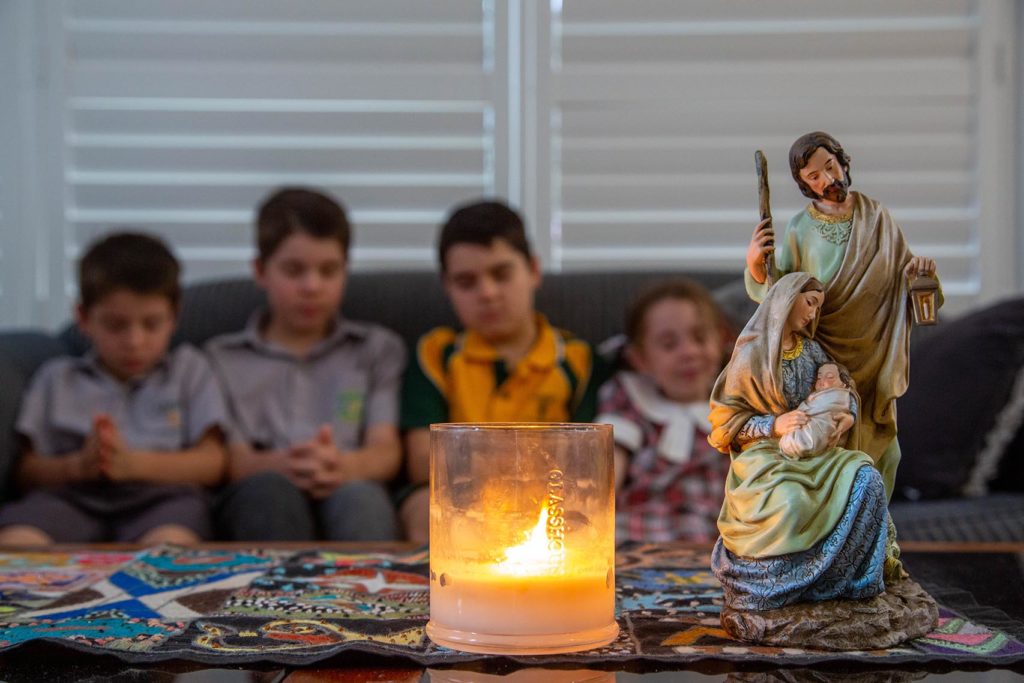
The Aguiliera children in prayer at their home in Parramatta. Quiet time for family reflection and prayer is an important part of the family routine. Image: Mary Brazell/Diocese of Parramatta
A domestic church is just that: a family. We look to the Holy Family of Joseph and Mary, who created a domestic church for Jesus as a model. We also look to Jesus, whose own community of disciples created a form of domestic church as well as a place of learning.
You don’t need to be a theology expert or have a perfect family to live your faith at home. The domestic church is built in simple, consistent moments:
- Prayer before meals or bedtime
- Talking about Sunday’s Gospel as a family
- Creating a prayer corner or sacred space in your home
- Listening to Catholic podcasts or music while driving
- Practicing forgiveness and patience, even when it’s hard
- Celebrating feast days or saints’ days in small ways
- Modelling joy in your faith, not just obligation
These small acts create a culture where faith isn’t confined to one hour on Sunday—it becomes part of your family’s identity.
The Catechism calls us to take up the burden, stating, “In our own time, in a world often alien and even hostile to faith, believing families are of primary importance as centres of living, radiant faith. (CCC1656) and we can all make a difference.
This week, embrace this challenge and start small; pray as a family; read a Bible passage and discuss before you watch TV; put up a crucifix in your home.
You do not have to be perfect, just willing and present. When the church is alive in our homes, our whole life starts to change.

Image: SewCreamStudio/Shutterstock