

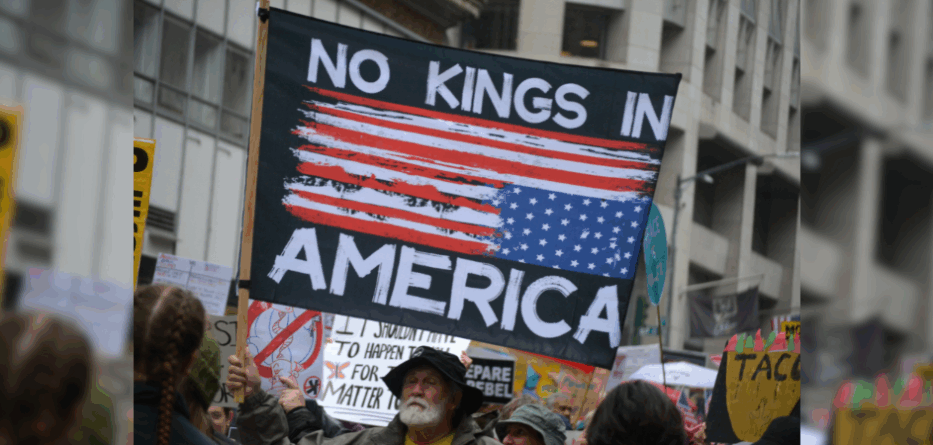
On October 18, the day of the most recent nationwide No Kings protest, my wife and I were driving back to Chicago from our son’s cross-country meet in Rock Island, Illinois. With some online sleuthing, we found a protest in the town of Oregon. We bought posterboard and markers, made makeshift signs (mine read “George Santos + Jeffrey Epstein = Donald Trump”), and headed to Oregon’s downtown courthouse. We feared we would be two of a dozen, but the headcount, we were told, was nearly seven hundred, impressive for a town of 3,700 in a ruby-red part of the state. The mood was defiant but celebratory; people seemed to find hope in gathering with others disturbed by the increasing authoritarianism of the government. The idea that we are subject to no king is deeply American.
On November 23, Catholics will nevertheless make an exception for one King; the liturgical year will close, as it does each year, with the feast of Christ the King. This year, in fact, marks the hundredth anniversary of the feast. Though the roots of the feast are biblical (e.g. Isaiah 9:6–7, Luke 1:32–3) and the identification of the kingship of Christ is certainly medieval, the feast itself is a modern innovation, established by Pope Pius XI in 1925, three years into Italy’s Fascist era. In Quas primas, the encyclical establishing the feast, Pius XI wrote that it was directed against the “plague of anti-clericalism” that had swept the world. The rights of the Church were denied in many countries—Mussolini’s Italy was no exception—and the rise of communism had led some countries even to deny God. Pius XI reiterated his previous contentions that
these manifold evils in the world were due to the fact that the majority of men had thrust Jesus Christ and his holy law out of their lives; that these had no place either in private affairs or in politics: and we said further, that as long as individuals and states refused to submit to the rule of our Savior, there would be no really hopeful prospect of a lasting peace among nations.
As a remedy, Pius XI proposed Christ the King, who is law-giver, judge, and executive power in one. This power is “spiritual” and “not of this world,” but “it would be a grave error, on the other hand, to say that Christ has no authority whatever in civil affairs, since, by virtue of the absolute empire over all creatures committed to him by the Father, all things are in his power.”
Naming Christ as king gives rise to certain tensions. One possibility is to identify divinity with kingship, exalting earthly rulers to godlike status, a temptation yielded to by many early modern kings. Another possibility is to declare that Christ alone is king, thereby humbling all earthly rulers and making them subject to Christ. In Quas primas, Pius XI seemed to want it both ways, declaring that rulers “rule, not by their own right, but by the mandate and in the place of the Divine King.” On the one hand, “not by their own right,” but on the other hand, “in the place of” God. On the one hand, all are “subject to the power of Jesus Christ” and rulers owe “reverence and obedience to the rule of Christ.” On the other hand, “Men will see in their king or in their rulers men like themselves, perhaps unworthy or open to criticism, but they will not on that account refuse obedience if they see reflected in them the authority of Christ God and Man.” The pope was still hoping in 1925 for rulers who obeyed God and people who obeyed their rulers.
That “if they see reflected” became more and more counterfactual in Italy as Mussolini tightened his grip on power. Mussolini, though a dedicated anticlericalist, wanted the Church’s support to consolidate his power, and offered concessions like reinstating religious education and crucifixes in primary-school classrooms. Pius XI wanted freedom for the Church’s ministries and was willing to negotiate with the Fascists. The result was the Lateran Treaties of 1929, by which the Church recognized the state of Italy and received compensation for the loss of the Papal States, and Catholicism was recognized as the “only religion of the State.” Two years later, however, Pius XI issued an encyclical, Non abbiamo bisogno, that recognized that a new religion had taken hold in Italy:
a regime based on an ideology which clearly resolves itself into a true, a real pagan worship of the State—the “Statolatry” which is no less in contrast with the natural rights of the family than it is in contradiction with the supernatural rights of the Church.
Mussolini had unleashed his thugs on Catholic Action and Catholic youth organizations. In reference to Mussolini, Pius XI wrote,
he is a Catholic only in name and by baptism (in contradiction to the obligations of that name and to the baptismal promises) who adopts and develops a programme with doctrines and maxims so opposed to the rights of the Church of Jesus Christ and of souls.
The tension I noted above, between sanctifying public power and critiquing it, continues to stalk the Catholic world. There are those for whom the feast of Christ the King is an affirmation of the integralist aspiration to reunite church and state. On last year’s anniversary of the feast, Catholic World Report published a review of a recently reissued 1928 book on Quas primas titled The Reign of Christ by Joseph Husslein. The reviewer’s takeaway for the present day is this:
Surely we can agree that it is better for rulers to humble themselves before God’s altar than for them not to do so…. Yet many modern Catholics are deeply uncomfortable with state recognition of the true religion…. I suggest that if this is controversial to us, something is seriously missing in our Catholic sensibilities.
The USCCB takes a different tack, framing Quas primas within its campaign for religious liberty. Pius XI instituted the feast of Christ the King to oppose “secularism and atheism”; today “our faith is repeatedly marginalized in public life.” “This solemnity encourages us to celebrate and live out our faith in public.” Though very different, both approaches—like Quas primas itself—are tainted by nostalgia and resentment for the Church’s loss of public power.
There is another possibility latent in this feast: that our loyalty to Christ the King would supersede and check our loyalty to any ruler, any nation-state, any structure of corporate power. At the present moment, the deepest problem is not the evacuation of divinity from the public sphere, but rather the idolatry of the nation. As in Pius XI’s time, authoritarian leaders try to harness Christianity to bolster their power. The Church needs to reject the unfaithful and counterproductive attempt to ride the coattails of authoritarians back to social relevance. Catholics and all Christians need to place discipleship before patriotism. We are not simply Americans who have “No Kings”; we are Christians who have no king but Jesus.
Reproduced with permission by Commonweal.