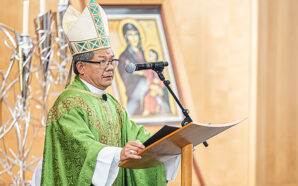


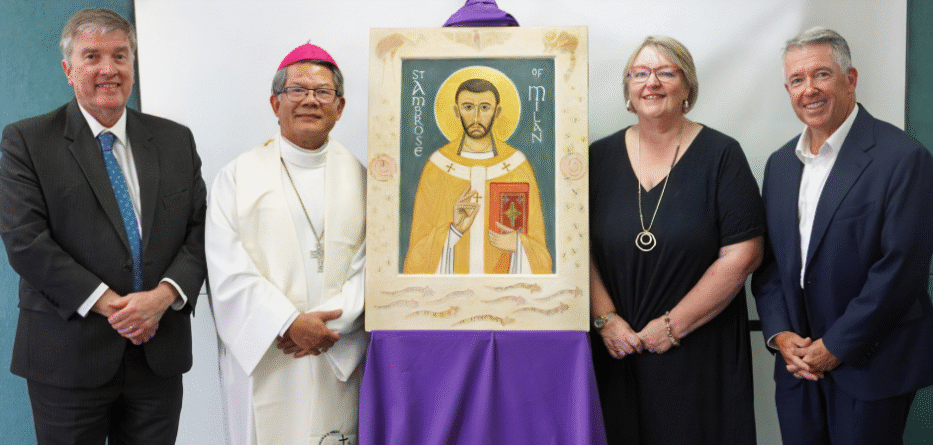
In a celebration of faith, place and purpose, a contemporary icon titled St Ambrose in Parramatta was recently blessed by Bishop Vincent Long OFM Conv, Bishop of Parramatta.
“Written” for Community Ventures by iconographer Mary Clancy, with indigenous artwork design by Darug artist Leanne Watson, the blessing of the icon marked a significant moment for Community Ventures. More than a beautiful work of art, the icon brings together the life of St Ambrose of Milan, the story of Parramatta, and the educational mission at the heart of Ambrose Early Years Education and School Age Care services.
As Mary said: “This is liturgical art. It is not created simply for decoration, but to encourage prayer and conversation with this Christian patron and role model.”
For Ambrose Early Years Education and School Age Care, the icon offers both a spiritual presence and a point of reflection for children, educators and families, inviting all who encounter it to feel welcomed into a shared story of faith, learning and community.
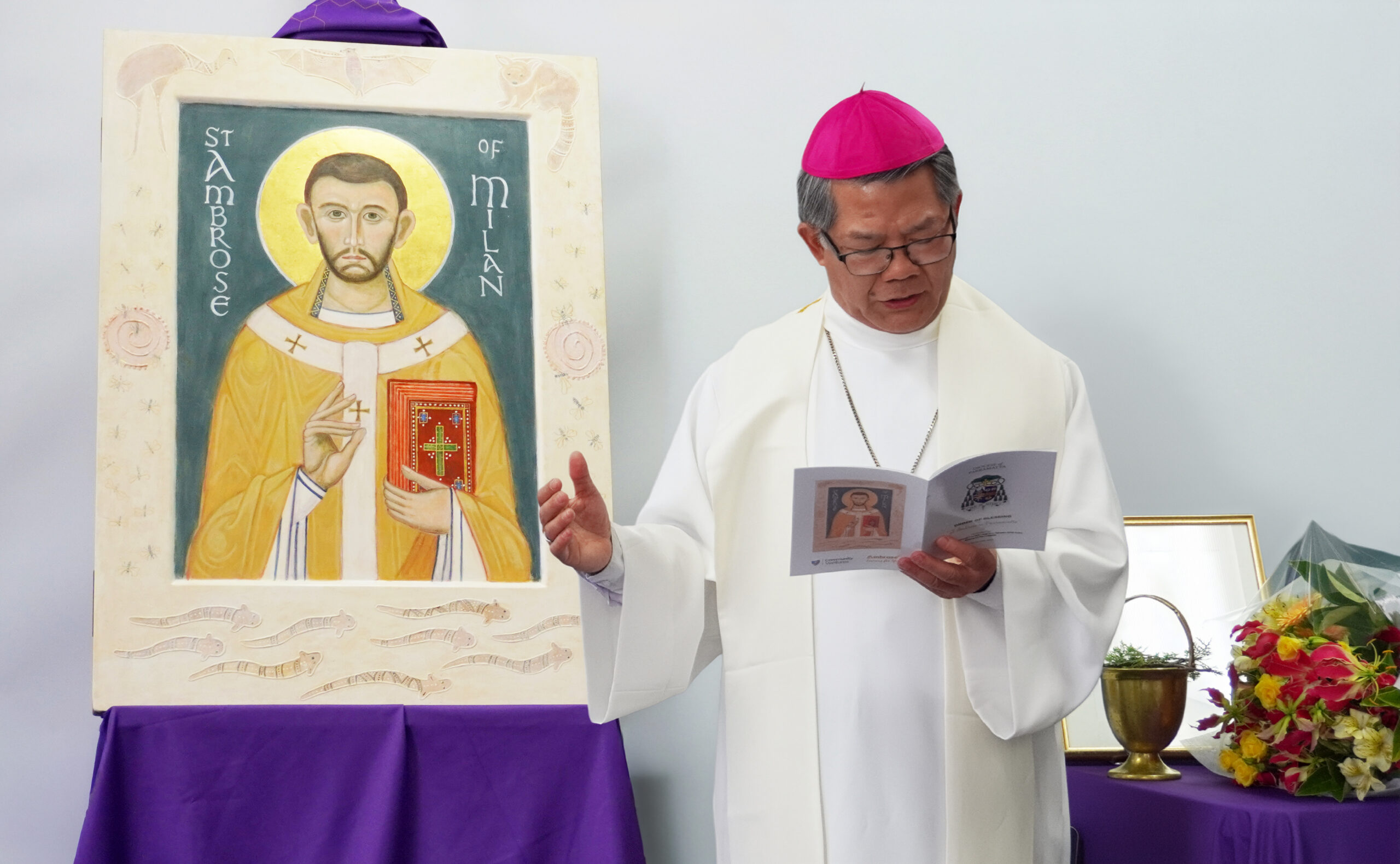
Bishop Vincent blesses the Icon titled ‘St Ambrose in Parramatta’. Image: Supplied
Honouring St Ambrose
St Ambrose is remembered as a compassionate bishop and scholar, especially committed to children, the poor and the vulnerable. As the Patron Saint of Learning and Beekeepers, he is traditionally associated with the story of bees resting on his lips in infancy, a sign that his speech and teaching would one day be “as sweet as honey”. Painted using the renaissance technique of egg tempera, the icon of St Ambrose is rich in symbolism. Ambrose is shown wearing a Roman toga, signifying his early career as a Roman official before his election as Bishop of Milan. His role as Bishop of Milan is expressed through the pallium and his priestly vestments, while the jewelled Book of the Gospels reflects his reputation as one of the Church’s great preachers.
Ambrose’s raised hand, set against a blackboard‑like background, identifies him as a scholar and teacher. Behind his head, the radiant halo symbolises holiness, his divinity and eternal life.
Placing St Ambrose in Parramatta
Distinctively, this icon places St Ambrose within the Diocese of Parramatta. The border, designed by Darug artist Leanne Watson, places Ambrose in the local landscape, with a gathering of little eels symbolising Parramatta and the coming together of children in this community.
Across the top of the icon appear the emu, flying fox and possum, totems of the Darug and Gundungurra peoples, who have lived in Western Sydney and the Blue Mountains for tens of thousands of years. Their inclusion honours First Nations peoples and their enduring relationship with the land.
Throughout the border, blue banded native bees and their hives serve as a reminder of St Ambrose’s recognition as the patron saint of beekeepers and learning, and of the collaborative nature of education and community.
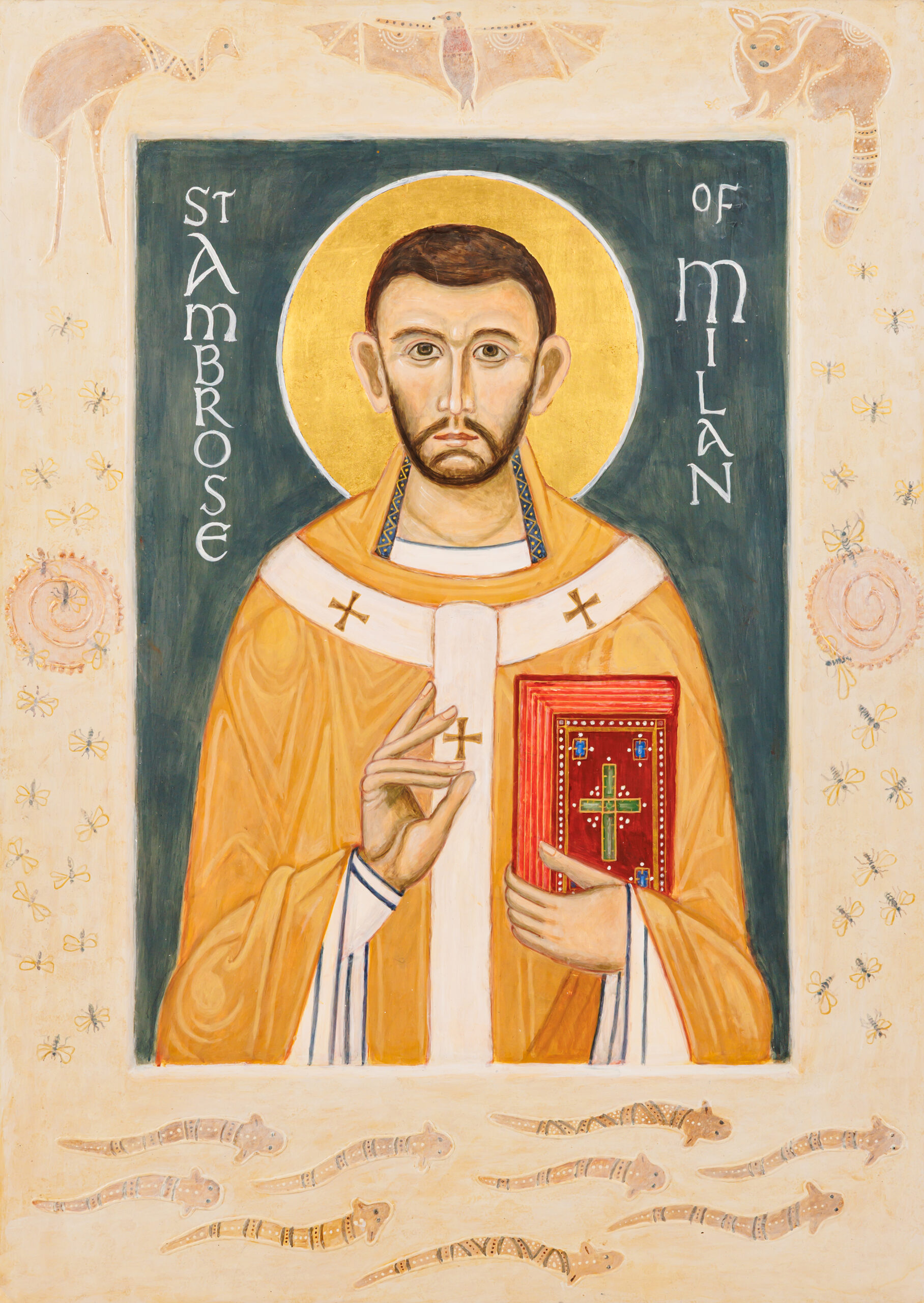
The Icon titled ‘St Ambrose in Parramatta’. Image: Supplied
An Icon for the Early Learning Community
Professor Didier Pollefeyt, professor at the Faculty of Theology and Religious Studies, KU Leuven and the initiator of the Enhancing Catholic School Identity (ECSI) program, observed that the blending of native Australian creatures with the bees of Ambrose “speaks to the universal call to find God in all of creation, while honouring the particular gifts of your Australian context”. He added that “just as bees work together to create something sweet and life‑giving, your Ambrose centres nurture communities where children can grow and flourish together”.
For Ambrose Early Years Education and School Age Care, St Ambrose in Parramatta reflects the safe, welcoming and nurturing community where children and families are supported in learning, growth and belonging. As Bishop Vincent reflected at the blessing, the icon’s true purpose is “to be a positive influence and a calming presence for the children and their families”.
Ambrose is a social enterprise of Community Ventures, a not-for-profit charity supporting communities within the Parramatta Diocese. To learn more visit www.ambrose.org.au.
This article was originally published in the 2026 June | Winter edition of the Catholic Outlook Magazine. You can read it online here or pick up a copy in your local parish.