

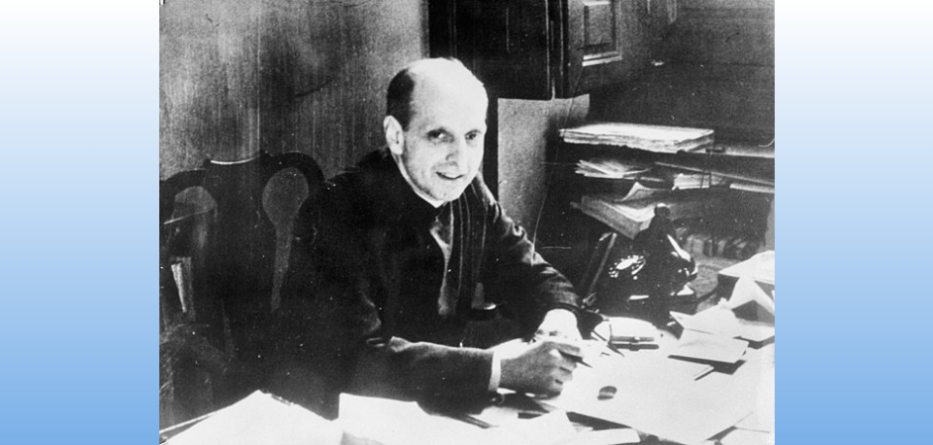
The closing session of the diocesan phase of Father Pedro Arrupe’s beatification process took place November 14 in Rome. The Superior General of the Society of Jesus from 1965 to 1983, Arrupe played a key role in renewing the Jesuit order and placing social justice at the heart of its mission in the post-Council context.
In a step closer toward the beatification, the diocesan phase of the sainthood cause of Jesuit Father Pedro Arrupe, the Superior General of the Society of Jesus from 1965 to 1983, concluded in Rome.
The diocesan process concluded November 14, the anniversary of Arrupe’s birth, at the Apostolic Palace of the Lateran in Rome. It brings to a close the initial phase of an extensive investigation into Arrupe’s life. Following the opening of his beatification cause in 2019, the tribunal began collecting oral and documentary evidence to support what is known as his “reputation for holiness.”
The investigation took over six years, with more than 70 witnesses interviewed in Rome, Madrid, and Japan, where the former Superior General lived.
Ten thousand pages of unpublished writings
A historical commission composed of Gianni La Bella, Monica Borsari, Robert Danieluk SJ, Massimo De Giuseppe, and Carlo Luongo also compiled nearly 10,000 pages of unpublished writings by Father Arrupe, particularly his correspondence with Jesuits and others during his leadership in Rome. “It’s not an exaggeration to think he wrote an average of 20 letters per day during his 18 years at the head of the Society and the 15 years he presided over the male religious life,” noted the Society of Jesus in a November 8 communiqué announcing the closing of the diocesan phase.
“All this documentation has been consulted to find the most significant aspects of his personality and activity,” the Jesuits said. “Several theological censors examined his numerous published writings – some of which are in Japanese only – and found that they contained nothing contrary to the church’s ‘faith and morals.’”
The historical commission prepared a detailed report based on the collected documents, which was presented November 14 at a public session and sealed in wax-stamped boxes.
Acts of Father Arrupe
The Acts will then be sent to the Dicastery for Saints’ Causes, where the canonical process’ so-called “Roman” phase will begin. Once the Acts are certified, the dicastery will open the drafting of the Positio by the Jesuit’s General Postulation. Consolidated into one or two volumes, the Acts will finally be reviewed and judged by the “church,” meaning theologians, bishops, and cardinals. This phase, which may take several years, could result in Father Arrupe being declared venerable.
Born in the Spanish Basque country in 1907, Pedro Arrupe joined the Jesuits in 1927 and continued his studies in Belgium, the Netherlands, and the United States. Ordained in 1936, he was sent as a missionary to Japan in 1938, where he was arrested under suspicion of espionage after the December 7, 1941, attack on Pearl Harbor.
As novice master at the Jesuit novitiate on the outskirts of Hiroshima, he witnessed the city turn into a lake of fire following the atomic bombing on August 6, 1945, and was among the first to aid the thousands of victims, converting the novitiate into an improvised hospital.
He was elected Father General of the Society of Jesus on May 22, 1965, six months before the end of Vatican II. As the 28th Superior General of the Society, Father Arrupe faced the formidable task of guiding the then 28,500 Jesuits through the societal and ecclesial changes that followed the Council (1962-1965).
Founder of the Jesuit Refugee Service
He convened the 32nd General Congregation (from December 1974 to March 1975), which directed the Jesuits with a “Faith and Justice” mission and adopted the decree: “Our Mission Today: The Service of Faith and the Promotion of Justice.” His commitment to justice also led Father Arrupe to establish the Jesuit Refugee Service (JRS).
Suffering a stroke in 1981, Father Arrupe was forced to step down. “More than ever, I find myself in God’s hands. This is what I wanted from my youth. Now, the initiative belongs entirely to God. It is a profound spiritual experience to feel so completely in God’s hands,” he said at the opening session of the 33rd General Congregation in 1983.
Father Arrupe passed away on February 5, 1991. His beatification cause was officially opened exactly 28 years later.
Reproduced with permission from La Croix International.