

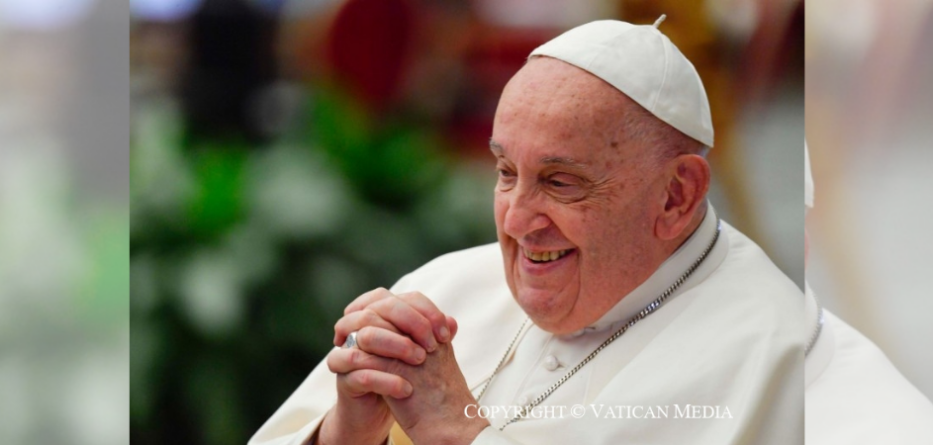
In recent days, the 88-year-old pope has repeatedly addressed the theme of fragility in his messages sent from Rome’s Gemelli Hospital, where he has been receiving treatment for over a month for double pneumonia.
Thirteen meters above them, one of the statues on Bernini’s colonnade seems to greet them. At midday on March 19, Joan and Frances Kendall, aged 41 and 67 respectively, exited St. Peter’s Basilica. These New York Catholics have come to Rome to pass through the Holy Door as part of the Jubilee of Hope, marked today by the pope’s absence, who has been hospitalized since February 14. “We are praying for him. Our pilgrimage is also for him. We know he has faith in God. That he surrenders to him.” In recent days, in his messages sent from Rome’s Gemelli Hospital, these American women have been struck by the 88-year-old pope’s emphasis on fragility.
“I share these thoughts with you as I go through a time of trial and unite myself with the many brothers and sisters who are ill: fragile, at this moment, like me,” Francis wrote in the text shared at the time of the Angelus on March 16. “Human fragility (…) has the power to make us more lucid about what lasts and what passes, about what gives life and what kills,” he continued in a letter published the next day by Corriere della Sera, in which Francis renewed his call for disarmament and peace. This same fragility was also evident in the photo showing him seated before the altar, dressed as a concelebrant, published late last week by the Holy See Press Office.
A counter-model to Trump and Putin
“It is clear that the pope is reflecting right now,” confided a cardinal elector known to be close to him. “I believe that when he speaks to us about fragility, he is simply sharing this doubt with us in all simplicity. I think that’s good.” He says he is praying that “he remains free and is not afraid” if, at some point, his responsibilities seem insurmountable, to step down. “I know that some other cardinals say he will never resign, but it is those who do not like him who say that.” The different cardinals La Croix was able to interview on the subject have reacted in very different ways. “We still need Pope Francis. I’d rather not think about what comes next…” one said. “Rather than engaging in media speculation, we should be told what it means for a pope to die. For us, death is the opportunity to praise God,” anticipates another.
No one knows today what Francis will decide, nor exactly what criteria he will use to discern his path forward. Fragility could prevent him from governing within a Curia where he has not made only friends over the past twelve years. However, an alternative hypothesis is also circulating: if Francis can no longer stand up if he remains on oxygen, and if his words become rarer, might he not actually become even more heard? “Even if Francis is weakened, I believe this weakness can be a testimony,” analyzed Cardinal Jean-Paul Vesco of Algiers, whom we met in Rome. “Faced with political leaders like (Donald) Trump or (Vladimir) Putin, who emphasize power dynamics, his presence will be a counter-model—of wisdom, tenderness, and love.”
On March 19, at the hour when he would usually address the faithful gathered to hear him in St. Peter’s Square or Paul VI Hall, Francis seemed to continue in the same vein, speaking in his catechesis, communicated in writing, about “encounters that illuminate life and bring hope.”
“It can happen that someone simply gives us a word that prevents us from feeling alone in the suffering we are experiencing,” wrote the pope, who has been receiving treatment for a month for double pneumonia.
Reproduced with permission by La Croix International.