

The Solemnity of Mary, Mother of God
Readings: Numbers 6:22–27; Psalm 66(67):2–3, 5, 6, 8; Galatians 4:4–7; Luke 2:16–21
1 January 2023
“Mary treasured these things and pondered them in her heart.” Luke 2:19
The vocation of every Christian is holiness of life. This means the pursuit of one’s own personal holiness and relationship with Christ and being a leaven in the world, influencing it by our Christian beliefs and practices. Before Mary conceived the incarnate Word in her womb, she first conceived him in faith in her heart. While the mind is where we seek to understand faith and give ascent to it, it is in the heart that we conceive and ponder the mystery of faith and live it out. Thus, Mary “treasured and pondered these things in her heart”.
As we begin another year by honouring Our Lady today, let us turn our gaze upon her who is the Mother of God and our spiritual mother, and the perfect pattern and model of what it means to be a disciple of Christ. It was because she opened herself completely with humble faith and trust to God and his will for her life that he was able, through her, to enter the world by sending the incarnate Word in her immaculate womb.
As she continued to ponder the mystery of Christ—her Son and her Lord—by living her life with total obedience to God, she invites us to do the same. It will not always be easy, but we will, like Mary, become “vessels of Christ” bringing him and his love into a world which has a profound and urgent need to, once again, be converted to Christ—the one Redeemer of the world and the Saviour of the human race.
As Christian disciples, each one of us has an indispensable part to play in this mission of our own, and the world’s, salvation. Now that’s a New Year’s resolution worth striving for!
Mother of God, and our mother, pray for us. Amen.
Fr Christopher G. Sarkis
Artist Spotlight
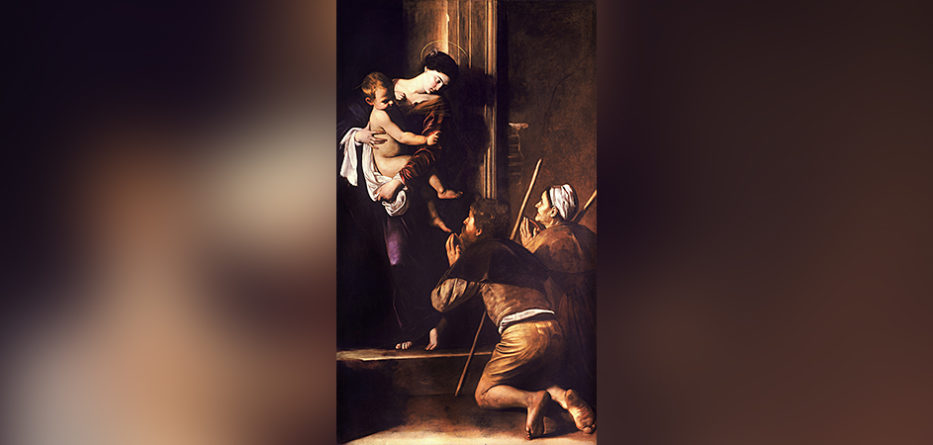
Madonna of the Pilgrims – Michelangelo Merisi Da Caravaggio (1571–1610)
Madonna of the Pilgrims (1604–1606). Oil on canvas, 260 cm x 150 cm. Basilica di Sant’Agostino, Rome, Italy. Public Domain.
On 21 July 1602, the Marquis Ermete Cavalletti died. According to his wishes, his heirs purchased a chapel in the Church of St Augustine in Rome and commissioned the artist Michelangelo Merisi da Caravaggio to create a painting of Our Lady of Loreto. This theme was very popular at the time.
The finished work created a sensation. Caravaggio’s style was unique. He painted directly onto the canvas without any preparatory drawings, and used as his models people straight off the street, sometimes even prostitutes and orphaned children. He wished to depict humanity at its most real—his figures displaying expressions of intense emotion. Caravaggio’s art can almost be immediately recognised by his skilful use of light.
The Madonna of the Pilgrims, as his painting is commonly called, does not have Mary seated on a throne befitting her status as Queen of Heaven. This Mary is a barefooted woman from the surrounding streets. Jesus seems to have outgrown his mother’s lap, yet she holds him so effortlessly. And it was common practice in paintings of the Madonna to show the patrons kneeling before her. But this couple are far too poor to be the patrons. They are just two humble and elderly peasants (look at the man’s dirty feet) honoured with a vision of the Mother and Child as they finish a pilgrimage. St Augustine’s is near the Piazza Navona and was the second-last stop for pilgrims making their way to St Peter’s. Caravaggio’s point? It is not the proud and haughty whom God will raise up, but the poor and lowly. Mary’s Magnificat is being played out on a dark and dusty Roman street.
Loreto is Italy’s holiest shrine and contains what is commonly believed to be the Holy House of Nazareth.
Sceptical? Certainly, the image of angels transporting the house through the air is far-fetched. But the archaeological evidence is compelling. Loreto’s basilica holds the remains of a three-sided brick house (the fourth side having been the cave on to which it was built, common in the Holy Land.) The brick is certainly native to Israel, and recent studies have found Crusader crosses embedded in the mortar between the bricks. For the true story is that when they saw the holy places about to be destroyed by marauding Saracens, English crusaders dismantled the Holy House and transported the stones to Italy. In fact, the first representation of the transportation of the Holy House is of a dwelling sitting on a ship (angels hovering above in poetic license by the artist.) The answer given to critics is a paraphrase of Pope St Gregory’s comment when he saw English slaves in the Roman market, “non angli sed angeli” (they’re not English, they’re angels)—”non angeli sed angli”: the house was not carried by angels but by the English!
Caravaggio seems to give an illusion to the Holy House in his painting—the partly decrepit wall of flaking brick beside the doorway. It is in Mary’s house that the pilgrims find Jesus. Hence the universal custom of naming churches after Our Lady, for she is the very image of the Church. Her “yes” to God was the Church’s first word, and her Magnificat the Church’s first hymn.
In revising the liturgical calendar, the Second Vatican Council returned to the custom of the early Church in venerating Our Lady and her role in the Incarnation on the Octave Day of Christmas (pre-Vatican II this was the feast of the Circumcision). Some years later, Pope St Paul VI wisely named this date as World Day of Prayer for Peace, and entrusting the Church and the world to Our Lady’s intercession. What was the result of her intercession at Cana? Christ’s first miracle, “And his disciples believed in him” (Jn 2:11). We are those two pilgrims in the painting. And our prayer today? Peace in Europe.
Monsignor Graham Schmitzer
Fr Christopher G Sarkis is the parish priest of Our Lady Help of Christians Parish in Rosemeadow, in the Diocese of Wollongong. He was ordained in 1985 and has served in several parishes in the diocese. His current diocesan appointments include the College of Consultors, Council of Priests, and Clergy Remuneration Fund.
Monsignor Graham Schmitzer is the retired parish priest of Immaculate Conception Parish in Unanderra, NSW. He was ordained in 1969 and has served in many parishes in the Diocese of Wollongong. He was also chancellor and secretary to Bishop William Murray for 13 years. He grew up in Port Macquarie and was educated by the Sisters of St Joseph of Lochinvar. For two years he worked for the Department of Attorney General and Justice before entering St Columba’s College, Springwood, in 1962. Fr Graham loves travelling and has visited many of the major art galleries in Europe.
With thanks to the Diocese of Wollongong, who have supplied this reflection from their publication, Incarnate – Advent & Christmas Daily Reflections 2022. Reproduced with permission.