

It has been another bitter season for Christians in the Middle East. Again, they fall victim to waves of unprovoked violence. Entire families endure a savagery that has destroyed their homes, churches, and livelihoods. The brutality bears down on their kin and desecrates the dead in their graves.
The latest carnage struck first on Sunday, June 22, when a suicide bomber opposed to the new Syrian leadership entered St. Elias Greek Orthodox Church in Dweila, a largely Christian village outside Damascus. First, he opened fire on worshipers gathered for the Sunday liturgy. Then he detonated an explosive vest. Thirty parishioners died as they prayed. Fifty-four others, among them infants and children, suffered life-threatening injuries. This was the first in what would be a wave of atrocities. Their perpetrators aimed not only at eradicating Christians from the Middle East but—with a strategy dating back to the Hamidian massacres of 1895—at erasing evidence that Christians were ever there.
Then, on July 14, nearly three weeks to the day after the Dweila attack, Jewish settlers stormed Taybeh, the oldest Christian village in the occupied West Bank. They set the fifth-century Greek Orthodox church of St. George ablaze. Desperate calls for help from the parish priest and community members were ignored by Israeli authorities. The next day, Greek Orthodox patriarch Theophilos III and Cardinal Pierbattista Pizzaballa, Latin patriarch of Jerusalem, joined traumatized parishioners to demand accountability from the Israeli officials who, they noted, facilitate and enable attacks by Jewish settlers on Palestinian Christian and Muslim communities. Speaking with NBC news, Cardinal Pizzaballa said, “The settlers feel that everything belongs to them. Unfortunately, it seems to me that the [Israeli] government is silent, if not supporting them, as we saw. So they feel free to behave as they want.” The Jerusalem Post denied that the attack ever took place, claiming that the fire had accidentally spread to the church from adjacent scrubland.
U.S. Ambassador to Israel Mike Huckabee expressed his concern. Obliquely referencing the Israeli government’s tacit approval of violence perpetrated by Jewish settlers against Palestinians and their property, Huckabee said that it was not enough to issue reprimands. “The perpetrators of such crimes need to be held responsible.” It remains to be seen if his words bring action. While still governor of Arkansas, Huckabee described himself as an “unreformed Zionist” and repeated claims made by Jewish settlers that no such thing as the West Bank exists. In yet another cynical attempt at erasure, the land, he insisted, is Judea and Samaria.
In 2024, the UN International Court of Justice unanimously determined that territories Israel captured during the 1967 War, including the West Bank, were illegal. Israeli prime minister Benjamin Netanyahu dismissed the decision as “a verdict of lies,” citing biblical and historical ties to the land. David Shulman, a Jewish activist with Ta’ayush, an Arab-Jewish partnership that works to counteract racism, segregation, and apartheid, says that Israeli settlers who attack Muslims and Christians are acting out a depraved messianic ideology that is a travesty of authentic Jewish tradition. Behind the settlers, almost always with support and approval, stands the army, the Israeli Defense Forces (IDF).
A day after the violence at Taybeh, a mob attacked and burned St. Michael Melkite Greek Catholic Church in the southern Syrian town of al-Sura al-Kabira. The pastor, Fr. Butrus al-Jut, expressed the fear and outrage of the community. He said that after the church was set ablaze, mobs rampaged through the town. “They didn’t stop at the church. They ransacked and burned our homes, shattered our windows, stole our belongings, looted our businesses. They set fire to our lives.” It is still unclear who was behind the attack on the church. Al-Sura is in an area where clashes between the Syrian military and Druze militias have become increasingly frequent.
The Druze, who do not identify as Muslims, branched off from mainstream Islam in the eleventh century. They were, until recently, among the “protected” Christian and Muslim minorities that also included Alawites, the Muslim sect associated with the Assads. With the collapse of the Assad regime, these “protected minorities” lost whatever protection they may have had. They have become, along with Kurds and Christians, targets of retribution. Retribution is most likely the motive behind the thwarted bombing, on July 13, of St. Elias Maronite Church in al-Khreibat, northwest Syria.
It has been another bitter season for Christians in the Middle East.
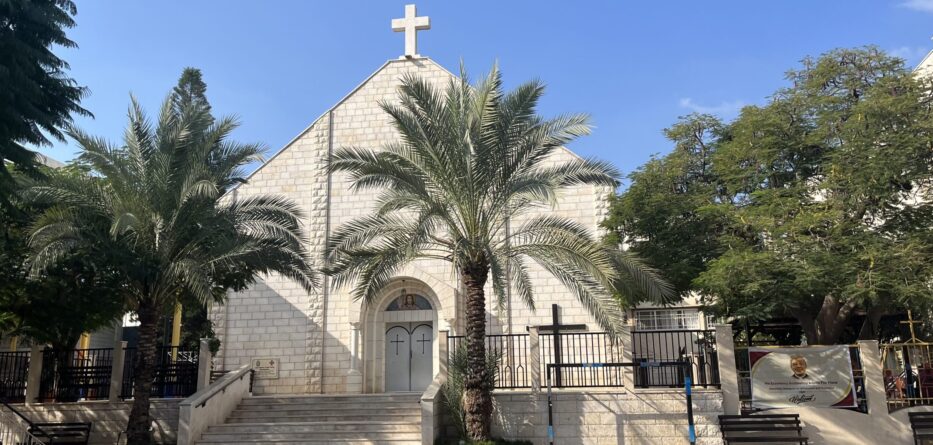
Four days later, on July 17, an IDF weapon struck Holy Family Catholic Church in Gaza, killing three people and wounding nine others. Fr. Gabriel Romanelli, the church’s pastor, was among those who sustained minor injuries. The IDF attributed the incident to errant mortar rounds that misfired in the direction of the church. In a phone call to Pope Leo the morning after the strike, Netanyahu expressed regret for the incident.
It was not the first time Holy Family Church has made news. On December 16, 2023, two Christian refugees sheltering at the church, Nahida and Samar—an elderly woman and her daughter—were walking from the church to a convent in the same parish complex when snipers from the IDF opened fire. They shot and killed Nahida; then they shot and killed her daughter as she tried to carry her mother’s body to safety. The snipers also wounded seven other refugees who had sought safety during the siege of Gaza. A statement released by the office of Cardinal Pierbattista Pizzaballa did not spare the details. “No warning was given, no notification was provided. [The two women] were shot in cold blood inside the premises of the parish where there are no belligerents.” In his Angelus address the following day, Pope Francis expressed horror at the attack. “I continue to receive very serious and sad news about Gaza where unarmed civilians are the targets of bombs and gunfire. This has happened even within the parish complex of the Holy Family where there are no terrorists, but families, children, the elderly, people who are sick and with disabilities in the care of religious sisters.” The Israeli government referred to the incident as an instance of collateral damage.
The carnage continues. Israeli air strikes against defenseless Gazans have killed tens of thousands of children, women, the sick and the aged, often with weapons and bombs supplied by the United States, which provides Israel with 80 percent of its weapons and military hardware. The remaining 20 percent comes from Germany. With Gaza’s infrastructure almost completely destroyed, survivors are left without food, water, shelter, and access to basic medical attention. Omer Bartov, an Israeli-American historian who studies genocide, writes, “I’m a genocide scholar. I know it when I see it.”
But Palestinians and Syrians have not been the only victims of the barbarity. U.S. citizens have also died. Hosam Saraye, a thirty-five-year-old Syrian American from Oklahoma City, was killed while visiting relatives in al-Sweida, Syria. Saifollah Musallat, a twenty-year-old U.S. citizen from Florida, was visiting relatives in the West Bank town of Sinjil when he was bludgeoned unconscious by Jewish settlers. Units of the Israeli army sent to quell the disturbance prevented an ambulance from reaching him or other victims of the assault. They died at the scene.
Meanwhile, here in the United States, media coverage of the violence remains curiously inconsistent. The bombing of Holy Family Church in Gaza received some attention. But the attacks on St. Elias Orthodox Church outside Damascus and St. Michael Greek Catholic Church in Taybeh, as well as the thwarted attack on the Maronite church in al-Khreibat, have gone largely unnoticed.
The United States has never declared itself to be a Christian nation, but as Marilynne Robinson writes, “An entanglement with something resembling religion gave it claims to a special righteousness that owed nothing to fact or reason or to the conventions of civilized politics.” The claims Robinson refers to are the guiding principles of Evangelical media outlets led by The Christian Broadcasting Network (CBN), which describes itself as “a global ministry committed to preparing the nations of the world for the coming of Jesus Christ.” CBN goes to great lengths to highlight Israel’s role in protecting Christian and Druze communities in Syria, while denying credible reports, from sources such as the United Nations Relief and Works Agency and Doctors Without Borders, that starvation in Gaza is rampant.
Americans are weary of the Middle East, weary of the endless cycles of violence that threaten to draw them into a conflict they do not understand, weary of the claims and counterclaims of responsibility. At the same time, support for Israel has never been stronger among American Evangelicals, who believe that the founding of the State of Israel in 1948 was the fulfillment of biblical prophecy. They believe that the triumphal second coming of Christ can take place only after the Jewish people are gathered in their biblical homeland. After Christ’s return, all nations—Israel included—will embrace Christianity. Such Evangelicals constitute a large part of the MAGA movement, and some of them hold high positions in the Trump administration.
Here in the United States, media coverage of the violence remains curiously inconsistent.
In the second major address of his pontificate, Pope Leo met with journalists and encouraged them to work for peace, dialogue, and understanding. He also appealed for the release of journalists imprisoned for their commitment to a free press that operates without the interference of government or special interests. Such interference takes a variety of forms—from the manipulation and outright suppression of facts to removing government funding from NPR and PBS. A more subtle form of interference involves diverting attention from the facts by manufacturing distractions. The Trump administration employs this tactic in a variety of ways—from demanding that the recipe for Coca-Cola be changed to claiming that Barack Obama has committed treason—all in an effort to quell the uproar over the White House’s handling of files related to convicted sex offender Jeffery Epstein. The same tactic was on display when Netanyahu ordered an attack on Iranian nuclear facilities, which was meant to divert attention from the devastation in Gaza and the stalemate in negotiations for the release of hostages.
Epstein’s crimes were appalling, and their extent may still await full disclosure, but Epstein is dead and his accomplice is imprisoned (for now). Meanwhile, obscured by the various distractions thrown up by Netanyahu and Trump, the remains of children and entire families lie shot, starved, and bombed—Middle East Christians, Palestinian citizens of the United States, the defenseless inmates of Gaza and the occupied West Bank or the churches of Syria—all the bitter, fallen fruit of American policy in the Middle East.
Reproduced with permission by Commonweal.