

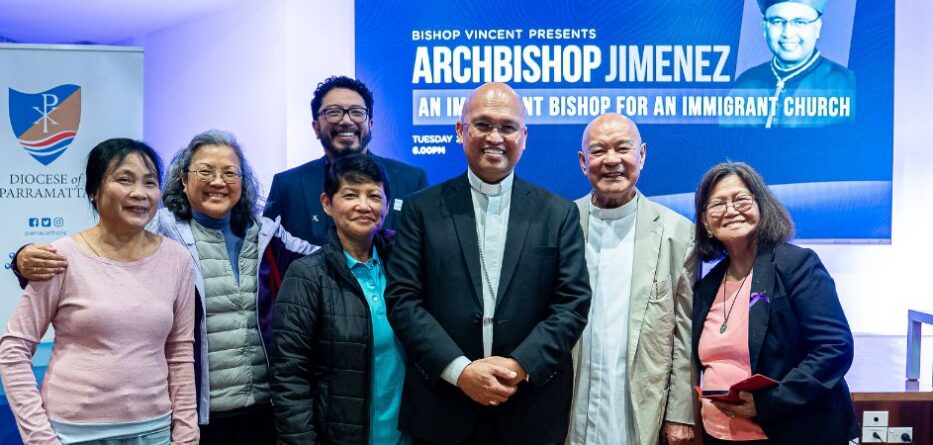
The Catholic Church and its many dioceses and parishes must celebrate – and above all make room for – difference and diversity in its ranks if it is to continue to affirm one of the central teachings of the Gospel, a visiting archbishop from the western Pacific has told an audience in Parramatta.
Archbishop Ryan Jimenez, of Agaña in Guam, spoke at the Cloister Hall at St Patrick’s Cathedral on Tuesday evening, 21 April, on the topic of “An immigrant bishop for an immigrant church”, as part of the Bishop Vincent Presents series of lectures. While he was in Parramatta he met Catholic teachers and vice-principals, Filipino clergy and members of the Filipino community.
An immigrant himself, Archbishop Jimenez was born and grew up in the Philippines before moving to the US territory of the Northern Mariana Islands, near the island of Guam, as a young man to teach at a Catholic school. He has stayed in the archipelago ever since, and was appointed Archbishop of Agaña in 2024.
This early experience living as an outsider influenced his view “that boundaries – ethnic, cultural, historical – still shape how we relate to one another”.
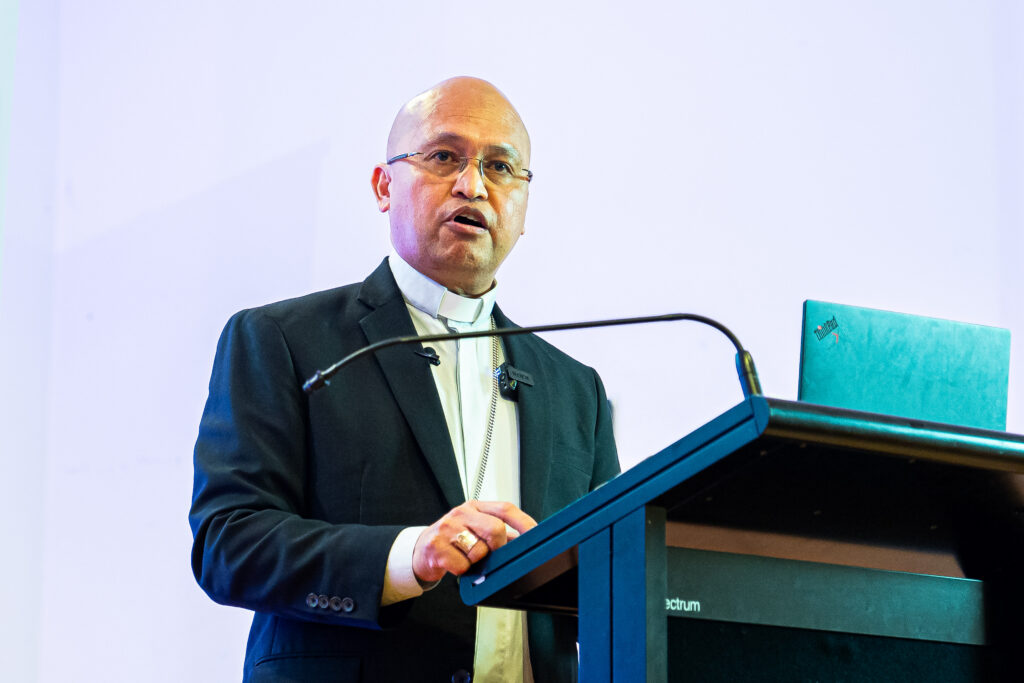
Archbishop Jimenez told the audience that it was not enough to aim for tolerance among people. Image: Anna Amos/Diocese of Parramatta
“If I am considered an outsider, who gets to be inside? And who decides who is inside and who is outside?” he told the Parramatta gathering.
“I recall the word of St Paul…that ‘there is neither Jew nor Greek, there is neither slave nor free person, there is no male and female, for [we] are all one in Christ Jesus’. (Galatians 3:8)”
He said it was not enough to aim for tolerance, but rather for true communion, which was “a shared life marked by encounter, dialogue and mutual transformation, rather than merely coexistence of cultures”.
Thus, the multicultural way of existing side by side should be extended to be “intercultural”, where people listen, share and grow together and “truly encounter one another”.
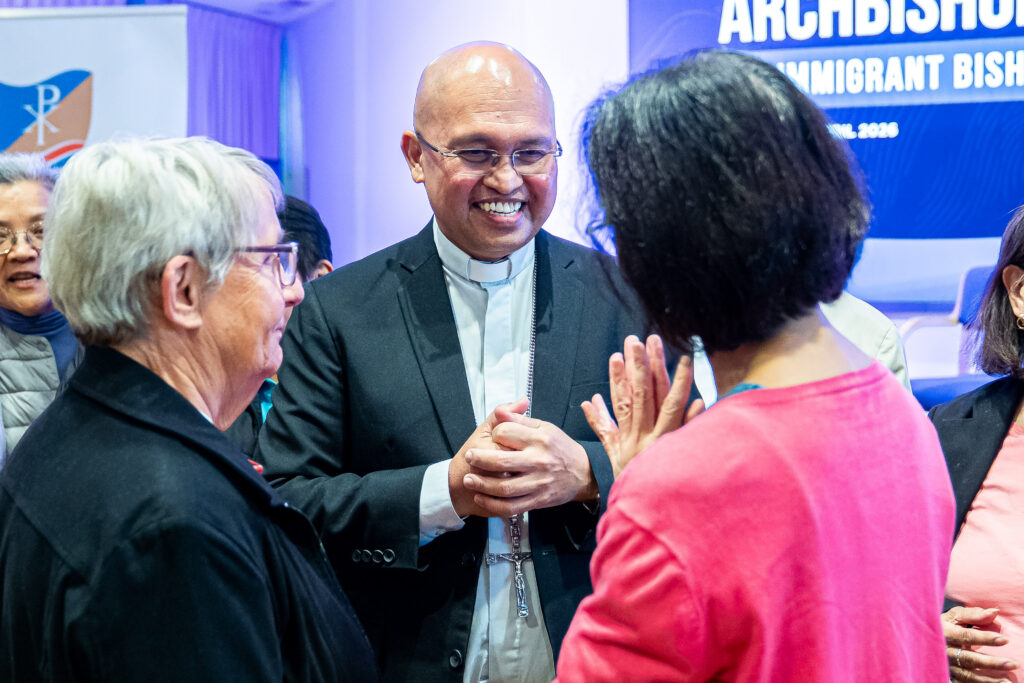
The Archbishop said “diversity is not a problem to fix. It is a gift to receive”. Image: Anna Amos/ Diocese of Parramatta
He said three steps were needed for this to occur: languages of all groups needed to be included where possible, especially indigenous languages; parishes needed to be “shared” between cultural groups that worship at separate masses within the parish; and in parish leadership, decision making must be shared and not tokenistic.
The challenge of inclusion
Archbishop Jimenez said these steps would often be uncomfortable and difficult, but “discomfort is not failure, it’s an invitation for communion, for integration”.
He gave an example in his own diocese.
“The question I always get in preparing for big liturgical celebrations such as parish fiestas: will the readings be in Chamorro (the main local language), Filipino or English? How about the Refalawasch (another local language)? Who feels included? Who feels left out?
“This is where the practical challenge of including everyone comes in.”
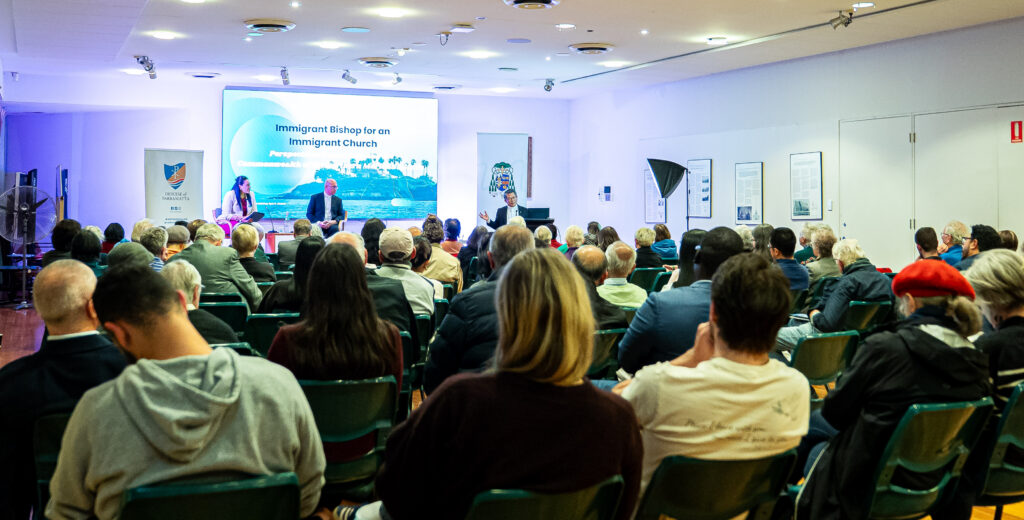
The audience during the lecture at Parramatta. Image: Anna Amos/ Diocese of Parramatta
He said in these situations ministers needed to ensure that nobody spoke on behalf of a group without “thorough consultation and proper discernment”.
“Our role as ministers is not to speak for communities, but to create spaces where they can speak for themselves,” he said, adding that sometimes this intercultural way of worshipping can be “messy”.
“A truly intercultural Church requires pastoral leaders who walk with people – yes, for the sacraments, but also as companions in life.
“Jesus showed us examples in the Gospels on how he walked with the people; he built relationships.
“Diversity is not a problem to fix. It is a gift to receive.”
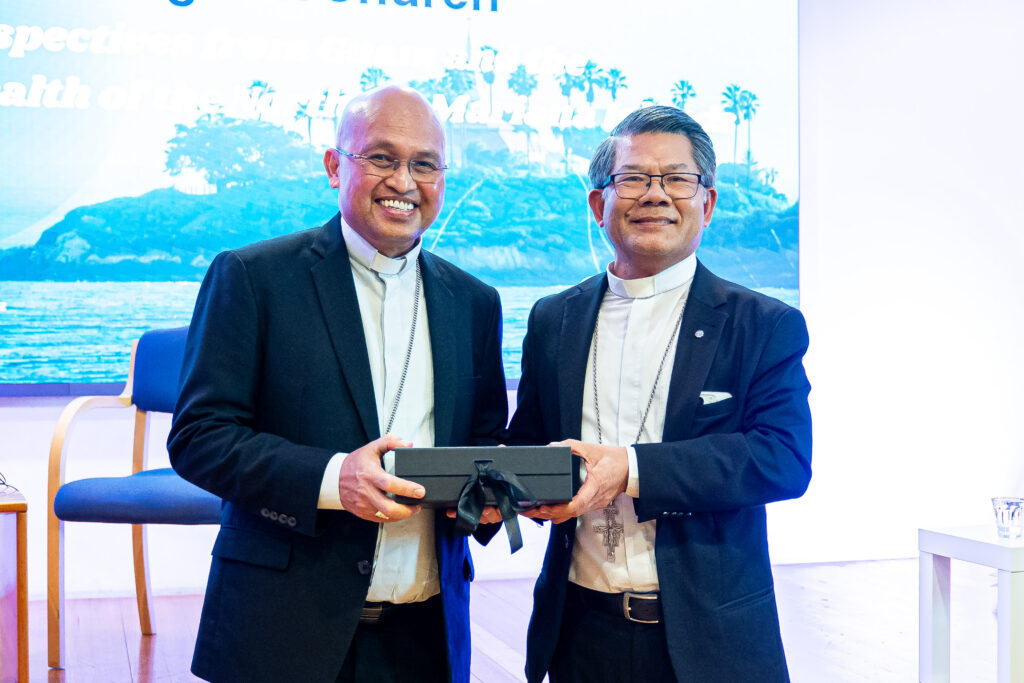
Afterwards, Bishop Vincent Long thanked the Archbishop for his lecture. Image: Anna Amos/ Diocese of Parramatta
Speaking later to Catholic Outlook, Archbishop Jimenez said he drew inspiration from Pope Leo XIV who was not afraid to address issues head on and work through them so they can be resolved.
“It’s always good to state that there can be tension, and to recognise and accept that, but I believe it’s a healthy tension and there’s always an opportunity for us to be able to be better and to work together.”
Climate change: ‘time to see concrete action’
Archbishop Jimenez is also head of the Episcopal Conference of the Pacific, which is the world’s largest conference of bishops by area, and an area that is one of the most prone to the effects of climate change.
Just before coming to Australia a typhoon hit several islands north of Guam, causing a lot of damage.
“This is really an example of climate change because this typhoon lingered in April, but this is not typhoon season,” he said.
“We need to really reflect and find our own little ways to save our common home. Something needs to be done and I don’t have the answer.”

Meeting audience members after the talk. Image: Anna Amos/ Diocese of Parramatta
He said he hoped a forthcoming meeting of bishops from the whole Oceania region, which included Australia, would address these issues. But it was a huge task and urgent action was needed to stop people in the Pacific suffering further.
“I always believe that you start small and do what you can…but it can be discouraging. Words are great but it’s time to see concrete action.”
A ‘prophetic message’
In thanking Archbishop Jimenez for coming to Parramatta, Bishop Vincent Long, OFM Conv, Bishop of Parramatta, said he was grateful for his courage, “deep faith steeped in pathos and your prophetic message for the Church today”.
He “leverages his experience to advocate for a more inclusive Church,” Bishop Vincent said. “This is a truly Catholic principle that is at the heart of the Gospel. Yet as he pointed out, being inclusive is not just about accommodating different groups and cultures; it is not about just co-existing in a melting pot.”
Archbishop Jimenez will travel to Melbourne for the Hélder Câmara lecture on 28 April.
Archbishop Jimenez’s lecture is an example of the Diocesan Pastoral Plan priority of Mission, Formation, Listening Dialogue and Discernment, and Community. Visit Synodality to learn more.
Watch Archbishop Jimenez’s lecture on our YouTube channel.
Listen to his interview with ABC Radio National here.
View the photo gallery on Flickr, or below.