

For Mauricio López Oropeza, the decision that would shape the course of his life came when he gave up everything and moved to the impoverished neighbourhoods of Mexico City.
As a young man who had just graduated from university and was discerning his future path, he had been asked to go and help work on a project “in the peripheral areas and with the poorest of the poor”, in a city in which he had no desire to live.
At the time, he was working at a university in his home town, living a very comfortable life among his family and friends and “with very good prospects for the future”. Yet the decision to leave all that behind was perhaps one of the most consequential in his journey of faith.
Mauricio says “it was a transforming experience, working with the poor”, not as an ideological exercise, but as a means of putting into practice all that he had learned during his theological formation as a lay person in the Church.
“It was actually when I went to that city, working with those communities and walking with them, that really changed my perspective.”
Recognising the presence of Jesus
What Mauricio discovered during that time in Mexico City 20 years ago – the power of accompanying those you are seeking to help – would stay with him and shape his mission in the years ahead, especially in his work with communities in the Amazon.
“That’s where I recognise the presence of Jesus in my life,” he says of those personal encounters. “And it’s not a theoretical presence, it’s people with names, with stories and who are friends in my life.”

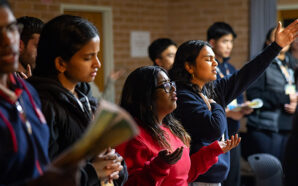
Mauricio Lopez speaks as part of the Hélder Câmara Lecture series in Melbourne in July 2025. Image: parallaxmedia/Diocese of Parramatta
The Amazon has been the focus of his life for the past 15 years and this work has made him one of the best-known and most influential lay leaders in the Catholic Church today.
He was one of the leaders of the Amazon Synod in 2019, which brought together communities from nine countries that make up the Amazon region of South America to discuss their hopes for the Church and how the Church could help them in their struggles to survive.
He is also the lay Vice-President of the Ecclesial Conference of the Amazon, the body responsible for implementing the outcomes of the Synod. He was a former member of the Dicastery for Promoting Integral Human Development, a member of the facilitation team for the Synod on Synodality in Rome and is founding director of the Amazon University Program, which is bringing higher education to the Amazon region.
No easy road to faith
This life as a lay person in the Church had its roots in Mauricio’s early faith formation, in the catechism and Jesuit schooling, which he says was very different to most people his own age who had a more traditional spiritual upbringing in parish life.
Rather, his was more about “searching” and “lived experiences”.
“Working with the poor was part of my life since I was a little boy in the catechism, and the movements where I participated,” he said. And formation “was more connected to congregations than parishes, and usually congregations with a very strong commitment to social justice and discernment”.
His time at a Jesuit school taught him that faith comes from “a very serious search” and does not come easily.
“I could feel it even as a little boy, [the Jesuits] wouldn’t give you the answers, they would really challenge you to look for those yourself,” Mauricio says. And if you wanted to go down that path of faith you had to look for it.

Mauricio Lopez Oropeza addressing the audience at the Cloister Hall, St Patrick’s Cathedral. Image: Alphonsus Fok/ Diocese of Parramatta
“The Spiritual Exercises experience is a really very structured and pedagogical approach which takes you deeper, which makes you responsible for the type of faith that you want to live,” he says. “And it really pushes you forward on what you want to do with your life.”
The importance of this teaching took a while for him to realise and it wasn’t until he was travelling and living in Europe and the US for a while after school that this became clearer. He was immersed in other cultures and confronted with many choices – such as drugs and relationships – where he was only answerable to himself, and it was here he chose to be faithful to his formation.
“I noticed that I was responsible for whatever path I wanted to follow, and how I could bring the best of that formation and it came quite organically, not as something that I felt I was forced to do.”
He could see this was different to others around him who had had a more “imposing type of religion”.
“Whenever they had a chance to go out, they would just go crazy. I felt I had a strong foundation to say, ‘no, this is who I am and who I want to be. Nobody’s forcing me to do it but I choose to continue this path’. And it’s been like that ’till now.
“That’s what my faith journey has been all about in this discernment – a dynamic and profound love for God and feeling part of the religion, not because I am forced, but because I truly believe in that.”
Being called to serve
His next big spiritual realisation came at university when it became clear that his path “was connected to the mission of the Church”. So he abandoned any idea of working for a big corporation and “started putting all those tools to work in a pastoral setting”.

Mauricio Lopez. Image: Supplied.
He went back to study theology and it was here where he again was influenced by the Jesuit teaching of a professor and missionary who had developed a program for lay leaders from all over Latin America. This formation convinced him of what he’d always believed – “that my calling was as a lay person serving in the Church with a very clear focus on social justice and in a truly horizontal type of collaboration”.
“There was something in my discernment where I felt God’s presence, and it was not in the religious pathway,” Mauricio says. “That’s important to highlight, laity is a vocation in the Church which has a very, very powerful value for the future of the mission of the Church.”
Mauricio Lopez was speaking in Parramatta on 23 July as part of the Bishop Vincent Presents series of public lectures.
This article was originally published in the 2025 Season of Creation | Spring edition of the Catholic Outlook Magazine. You can read the digital version here or pick up a copy in your local parish.