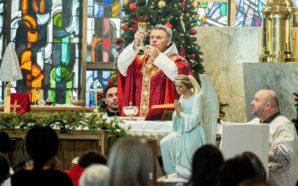


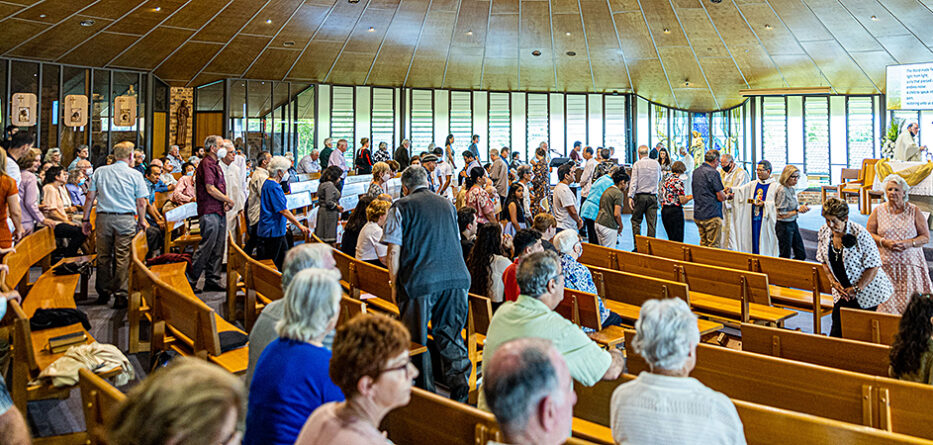
As a concelebrant at the Sunday Mass at Mission Basilica, I am touched and edified, week after week, by those who come to the table of grace. My vantage point is a privileged one. From the altar I see the faces: families, the elderly, the young, each approaching with their own history and their own hunger. On several recent Sundays a beautiful, large young family has come forward, five or six children in tow. The reverence and sincerity on their faces is moving. Some of the children have not yet made their First Communion, and so they stand ever so reverently with arms crossed, hoping for a blessing or a sign of acknowledgment from the minister. I cannot witness that without my own faith being enriched.
It also raises a question the Church has never fully answered. What is she to do with that moment? What is she to do, as well, with the catechumen in the next pew, the visiting Lutheran cousin two rows back, or the friend at a funeral Mass who professes no faith at all?
The custom of extending some gesture to those not receiving the Eucharist is, by any honest reckoning, without a home in the liturgical books. It appears in no rubric of the Missal. The General Instruction speaks only of “communicants” in the Communion procession (GIRM, no. 160), which tells us plainly enough what the procession was designed for. Interpretatio benigna has its limits, and I will not pretend that the silence of the liturgical books is itself an endorsement.
What Rome Has Actually Said
Candor requires that I address the one document that speaks to this with any specificity: a private letter of November 22, 2008, from the Congregation for Divine Worship and the Discipline of the Sacraments (Prot. No. 930/08/L), responding to a private inquiry. The letter is not legislation. It says as much of itself, noting the matter was “under the attentive study of the Congregation” and offering only provisional observations. But its points deserve a fair hearing rather than a footnote.
The Mass already contains its blessing — at the very end, moments after Communion — so nothing is lost by declining to anticipate it mid-procession. Lay ministers, the letter insists, are simply incapable of conferring a liturgical blessing within Mass; that competence belongs to the ordained. The laying on of hands is to be discouraged outright, since the gesture already carries a distinct sacramental meaning that does not belong here. And — this is the point I will not soften — the letter states plainly that those not admissible to Communion, non-Catholics explicitly included, “should not approach Holy Communion nor receive a blessing.”
I will not pretend that sentence is comfortable for the argument I want to make. It is the strongest textual evidence against treating this as merely in the realm of pastoral discretion. But three qualifications matter, and they are the actual canonical status of the letter, not evasions of it. It is private correspondence, not universal law. It names itself provisional, pending further study never since completed or promulgated in the intervening 18 years! And neither the USCCB’s 1996 Guidelines nor any subsequent conference action has incorporated its judgment into binding legislation for the Church in the United States. What we have is a documented response from a Vatican Dicastery, not a settled prohibition.
Whom the Church Acknowledges — and How
Here is where I think the pastoral argument deserves more than a modicum of attention, as we examine three distinct situations and a possible pastoral accommodation.
The child and the candidate. For the child not yet at First Communion, and for the catechumen or candidate in OCIA formation, the Church already has more liturgical footing than the general debate usually credits. The Order of Christian Initiation of Adults itself provides rites of blessing for catechumens — a wordless tracing of the cross, offered by the ordinary minister, without touch and without the formula the 2008 letter specifically objects to, falls comfortably within that same logic. This is not innovation; it is a modest extension of a blessing the Church already gives elsewhere in the initiation process, offered here as a sign that formation is underway and welcomed.
The baptized Christian not in full communion. Here the theological ground shifts. Vatican II’s Unitatis Redintegratio teaches that the baptized who are not Catholic already stand in a real, if imperfect, communion with the Church through the waters they share with us. A silent gesture of acknowledgment toward such a visitor is not an invention grafted onto Eucharistic discipline; it is a recognition of a communion that already exists sacramentally, however incompletely. This is precisely the perspective in which “a sign of respect” is the right description — not hospitality extended to a stranger, but honor paid to a baptismal bond the Church already confesses as real.
The visitor of another faith, or of none. Here I think the same gesture becomes theologically imprecise, however kindly intended. Tracing a cross over someone with no baptismal share in that sign risks importing a specifically Christian sacramental meaning onto a person for whom it carries no such content — the very confusion the 2008 letter worried about, arriving by a different door. Nostra Aetate and Gaudium et Spes give the Church ample warrant to honor the dignity and the goodness of such a visitor without dressing that honor in liturgical gesture it cannot properly bear. A minister’s simple word — “welcome,” a moment of real eye contact, nothing traced or spoken in the register of blessing — accomplishes the acknowledgment without the confusion. The 1996 USCCB Guidelines already point this direction: those outside the Christian faith are invited to unite themselves in prayer for peace and unity, not to approach the sanctuary at all.
Where the Pastoral Judgment Actually Lives
I do not think this resolves into “anything not forbidden is permitted” — that is too blunt an instrument for sacramental theology. But neither is it accurate to say the practice stands condemned across the board. What we have is a hierarchy of norms: universal liturgical law that is silent rather than prohibitive; a provisional and non-binding Roman letter from a Vatican Dicastery whose sharpest objections fall on spoken blessings and physical touch; and, for at least one of these three groups, an existing liturgical precedent in the Church’s own initiation rites.
A pastor who permits a silent, wordless tracing of the cross for children and candidates in formation, extends the same sign to baptized Christians as an honoring of real but imperfect communion, and offers visitors of other faiths — or none — a plain human word of welcome rather than a liturgical gesture, is not defying Rome’s judgment. He is honoring its narrower and more defensible substance, differentiated according to what is theologically true of each person before him, rather than extending one undifferentiated gesture further than either the letter or ecumenical theology actually supports.
Perhaps, the best accommodation to this pastoral conundrum for those presiders and communities that value hospitality and welcome of visitors is a simple wordless gesture of the hand on the head or shoulder in silence with appropriate eye contact.
The alternative — a hard line drawn nowhere in the Missal, defended only by a private letter that calls itself provisional — risks teaching a harder ecclesiology than the Church herself has taught. “Let the children come to me, and do not prevent them” (Mk 10:14) was spoken at no specified threshold. There is no reason to assume it stops short of the altar.
With thanks to Liturgy & Truth and Monsignor Arthur Holquin, S.T.L., where this article originally appeared.