

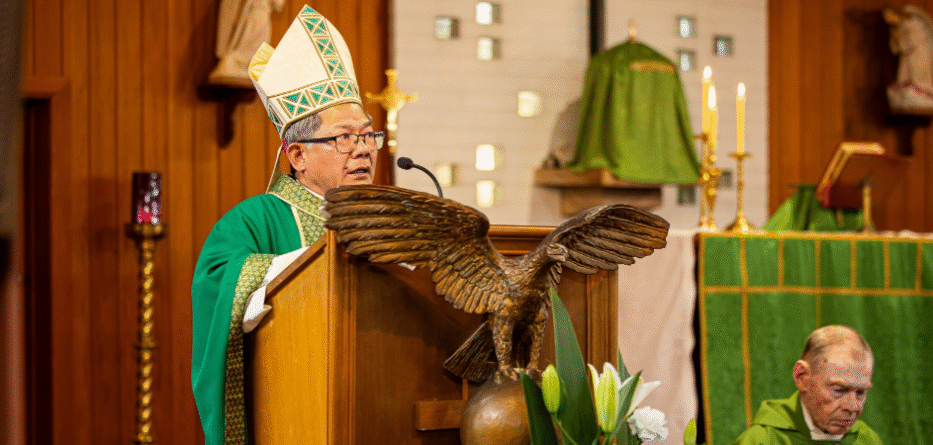
Most Reverend Vincent Long Van Nguyen OFM Conv DD STL, Bishop of Parramatta
Homily for the 29th Sunday in Ordinary Time, Year A
Readings: Isaiah 45:1-6; 1Thes 1:1-5; Matthew 22:15-21
Called to be an alternative society under God’s rule
Dear friends,
One of the deepest strands in the biblical tradition is the desire of the Jewish people to be an alternative society to the oppressive domination systems. These systems were designed by empires to enslave their subjects via forced labour, tributes, taxes and other means of exploitation. The people of God -being a small nation- had a fair share of exploitation. Their experience of imperial domination- from Egypt to Assyria, from Babylon to Rome- fed into a radically counter-cultural vision. Therefore, in contrast to the gods of the empire, who serve the will of the king, the Hebrews worshiped Yahweh, who they understood to be free, the critic of kings, and the advocate of vulnerable, oppressed people.
Today’s liturgy of the Word is set in this context of the long history of oppression of the Jews and their indomitable desire to be an alternative society under God’s rule. In contrast to the harsh social reality of the empire, God’s people are called to be a community of hospitality, compassion and neighbourliness.
In the first reading, the prophet Isaiah speaks of God’s rather surprising and unexpected way. After decades of exile in Babylon, the people would be able to return to their homeland thanks to an unlikely hero, Cyrus –not Miley Cyrus- but Cyrus the king of Persia. He had defeated the terrible Babylonians, who destroyed Judah, the temple and most of all banished the Israelites into captivity. Isaiah refers to Cyrus as God’s “shepherd” and, even, God’s “anointed one”. It is an extraordinary acknowledgement of a foreign ruler. God indeed could use an unlikely instrument to bring about his plan for the people.
Isaiah, however, does not see God’s intent to rehabilitate Israel in terms of a return to the good old days of the monarchy. When it reached the zenith of political power, Israel had ironically betrayed its calling by engaging in practices of oppression, violence and injustice. Hence, the exile was a kind of course correction, a reset and a conversion to being a humble, compassionate people and a fitting instrument for God’s purpose. Isaiah speaks of the rebuilding not so much of temple and monarchy as the spiritually revitalised and realigned Israel. The mission of the faithful remnants was not so much about restoring their former status as a military power as about becoming a model society in which the care of the most marginalized was to be the essential distinguishing feature.
In the Gospel, Jesus reinforces the message of Isaiah. In response to the question of paying taxes to Caesar, Jesus asked for a coin and posed a rhetorical question “Whose image and whose inscription is it?” The Roman coin would have the image of Caesar with the words “Son of God”. These features would have been considered idolatrous since the Shema, that is, the daily Jewish prayer calls them to worship God to the exclusion of all other gods. The Shema prohibits any form of carved images and requires the people to inscribe God’s covenant in their hearts. Thus, allegiance to the covenant means a rejection of Caesar and his Pax Romana, that is, the imperial political system that falsely claims what belongs to God.
“Give back to Caesar what belongs to Caesar and to God what belongs to God” This statement then is not an endorsement of a temporal order, let alone a corrupt imperial system based on idol worship. Rather, it invites the listeners to choose their allegiances. To the Jews, nothing belongs to Caesar. Empires have no power and authority over the land and its people, because everything belongs to God. Jesus reasserts the deep belief that only God has a real claim on us, and it is our duty to witness to our Kingdom citizenship.
Dear brothers and sisters,
The Word of God requires us not only to show our loyalty to his kingdom vision but also to embed this vision into every aspect of our lives. We cannot live our faith to the full without embracing the challenge of being the contrast society that our Jewish forebears demonstrated. The early Christians also understood the significance of being fundamentally counter-cultural in how they lived, how they related, how they shared resources and how they showed the characteristics of an alternative society. In the second reading, Paul thanks God for the Christians in Thessalonika for their faith in action. They have turned to God from idols and embraced a life of faith, hope and love in contrast to their pagan counterparts.
Christians today must respond to imperial ideologies which manifest in hate, discrimination, fear, oppression, power, violence and exploitation. Pope Leo in his landmark encyclical “Magnifica Humanitas” speaks of the choice between building a Tower of Babel and a civilization of love. Faced with a historic crossroads, he urges us to witness to human dignity, the common good and solidarity with the poor, and the marginalized. The Gospel guides us in our call to be the social conscience in the time of unbridled progress. Let us pray even as we enact liturgically the Kingdom vision of Jesus in our Sunday’s Eucharist that we may be able to live up to that calling.